What the Two of Pentacles means in Tarot
Pentacles are the most grounded suit in the deck: they are responsible for money, the body, material things, and everyday life, and their element is earth. The Two of Pentacles is the second card of the suit, and it no longer has the silence of the Ace: the spark has become at least two tasks at once, and from this moment on, they must somehow be kept together.
An important nuance that is lost in retellings: the card describes controlled instability, not chaos. The upright Two of Pentacles is not about everything falling apart, but about the fact that a person has already learned to keep several balls in the air at the same time and is coping for now. Work and study, two side jobs, repairs and current bills, taking care of yourself and a loved one — the specific set will be shown by neighboring cards.
This card should be immediately separated from a catastrophe: the minor arcana speaks of a weekly episode of juggling tasks, not about a breakdown of one's entire life, as happens with major arcana like the Tower. The Two of Pentacles almost never says "too much," it says "it's working for now, but without the right to pause."
Reversed Two of Pentacles: meaning
The reversed Two of Pentacles is the same juggler, but one of the balls is already falling. The spread usually refers to one of three options, and the question itself serves as a hint.
- Balance is lost. There are more tasks than can be held: something is postponed, forgotten, done in a hurry.
- Financial confusion. Expenses and income have drifted apart in terms of timing, the budget is hard to balance, and one has to patch one thing at the expense of another.
- Fatigue from constant maneuvering. A person has been juggling for a long time and is simply exhausted from holding everything at once, even if formally nothing has fallen yet.
There is also a softer reading: sometimes the reversed position is a signal that it is time not to hold onto everything, but to honestly set priorities and temporarily give something up. The difference from the upright position is that there the balance is still holding, while here it already requires revision.
Two of Pentacles in a "yes or no" spread
In "yes/no" spreads, the Two of Pentacles is one of the few cards where the honest answer is "both yes and no," and this is not evasion, but its essence: the card is about combining, not about an unambiguous choice. If the question sounds like "will I be able to handle both tasks at once" — the answer is likely yes, but without room for relaxation.
If the question involves choosing one of two options, the Two of Pentacles hints that the decision can be postponed and you can try to keep both — at least for a while. It rarely advises making rash decisions.
The reversed position in this spread is read more harshly: "no, not in the current form" — trying to hold everything at once is no longer working, and the question should be reformulated not as "will it work out," but as "what can be given up."
Two of Pentacles in relationships and feelings
In a relationship spread, the upright Two of Pentacles usually speaks of a balance between the relationship and the rest of life: work, study, other people, personal plans. This is not about a lack of feelings, but about a lack of time — the partner has to share attention with tasks that also cannot be abandoned.
In the position of feelings, the card shows a slight duality: the person is not torn between two people in a dramatic sense, but rather is trying to combine the feeling with other obligations without sacrificing either. Relationships at this stage are alive but require flexibility and agreements about time, rather than loud words.
The reversed Two of Pentacles in relationships is usually a signal that the balance has shifted: one person is carrying more than they can handle, and the relationship begins to suffer not from quarrels, but from a simple lack of strength for them.
Two of Pentacles in work and money
In career spreads, the Two of Pentacles describes combining: two jobs, a project and a side job, full-time employment and one's own initiative in parallel. The card does not condemn such multitasking — it simply records it as the current state of affairs that requires organization.
In money, the upright position speaks of an uneven but manageable budget: income and expenses do not arrive synchronously, and money has to be redistributed between items rather than saved indiscriminately. This is a card about financial flexibility, not about income growth or decline — it does not show amounts or dates.
The reversed Two of Pentacles in work and money means being overloaded with commitments or a budget that no longer balances: expenses are outpacing planning, and there are more work tasks than can be completed on time. The advice of the card in both positions is the same: consolidate the list of tasks and expenses in one place, rather than keeping them in your head.
Two of Pentacles as a person: man and woman
When the Two of Pentacles appears in the "what kind of person" position, it does not describe the character as a whole, but the role of a juggler in someone else's life: someone who handles several tasks at once, flexibly adapts to circumstances, and knows how to find time where there formally is none.
The Two of Pentacles man is a person with several projects and side jobs at the same time, easy-going, but not always punctual precisely because of the workload. The Two of Pentacles woman is someone who combines work, family, and personal affairs and does it seemingly easily, although constant rescheduling of plans lies behind it.
The flip side for both is the same: it is difficult for such a person to take on anything else, even if they really want to — first, they will have to unload what they already have.
Two of Pentacles sa posisyon ng pag-iisip
Sa posisyon ng pag-iisip, ang Two of Pentacles ay nangangahulugan ng isip na abala sa pagbabalanse: ano ang uunahin, ano ang maaaring ipagpaliban, at paano pagsasabayin ang lahat. Hindi ito purong pagkabalisa, kundi isang tuluy-tuloy na internal time-management na nakakaubos ng lakas kahit wala pang panlabas na problema.
Kung may mga Swords sa tabi nito sa spread, ang mental na pag-juggling ay maaaring mauwi sa nakaka-stress na overload at hindi makatulog sa pag-iisip; kung katabi naman ang mas mahinahong baraha tulad ng Cups, ito ay isang produktibo at hindi nakakapagod na proseso ng paglipat-lipat sa mga gawain.
Ano ang gagawin kung lumabas ang Two of Pentacles
Ang payo ng baraha ay praktikal: huwag subukang panatilihing perpekto ang lahat nang sabay-sabay — magtakda ng pagkakasunod-sunod, huwag basta bitawan ang mga bola. Ang Two of Pentacles ay hindi tungkol sa pag-iwas sa multitasking, kundi tungkol sa pagpigil dito na maging magulo.
Ano ang dapat gawin:
- Ilista ang lahat ng kasalukuyang gawain at gastos sa isang lugar. Hangga't nasa isip lang ang listahan, hindi mo matatantya ang tunay na bigat ng load.
- Tukuyin kung ano ang maaaring i-reschedule. Hindi lahat ay nangangailangan ng parehong bilis — ang ilang gawain ay kayang maghintay nang walang masamang epekto.
- Maglaan ng buffer para sa oras at pera para sa mga hindi inaasahang pangyayari. Ang baraha ay tungkol sa pagbabago, at ang pagkakaroon ng reserba ay nagpapadali sa pag-juggling.
- Regular na suriin ang balanse, huwag umasa sa memorya. Ang nakayanan kahapon ay maaaring hindi na magkasya bukas.
Kung ang dahilan ng tanong ay hindi simpleng pagod sa gawain, kundi seryosong problema sa pera o burnout mula sa multitasking, ang spread ay hindi kapalit ng konsultasyon sa eksperto: ipinapakita ng baraha ang estado ng balanse, hindi nito ito inaayos para sa tao.
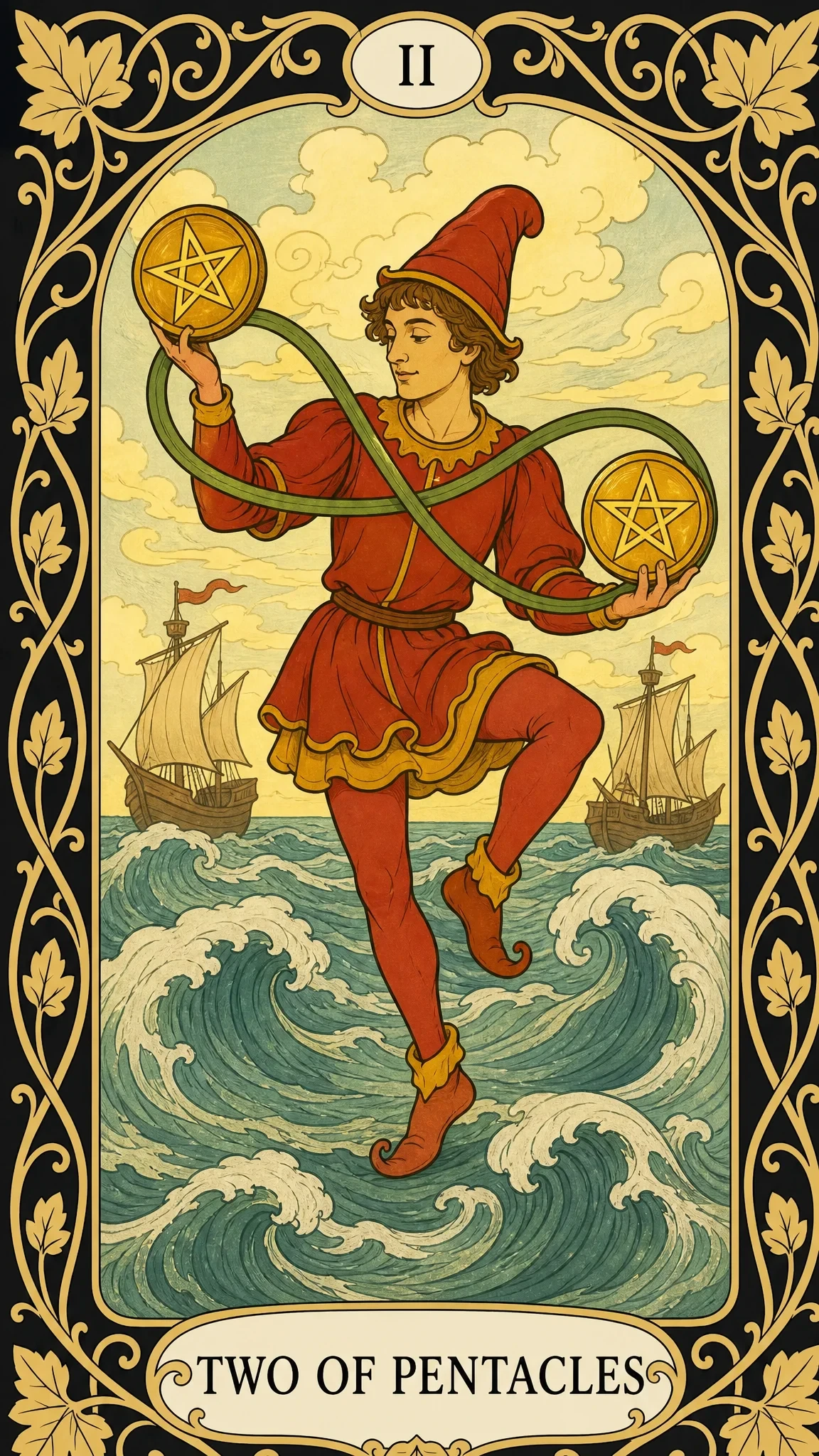
Ano ang nakaguhit sa baraha
Sa ating baraha ay may isang binata na nakasuot ng matingkad na pulang costume ng jester na may sumbrero, nakatayo sa isang paa sa harap ng maalon na dagat. Hawak niya ang dalawang gintong pentacle na may limang-tulis na bituin sa loob, na pinagdugtong ng isang berdeng laso na bumubuo ng infinity sign sa pagitan nila. Sa likod niya, dalawang barkong may layag ang umaalog sa malalaking alon.
Ganito binabasa ang eksenang ito:
- Posisyon sa isang paa — hindi ito pagkawala ng balanse, kundi pagpapakita nito: ang balanse ay pinapanatili sa paggalaw, hindi sa pagiging static, at ganyan ito dapat intindihin sa barahang ito.
- Laso na hugis infinity sa pagitan ng mga pentacle — ang dalawang gawain ay magkaugnay at umiikot sa isa't isa, hindi sila hiwalay: ang atensyon ay patuloy na dumadaloy mula sa isa patungo sa isa pa.
- Maalong dagat at mga barkong umaalog — mga nagbabagong panlabas na sitwasyon na hindi mo kontrolado, ngunit kailangang isaalang-alang sa pagpaplano.
- Kasuotang jester — ang gaan at husay ng pag-juggling: sa paningin ng iba, mukha itong laro, kahit na nangangailangan ito ng patuloy na konsentrasyon.
Sa itaas ng baraha ay ang Roman numeral na II, sa ibaba ay ang label na TWO OF PENTACLES: ang deck ay iginuhit sa tradisyon ng Rider-Waite, kung saan ang eksenang ito ng jester at maalong dagat ay isa sa mga pinakakilalang baraha ng suit ng Pentacles.
Two of Pentacles bilang baraha ng araw
Ang Two of Pentacles bilang baraha ng araw ay isang babala na magiging abala ang araw: maraming gawain nang sabay-sabay, paglipat-lipat sa mga task, at pangangailangang mag-prioritize habang gumagalaw. Hindi ito masamang senyales — sadyang hindi ito araw para sa isang malaking gawain, kundi para sa ilang katamtamang laki na mga bagay.
Isang kapaki-pakinabang na mindset para sa araw na ito — magdesisyon nang maaga kung ano ang dapat matapos at ano ang pwedeng i-move, at huwag magsimula ng bago hangga't hindi pa tapos ang bahagi ng kasalukuyang gawain. Kung ang baraha ay lumabas na baligtad (reversed), maging maingat sa mga deadline at pera: sa araw na ito madaling makaligtaan ang ilang detalye.
Mga madalas itanong tungkol sa Two of Pentacles
Ito ba ay Major o Minor Arcana?
Minor Arcana, suit ng Pentacles, elementong Lupa. May kabuuang 56 na Minor Arcana sa Tarot deck — 14 na baraha bawat isa sa apat na suit, at ang Two of Pentacles ay sumusunod sa Ace, na nagbubukas ng tema ng pagsasabay ng maraming gawain.
Ano ang pagkakaiba ng Two of Pentacles sa Two of Wands?
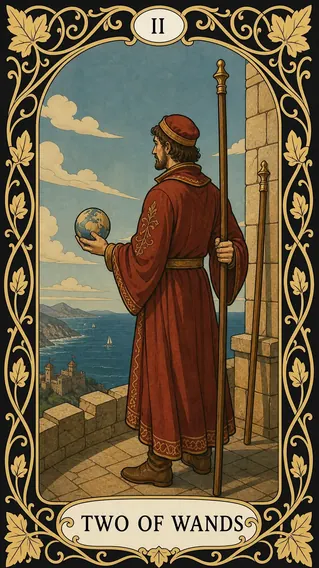
Ang parehong 'two' ay tungkol sa pagpili at pagsasabay, ngunit magkaiba ang kalikasan. Ang Pentacles ay elementong lupa, praktikal at pang-araw-araw: ang Two of Pentacles ay tungkol sa pag-juggling ng mga kasalukuyang gawain at pera dito at ngayon. Ang Wands ay elementong apoy, kalooban at pagpaplano: ang Two of Wands ay tungkol sa pagpili ng direksyon at pagdedesisyon kung saan susunod na pupunta. Kung ang spread ay tungkol sa multitasking sa buhay, ito ay Pentacles; kung tungkol sa strategic na pagpili ng landas, ito ay Wands.
Ang Two of Pentacles ba ay 'oo' o 'hindi'?
Kadalasan ay parehong 'oo' at 'hindi': ang baraha ay tungkol sa pagsasabay, hindi sa isang tiyak na pagpili. Kung ang tanong ay kung magagawa bang panatilihin ang dalawang bagay nang sabay, ang sagot ay malamang na 'oo', pero walang puwang para mag-relax. Ang baligtad na posisyon ay mas mahigpit ang kahulugan — bilang 'hindi, hindi sa kasalukuyang anyo nito'.
Ano ang ibig sabihin ng baligtad (reversed) na Two of Pentacles?
Ang parehong juggler, ngunit nahuhulog na ang isa sa mga bola: nawala ang balanse, hindi nagtutugma ang budget, o naipon ang pagod mula sa patuloy na pag-aadjust sa mga gawain. Minsan hindi ito sakuna, kundi isang senyales na maging tapat sa pag-prioritize at pansamantalang bitawan ang ilang bagay.
Ang Two of Pentacles ba ay nangangahulugan ng pera?
Oo, ngunit bilang pabago-bago, hindi bilang lumalaki o lumiliit na kita: ang baraha ay tungkol sa pangangailangang patuloy na i-reallocate ang mga pumapasok at lumalabas na pera, hindi tungkol sa isang tiyak na halaga. Hindi ito nagpapakita ng eksaktong numero o petsa — tanging ang estado ng balanse ng pera lamang.