What the Ace of Wands means in Tarot
Aces in Tarot are not events, but the pure potential of the suit: a faint spark from which anything can grow if someone is found to fan it. The Ace of Wands is the most obvious of the four: wands are responsible for will, initiative, and physical energy; their element is fire, and fire ignites immediately, without warning.
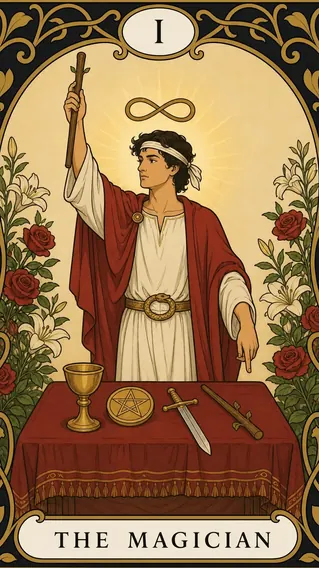
An important nuance that is lost in retellings: the minor arcana describes an episode, not a destiny. If the major Magician speaks of a person's readiness to act in general, the Ace of Wands is about a specific Monday when an idea came, a call with an offer was received, or you suddenly wanted to start something that had been put off for months. The card is not about how everything will end, but only about the fact that a reason to start has appeared.
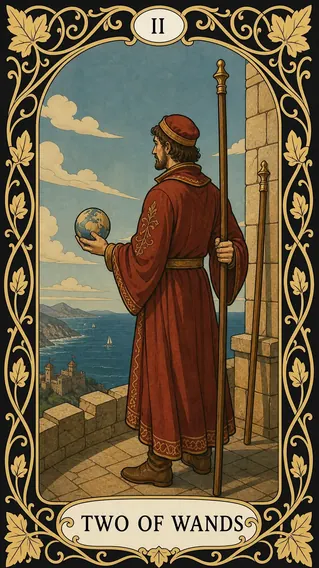
The upright position is read unambiguously: interest, excitement, desire to try. The impulse is real, not invented out of politeness. But the card also has a flip side that is useful to keep in mind immediately: a spark is not yet a bonfire. The Ace of Wands does not promise how far the venture will go; for this, one should look at the neighboring cards in the spread, primarily the Two of Wands, which is already about a plan, not a burst.
Reversed Ace of Wands: meaning
The reversed Ace of Wands is the same fire, but without the drive. Usually, the spread refers to one of three options, and the question itself helps to choose.
- The idea is there, but it's impossible to start. The most frequent case: the plan is thought out, but the first step is constantly postponed until tomorrow.
- The enthusiasm flared up and went out. Started with enthusiasm, but the energy lasted for a week, and then things go by inertia or not at all.
- The internal brake is stronger than the desire. Fear of looking stupid, fear of wasting effort, fatigue at the very start — what extinguishes the spark before it has time to flare up.
There is also a soft reading: sometimes the reversed Ace of Wands is not a refusal to act, but a sober pause before rushing into a new business without preparation. The difference is whether the person feels this pause as a relief or as getting stuck.
Ace of Wands in a "yes or no" spread
In "yes/no" spreads, the Ace of Wands is read as yes — but with a caveat that is easy to miss: the card does not answer about the outcome, but about the appearance of a chance. If the question sounds like "should I start," "will an opportunity appear," "will there be a push to act" — the answer is affirmative, and often faster than expected.
If the question is about the result ("will it work out," "will I see it through to the end") — the Ace of Wands does not answer it at all, because it only shows the starting point. To answer such a question, other cards are needed in the spread.
The reversed position in this spread is "yes, but not now": the opportunity exists, but there is not enough enthusiasm for it yet, and the question should be reformulated: not "will it happen," but "what is preventing the start."
Ace of Wands in relationships and feelings
In a relationship spread, the upright Ace of Wands almost always describes a flash: sudden interest, attraction, a desire to take the first step. This is a card of the beginning of a feeling, not its depth — about that very spark between people that is talked about on first dates, not about long-term attachment.
In the position of feelings, the Ace of Wands is noticeably physical: wands are responsible for the bodily, not just emotional side of attraction, and the card often points precisely to this layer — attraction as energy, not just as sympathy. For existing relationships, the upright Ace of Wands can mean a new round of passion after a lull: wanting not to "talk about feelings," but to do something together, spontaneously.
Reversed Ace of Wands in relationships — there is attraction, but it is scary to act: they do not dare to write first, suggest a meeting, confess. Or passion that was there, but faded before it could become an attachment.
Ace of Wands in work and money
In career spreads, the Ace of Wands is a job offer, a project idea, an invitation to start your own business. The card well describes the moment when energy and a desire to take a risk appear: to change direction, to take on what was previously put off as "someday."
In money, the upright position is not ready-made profit, but precisely the chance to create it: a new side job, an idea that can bring income if implemented. This is a card about a potential source of money, not about the amount in the account — not at all the same thing as, say, the Ace of Pentacles, which is closer to a material result.
Reversed Ace of Wands at work — an interesting offer that is postponed out of caution, or a project that started too hastily and is already stalling without a plan. There is only one piece of advice here: before grabbing an idea, it is worth cooling down for a minute and understanding if there are resources to see it through.
Ace of Wands as a person: man and woman
When the Ace of Wands falls in the "what kind of person" position, it describes not the character as a whole, but the role of the initiator: the one who brings an idea, calls to start something, charges a company or project with energy. Usually, this is a bright, proactive person with whom it is never boring.
Ace of Wands man — the one who acts before thinking, captivates on the fly, and does not like long warm-ups. Ace of Wands woman — the one who is the first to suggest trying something new and is not afraid to start from scratch.
The flip side for both is the same: such a person is good at the start and does not always stay until the end. If the card is important in the spread precisely as a forecast for reliability — it is worth looking at whether there are cards nearby that speak of constancy, for example, the Four or Ten of the same suit.
Ace of Wands sa posisyon ng kaisipan
Sa posisyon ng kaisipan, ang Ace of Wands ay isang magulo ngunit kaaya-ayang enerhiya: ang isip ay puno ng mga ideya, gustong gawin ang maraming bagay nang sabay-sabay, at ang mga kaisipan ay lumilipat mula sa isang plano patungo sa isa pa. Ito ay isang estado ng malikhaing pag-aalab, hindi pagkabalisa: ang tao ay hindi natatakot, kundi sabik na kumilos.
Ang hamon ay sa dami ng ideya, mahirap pumili ng isa at tapusin ito. Kung ang mga Espada (Swords) ay nasa tabi sa pagbasa, ang labis na kaisipan ay maaaring maging kalat; kung kasama ang mga Pentacle, ang ideya ay mas malamang na maisakatuparan.
Ano ang dapat gawin kung lumabas ang Ace of Wands
Ang payo ng baraha ay simple: magsimula habang may alab, huwag itong patagalin sa walang katapusang pagpaplano. Ang Ace of Wands ay tungkol sa pagkilos sa kasalukuyan, hindi sa perpektong paghahanda; habang mas pinapatagal ang unang hakbang, mas mabilis na nawawala ang ningas.
Ano ang dapat gawin:
- Gumawa ng isang konkretong hakbang sa mga susunod na araw. Hindi ang buong plano agad — ang unang aksyon lang na magpapatakbo sa bagay.
- Huwag ipagpalit ang inspirasyon sa tapos na resulta. Ang baraha ay nagbibigay ng enerhiya para magsimula, hindi garantiya ng tagumpay — ang pagpapaunlad ng ideya ay nakadepende sa ibang mga hakbang at ibang baraha.
- Isulat ang ideya habang sariwa pa. Ang malikhaing silakbo ng Wands ay mabilis na nawawala kung hindi ito itatala.
- Suriin kung may lakas na tapusin ang gawain bago mamuhunan nang malaki — lalo na kung ang desisyon ay tungkol sa pera o pagpapalit ng trabaho.
Kung ang dahilan ng tanong ay hindi ideya o proyekto, kundi isang mabigat na sitwasyon sa buhay, ang pagbasa ay hindi kapalit ng pakikipag-usap sa eksperto: ang baraha ay nagpapakita ng pagdaloy ng enerhiya, hindi solusyon sa mga kumplikadong problema.
Ano ang nakaguhit sa baraha
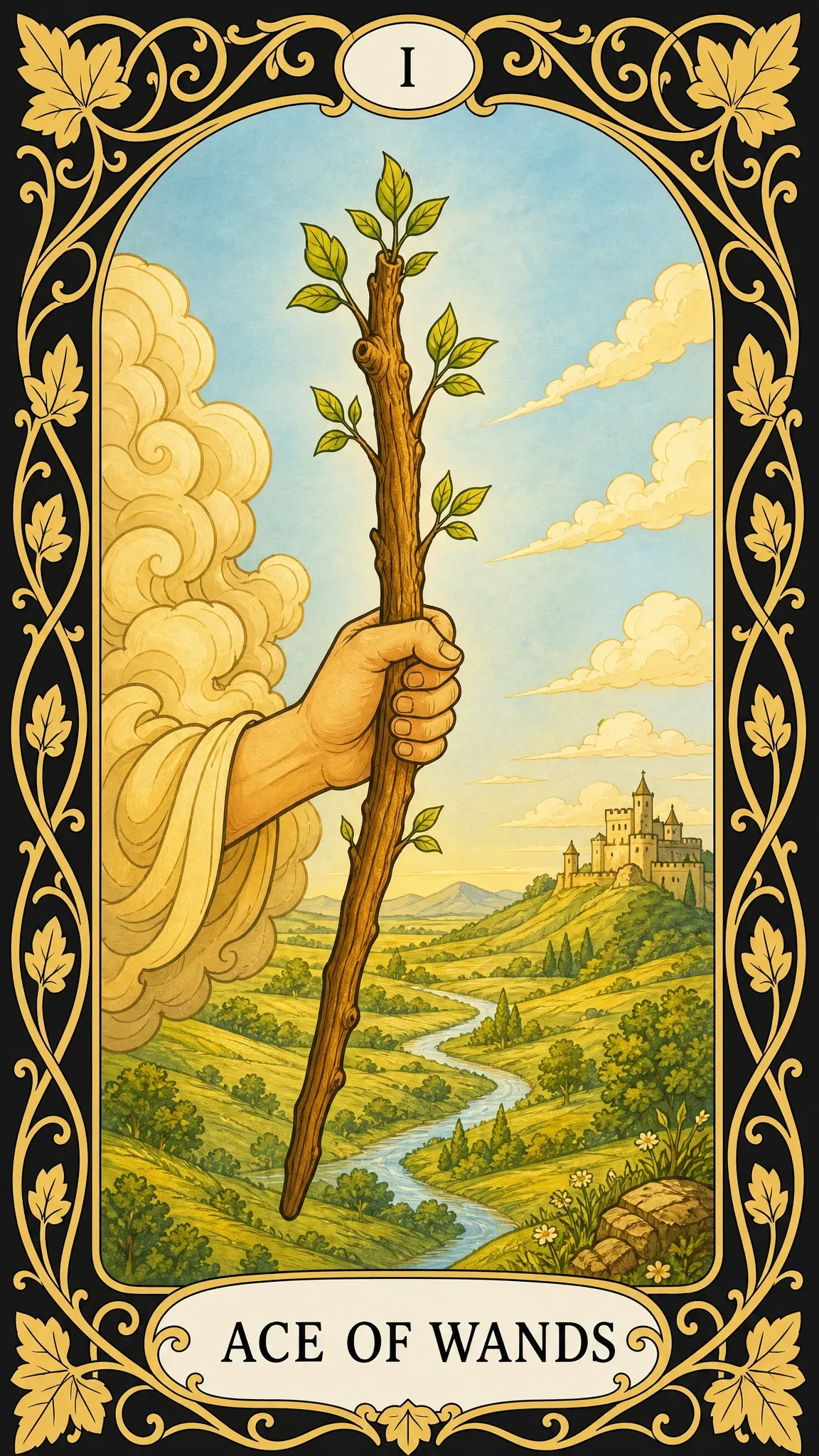
Sa ating baraha, may isang kamay na lumalabas mula sa gintong ulap, mahigpit na hawak ang isang kahoy na baston na may mga batang berdeng dahon: ang wand ay literal na tumutubo, parang sanga na hindi pa tuluyang napuputol. Sa likod ng kamay, sa isang mabatong mataas na lugar, ay isang tanawin: isang paikot-ikot na ilog, mga berdeng burol, at isang kastilyo sa malayo.
Ang eksena ay binabasa nang ganito:
- Kamay mula sa ulap — lakas na nanggagaling sa labas, bilang pagkakataon o tulak, hindi bilang resulta ng sariling mahabang pagsisikap: ang wand ay ibinibigay, hindi pinalalaki sa loob ng maraming taon.
- Buhay na dahon sa baston — ang ideya mismo ng gawain ay buhay pa, hindi pa napoproseso, bagong labas sa mundo; ito ang nagpapaiba sa Ace mula sa, halimbawa, sa tapos na baston ng Knight o King ng parehong suit.
- Ilog at kastilyo sa malayo — isang mundong tinitirhan at narating na, na kailangan pang puntahan: ang layunin ay nakikita, ngunit ang landas patungo rito ay hindi pa natatahak.
Sa itaas ng baraha ay ang Roman numeral na I, hindi ang karaniwang kawalan ng numero sa mga Ace sa klasikong Rider-Waite deck: binibigyang-diin ng ating deck na ito ang pormal na una, panimulang baraha ng suit. Sa ibaba ay isang plake na may pangalang ACE OF WANDS.
Ace of Wands bilang baraha ng araw
Ang Ace of Wands bilang baraha ng araw ay isang magandang pagkakataon para gawin ang matagal nang ipinagpapaliban: maunang mag-message, magmungkahi ng ideya, mag-sign up sa isang bagay na kulang sa lakas ng loob. Ang araw ay angkop para sa pagsisimula, hindi para sa pagtatapos — huwag asahan ang mga resulta, kundi ang tulak lamang.
Kung ang baraha ay lumabas na baligtad — ang araw ay mas tungkol sa panloob na paglaban: naroon ang pagnanais, ngunit natatakot magsimula. Ang kapaki-pakinabang na mindset ay huwag gawin ang buong hakbang agad, kundi kahit maliit na bahagi lang nito, para lang makagalaw.
Mga madalas itanong tungkol sa barahang Ace of Wands
Ito ba ay Major o Minor Arcana?
Minor Arcana, suit na Wands, elementong Apoy. May kabuuang 56 na Minor Arcana sa Tarot deck — 14 na baraha para sa bawat isa sa apat na suit, at ang Ace of Wands ang nagbubukas ng bilang para sa mga Wands.
Ano ang pagkakaiba ng Ace of Wands sa Ace of Cups?
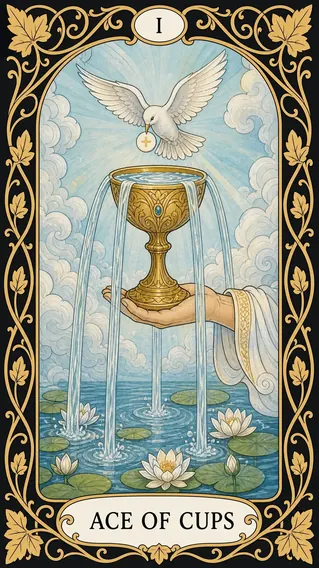
Parehong tungkol sa pagsisimula ang mga Ace, ngunit magkaiba ang kalikasan. Ang Wands ay elementong apoy, kalooban at inisyatiba: ang Ace of Wands ay tungkol sa silakbo para kumilos, simulan ang gawain, pisikal at malikhaing enerhiya. Ang Cups ay elementong tubig, damdamin: ang Ace of Cups ay tungkol sa bagong emosyon, pagmamahal, pagiging bukas ng puso. Kung ang interes sa pagbasa ay pagsisimula ng proyekto o lakas ng loob — ito ay tungkol sa Wands; kung bagong damdamin o relasyon sa antas ng puso — tungkol sa Cups.
Ang Ace of Wands ba ay oo o hindi?
Mas malamang na oo: sinasabi ng baraha na may darating na pagkakataon para magsimula — ngunit hindi nangangako ng resulta. Kung ang tanong ay tungkol sa mismong pagsisimula, ang sagot ay positibo. Kung ang tanong ay kung matatapos ba ang gawain, hindi ito sinasagot ng Ace of Wands — kailangan ng mga katabing baraha.
Ano ang ibig sabihin ng baligtad na Ace of Wands?
Parehong silakbo, ngunit walang pag-usad: may ideya, pero hindi makapagsimula, o kaya naman ay nag-alab ang ningas at mabilis na namatay. Minsan ito ay pahinga lang bago magsimula, hindi pagtanggi na kumilos — ang pagkakaiba ay kung nararamdaman ba ito bilang ginhawa o bilang pagka-stuck.
Maaari bang mangahulugan ng pera ang Ace of Wands?
Oo, ngunit bilang potensyal na mapagkukunan ng kita, hindi bilang tapos na tubo: bagong sideline, ideya para kumita, alok na sumubok ng sariling negosyo. Hindi ipinapakita ng baraha ang halaga at resulta — tanging ang katotohanan na may pagkakataon na itong likhain.