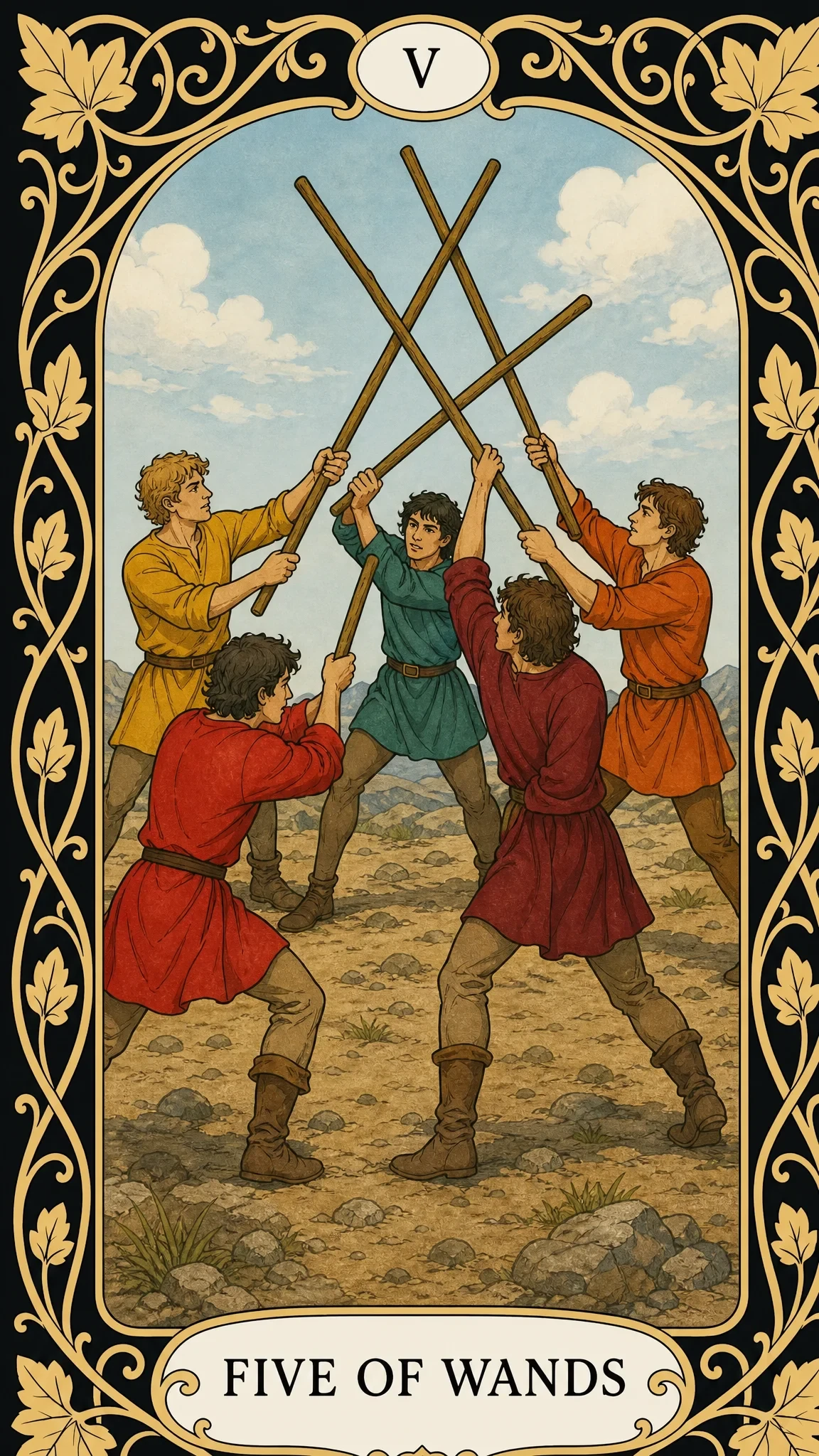
Kaj pomeni Petica palic v Tarotu
Petica palic je karta hrupnega, a ne smrtnega spopada. Pet ljudi s"krza palice, vsak vleče v svojo smer, nihče nima ocitne prednosti – in to je bistvo karte: to ni vojna do uničenja, ampak spopad za mesto, za vrstni red, za to, čigavo verzijo bodo najprej slišali.
Pomembno je takoj ločiti to karto od višjih arkanov. Stolp ali Hudič opisujeta veliko temo za leta naprej; Petica palic je bistveno skromnejša po obsegu. To je konkreten spor na klicu, prepir v klepetu, tekmovanje za pozornost v družbi, ne pa usodna prelomnica. Brati jo kot »v življenju se bo začel kaos« pomeni karto prenapihniti: mlajši arkani govorijo o epizodi, ne o usodi.
Element Ogenj in barva Palice postavljata ton: energije je veliko, izbruhne navzven, vendar je usmerjena narobe – vsi se potiskajo, nihče se ni vnaprej dogovoril o pravilih. Od tod klasičen pomen: rivalstvo, trenja, manjši konflikti, razpršeni napori. Pogosto karta izpade tam, kjer je več ljudi hkrati po svoje pravih in nihče ni pripravljen prvi popustiti.
Obrnjena Petica palic: pomen
Obrnjena Petica palic je ista prerivajoča se množica, le da je dušena. Tri pogoste interpretacije, med katerimi izbiramo glede na vprašanje "razkrivanja":
- Spor se je končal – ne zato, ker je nekdo koga prepričal, ampak ker so vsi utrujeni. Formalno premirje brez pravega soglasja.
- Konflikt se je premaknil v notranjost. Zunaj je mirno, a razdraženost in rivalstvo nista izginila – le ne kažeta se več.
- Spopad poteka nepošteno. En glas utiša druge, in videz boja »na enakih nogah« iz pokončnega položaja izgine – nekdo drug si utira pot.
Obrnjen položaj je signal, da se odprtega spopada, ki ga opisuje pokončna karta, ni zgodilo ali se mu zavestno izogibajo. Včasih je to bolje, včasih – le isti pogovor, odložen za kasneje.
Petica palic v "razkrivanju" "da ali ne"
V "razkrivanju" "da ali ne" Petica palic običajno pomeni da, vendar ne brez boja. Vprašanje kot je »bo uspelo« se odgovori pritrdilno – le rezultat bo treba braniti, ne pa ga dobiti takoj in brez upora.
Če je vprašanje o miru – »bo minilo brez spora«, »se bodo strinjali brez ugovorov« – karta bolj odgovarja ne: trenja bodo, nekdo se bo zagotovo izrekel proti.
Obrnjena različica blaži odgovor na »konflikt se ni pojavil« ali »strani so se že naveličale prepirati«: praktični pomen je v tem, da odprtega spopada, ki ga obeta pokončen položaj, v bližnji prihodnosti ni pričakovati.
Petica palic v odnosih in čustvih
V odnosih je pokončna Petica palic – to so partnerji, ki se nenehno nekoliko tekmovalno obravnavajo: kdo je več vložil, kdo ima prav v vsakdanjem sporu, čigavo mnenje je bolj pomembno pri sprejemanju odločitev. Samo po sebi to ni obsodba para – mnogi pari tako živijo leta, in trenje celo ohranja zanimanje živo.
Pogosto se karta pojavi tam, kjer za eno osebo tekmuje več strani: neposreden tekmec za pozornost ali pa konkurenčne obveznosti – družina, delo, stara razmerja, – ki vlečejo v različne smeri. Mirnega, spokojnega čustva ta karta ne opisuje ne v pokončnem ne v obrnjenem položaju.
V položaju čustev je to bolj strast kot nežnost: želja dokazati, biti slišan, ne popustiti v sporu, ki v resnici ni vreden takšne napetosti.
Obrnjena Petica palic v odnosih – bodisi spor, ki so ga potisnili vase in ga niso izrazili, bodisi, nasprotno, kratko premirje po prepiru, ki ni rešilo prvotnega vzroka.
Petica palic pri delu in denarju
V delovnih "razkrivanjih" je to odprta konkurenca: več ljudi kandidira za en projekt, proračun se deli z bojem, sestanek se spremeni v prerivanje namesto razprave. Pogosto je to ekipa, kjer vloge niso natančno razdeljene, in vsak vleče odejo nase ne iz zlobe, ampak zato, ker sicer nihče ne bo slišal njegovega prispevka.
V denarju je karta – o sporu glede zneska: kdo koliko dolguje, kdo za kaj plačuje, pogajanja pri delitvi premoženja ali stroškov. Neposredne izgube karta ne obljublja – obljublja boj za to, kako se bo porazdelilo tisto, kar je.
Kaj Petica palic svetuje v bistvu: preden se nadaljuje s sporom, se dogovoriti o pravilih spora – kdo govori prvi, kaj se sploh deli in na koliko delov. Kaos na karti – to ni pomanjkanje sredstev, ampak pomanjkanje uredbe.
Petica palic kot oseba: moški in ženska
Ko Petica palic izpade kot opis osebe, je to nekdo, ki se prepira o vsem – ne nujno iz zlobe, ampak zato, ker mu je pomembno javno braniti svoj položaj. Ob takšni osebi redko kdaj mir: preverja tuje argumente glede trdnosti in pričakuje enako v zameno.
Moški-Petica palic – strasten prepirljivec, obožuje tekmovalne situacije, zlahka se vplete v prepir in prav tako lahko iz njega izstopi brez zamere. Ženska-Petica palic – tista, ki ne popušča in ne molči, tudi če je prepir neprijeten ali neugoden glede na status.
To ni opis konfliktne ali zlobne osebe – bolj tiste, ki ji je pomembno biti slišana v splošnem hrupu, in je pripravljena za to tekmovati.
Five of Wands in the thoughts position
In the thoughts position, the Five of Wands represents a mind where several inner voices argue simultaneously: one insists on its own version, another objects, a third doubts everything at once. It's difficult to concentrate precisely because thoughts compete with each other instead of lining up in order.
This is often the state before an important conversation or decision: a person mentally rehearses arguments for all sides at once, preparing for disputes that haven't happened yet. Neighboring cards will indicate whether this internal struggle is productive or just exhausting in vain.
What to do if the Five of Wands appears
The card's advice is simple, though not the most pleasant: don't disengage from the argument, but don't turn it into a war of annihilation. The Five of Wands is about energy scattered on trifles, and the first task is to gather it back.
What to do specifically:
- Name what the argument is really about. Often, a more serious unresolved issue lies behind a squabble over a trifle.
- Agree on rules, not just content. Who speaks, in what order, by what deadline is the result needed.
- Don't confuse competition with personal offense. The excitement of an argument doesn't mean the opponent is an enemy.
- Leave room for a draw. Not every clash must have a clear winner.
If the card represents not a petty squabble but a long, exhausting conflict, the spread describes the dynamics but doesn't resolve them; in such cases, direct conversation or a mediator helps, not another card in the deck.
What is depicted on the card
On our Five of Wands, there are five young men in a rocky wasteland, each holding his own single wand: no one grips two at once, nor shares a wand with a neighbor. All five stand at full height in a loose circle, simultaneously raising their wands above their heads, so that the wands converge in the sky in a sweeping cross. Their poses indicate a brawl rather than a one-on-one duel: some pull their wands towards themselves, some push them away, and the young man in the turquoise tunic in the center holds his with both hands, squeezed by others' wands from both sides.
The scene is interpreted as follows:
- Five tunics — five equal positions. Golden-yellow, red, turquoise-green, dark red, and orange. The colors are deliberately mismatched. This is a dispute among equals, not a hierarchy where one is clearly superior.
- Each has exactly one wand. No wand is shared, and none are left over: no extra wands on the ground or in free hands — the balance of power in the skirmish is fair, without bias towards anyone.
- Wands crossed high above heads — no blow is fully delivered, no one is wounded or defeated: it looks more like an excited scuffle than a real fight.
- Rocky, dry ground and bare hills in the background — the setting is resource-poor, and the clash is partly about who gets the little that exists.
- Light sky with clouds — unlike cards of true disaster, the background here is calm: the storm is only among the people, not around them.
At the top of the card is the Roman numeral V, and at the bottom, the English name FIVE OF WANDS: our deck is drawn in the Rider-Waite tradition, where this card is the fifth in the suit of Wands.
Five of Wands as the card of the day
The Five of Wands as the card of the day signifies a day with increased background friction: someone will inevitably argue on a call, in chat, in line, or at home over a trifle. This is not necessarily a bad sign — rather, it's a signal to be prepared to defend your point of view more often than usual.
A useful mindset for such a day: don't perceive every objection as an attack, and don't get involved in others' disputes that don't directly concern you. The excitement of this day quickly burns out on its own if you don't add fuel to the fire.
Frequently asked questions about the Five of Wands card
Is it a Major or Minor Arcana?
The Five of Wands is a Minor Arcana, suit of Wands, element of Fire. There are 56 Minor Arcana in a Tarot deck — 14 in each of the four suits, and the Five of Wands is one of them.
How does the Five of Wands differ from the Five of Swords?
Both cards are about conflict, but in different ways. The Five of Swords is about a dispute with a clear loser and lingering resentment after a victory at any cost. The Five of Wands is gentler: it's a noisy competition without a single winner and without real animosity — the parties let off steam rather than destroy each other.
Does the Five of Wands mean a fight?
Not literally. The card describes the energy of rivalry and friction — arguments, competition, a struggle for attention, not physical violence. The five characters on the card are waving wands, but none of them are injured: the meaning is in the struggle itself, not its outcome.
What does the reversed Five of Wands mean?
Usually one of three options: the conflict has ended due to exhaustion, not mutual agreement; the dispute has gone internal and is not verbalized; or, conversely, one person is pushing their agenda, and the appearance of fair competition from the upright position is lost.
Is the Five of Wands a bad card?
No, rather neutral. It describes an energy-consuming but not destructive period: competition, arguments, scattered efforts. The card does not bring real disaster or loss — what a person does with this friction is more important than the fact of its existence.