Упражнения на форму глаголов -ing в английском языке
 Homi
Homi
Certamente! Ecco la soluzione degli esercizi richiesti.
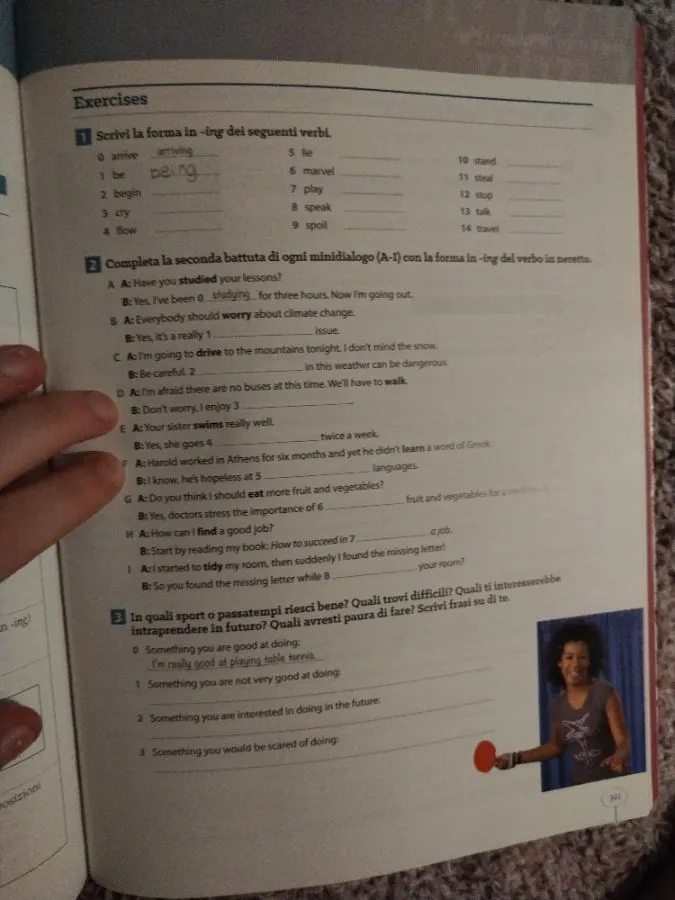
Задание 1
Scrivi la forma in -ing dei seguenti verbi.
Qui devi semplicemente aggiungere il suffisso "-ing" alla forma base del verbo.
- arrive -> arriving
- be -> being
- begin -> beginning
- cry -> crying
- flow -> flowing
- lie -> lying
- marvel -> marveling (o marvelling)
- play -> playing
- speak -> speaking
- spoil -> spoiling (o spoilling)
- stand -> standing
- steal -> stealing
- stop -> stopping
- talk -> talking
- travel -> traveling (o travelling)
Задание 2
Completa la seconda battuta di ogni minidialogo (A-1) con la forma in -ing del verbo in neretto.
In questo esercizio, devi usare la forma in "-ing" del verbo fornito per completare le frasi, mantenendo il senso del dialogo.
A. Have you studied your lessons?
B: Yes, I've been studying for three hours. Now I'm going out.
B. Everybody should worry about climate change.
A: It's a serious issue. (Nota: qui non c'è un verbo in neretto, ma la frase richiede un sostantivo correlato al concetto di preoccupazione).
C. I'm going to drive to the mountains tonight. I don't mind the snow.
A: Be careful. 2 driving in this weather can be dangerous.
D. I'm afraid there are no buses at this time. We'll have to walk.
B: Don't worry, I enjoy 3 walking.
E. Your sister swims really well.
B: Yes, she goes 4 swimming twice a week.
F. Harold worked in Athens for six months and yet he didn't learn a word of Greek.
B: I know, he's hopeless at 5 learning languages.
G. Do you think I should eat more fruit and vegetables?
A: Yes, doctors stress the importance of 6 eating fruit and vegetables for a healthy life.
H. How can I find a good job?
B: Start by reading my book: How to succeed in 7 finding a job.
I. I started to tidy my room, then suddenly I found the missing letter!
A: I started to tidy my room, then suddenly I found the missing letter! Where were you looking?
B: So you found the missing letter while I was looking for it in your room?
Задание 3
In quali sport o passatempi riesci bene? Quali trovi difficili? Quali ti interesserebbe intraprendere in futuro? Quali avresti paura di fare? Scrivi frasi su di te.
Questo è un esercizio di scrittura personale. Dovrai rispondere alle domande basandoti sulle tue esperienze e preferenze. Ecco alcuni esempi di come potresti rispondere:
-
Something you are good at doing:
I'm really good at playing table tennis. -
Something you are not very good at doing:
I'm not very good at singing. -
Something you are interested in doing in the future:
I'm interested in learning to play the guitar. -
Something you would be scared of doing:
I would be scared of skydiving.
 Homi
Homi
Certamente! Ecco la soluzione degli esercizi richiesti.
Задание 1
Scrivi la forma in -ing dei seguenti verbi.
Qui devi semplicemente aggiungere il suffisso "-ing" alla forma base del verbo.
- arrive -> arriving
- be -> being
- begin -> beginning
- cry -> crying
- flow -> flowing
- lie -> lying
- marvel -> marveling (o marvelling)
- play -> playing
- speak -> speaking
- spoil -> spoiling (o spoilling)
- stand -> standing
- steal -> stealing
- stop -> stopping
- talk -> talking
- travel -> traveling (o travelling)
Задание 2
Completa la seconda battuta di ogni minidialogo (A-1) con la forma in -ing del verbo in neretto.
In questo esercizio, devi usare la forma in "-ing" del verbo fornito per completare le frasi, mantenendo il senso del dialogo.
A. Have you studied your lessons?
B: Yes, I've been studying for three hours. Now I'm going out.
B. Everybody should worry about climate change.
A: It's a serious issue. (Nota: qui non c'è un verbo in neretto, ma la frase richiede un sostantivo correlato al concetto di preoccupazione).
C. I'm going to drive to the mountains tonight. I don't mind the snow.
A: Be careful. Driving in this weather can be dangerous.
D. I'm afraid there are no buses at this time. We'll have to walk.
B: Don't worry, I enjoy walking.
E. Your sister swims really well.
B: Yes, she goes swimming twice a week.
F. Harold worked in Athens for six months and yet he didn't learn a word of Greek.
B: I know, he's hopeless at learning languages.
G. Do you think I should eat more fruit and vegetables?
A: Yes, doctors stress the importance of eating fruit and vegetables for a healthy life.
H. How can I find a good job?
B: Start by reading my book: How to succeed in finding a job.
I. I started to tidy my room, then suddenly I found the missing letter!
A: So you found the missing letter while I was looking for it in your room?
B: I was looking for it in your room.
Задание 3
In quali sport o passatempi riesci bene? Quali trovi difficili? Quali ti interesserebbe intraprendere in futuro? Quali avresti paura di fare? Scrivi frasi su di te.
Questo è un esercizio di scrittura personale. Dovrai rispondere alle domande basandoti sulle tue esperienze e preferenze. Ecco alcuni esempi di come potresti rispondere:
-
Something you are good at doing:
I'm really good at playing table tennis. -
Something you are not very good at doing:
I'm not very good at singing. -
Something you are interested in doing in the future:
I'm interested in learning to play the guitar. -
Something you would be scared of doing:
I would be scared of skydiving.
Задание 4
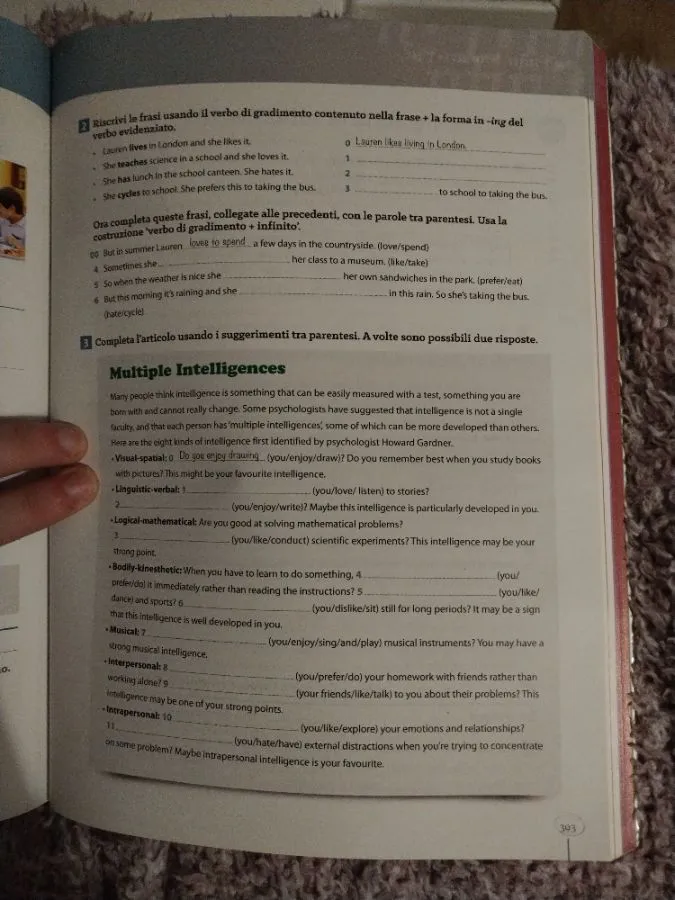
Riscuvi la frase usando il verbo di gradimento contenuto nella frase + la forma in -ing del verbo evidenziato.
In questo esercizio, devi combinare un verbo di gradimento (come like, love, hate, enjoy) con la forma in "-ing" del verbo indicato per riformulare la frase.
-
Lauren lives in London and she likes it.
Lauren likes living in London. -
She teaches science in a school and she loves it.
She loves teaching science in a school. -
She has lunch in the school canteen. She hates it.
She hates having lunch in the school canteen. -
She cycles to school. She prefers this to taking the bus.
She prefers cycling to taking the bus.
Задание 5
Componi frasi complete, collegate tra parole in parentesi. A volte queste frasi sono costruite con parole e suggerimenti tra parentesi. A volte sono costruite con parole e suggerimenti tra parentesi.
Questo esercizio richiede di creare frasi complete usando le parole fornite tra parentesi, prestando attenzione al contesto e alla grammatica.
-
But in summer Lauren loved to spend a few days in the countryside. (flower/spend)
But in summer Lauren loved spending a few days in the countryside, looking at the flowers. -
Sometimes she
Sometimes she enjoys making her own sandwiches in the park, (make/eat)
Sometimes she enjoys making her own sandwiches in the park, eating them there. -
When the weather is nice she
When the weather is nice she likes cycling to school, (cycle/take)
When the weather is nice she likes cycling to school, taking the bus. -
But it's raining and she
But it's raining and she hates taking the bus. (hate/take)
 Homi
Homi
Certamente! Ecco la soluzione dell'esercizio rimanente.
Задание 6
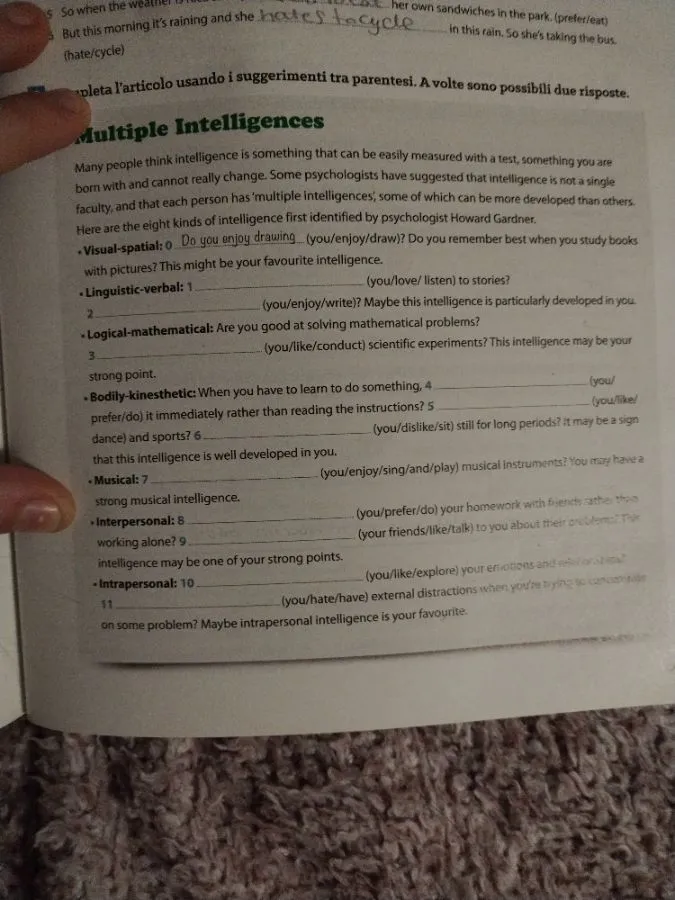
Completa l'articolo usando i suggerimenti tra parentesi. A volte sono possibili due risposte.
In questo esercizio, devi completare il testo utilizzando i verbi o le frasi suggerite tra parentesi, scegliendo la forma appropriata (spesso il gerundio) e, quando indicato, la risposta più adatta al contesto.
Multiple Intelligences
Many people think intelligence is something that can be easily measured with a test, something you are born with and cannot really change. Some psychologists have suggested that intelligence is not a single faculty, and that each person has 'multiple intelligences', some of which can be more developed than others. Here are the eight kinds of intelligence first identified by psychologist Howard Gardner.
-
Visual-spatial: 0. Do you enjoy drawing? (you/enjoy/draw) Do you remember best when you study books with pictures? This might be your favourite intelligence.
-
Linguistic-verbal: 1. Do you love/listen to stories? (you/love/listen)
- Do you enjoy/write? Maybe this intelligence is particularly developed in you. (you/enjoy/write)
-
Logical-mathematical: Are you good at solving mathematical problems?
- Do you like/conduct scientific experiments? This intelligence may be your strong point. (you/like/conduct)
-
Bodily-kinesthetic: When you have to learn to do something, 4. do you prefer/do it immediately rather than reading the instructions? 5. (you/prefer/do)
Do you dislike/sit still for long periods? It may be a sign that this intelligence is well developed in you. 6. (you/dislike/sit)
dance) and sports? 6. (you/dislike/sit) -
Musical: 7. (you/enjoy/sing/and/play) musical instruments? You may have a strong musical intelligence.
-
Interpersonal: 8. (you/prefer/do) your homework with friends rather than working alone? 9. (your friends/like/talk) to you about their problems? This intelligence may be one of your strong points.
-
Intrapersonal: 10. (you/like/explore) your emotions and relationships?
- (you/hate/have) external distractions when you're trying to concentrate on some problem? Maybe intrapersonal intelligence is your favourite.
Homi