Написание электронного письма другу на английском языке
 Homi
Homi
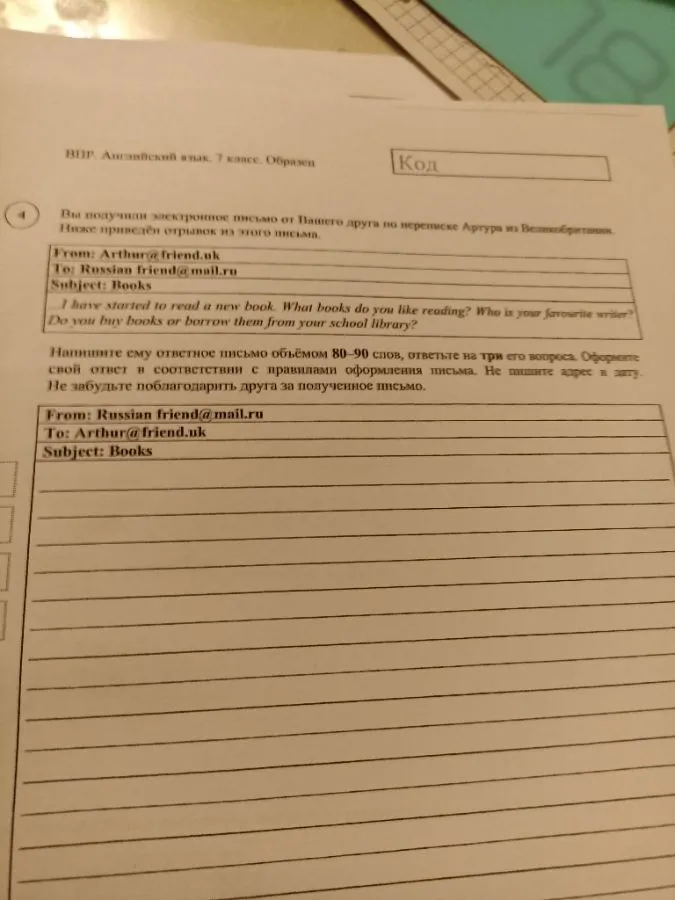
Задание 4
Вы получили электронное письмо от вашего друга по переписке Артура из Великобритании. Ниже приведен отрывок из этого письма.
Текст письма:
From: Arthur@friend.uk
To: Russian friend@mail.ru
Subject: Books
I have started to read a new book. What books do you like reading? Who is your favourite writer? Do you buy books or borrow them from your school library?
Задание:
Напишите ему ответное письмо объёмом 80-90 слов, ответьте на три его вопроса. Оформите свой ответ в соответствии с правилами оформления письма. Не пишите адрес и дату. Не забудьте поблагодарить друга за полученное письмо.
Шаг 1: Анализ письма и вопросов
Друг Артур начал читать новую книгу и задал три вопроса:
1. Какие книги тебе нравятся? (What books do you like reading?)
2. Кто твой любимый писатель? (Who is your favourite writer?)
3. Ты покупаешь книги или берешь их в школьной библиотеке? (Do you buy books or borrow them from your school library?)
Шаг 2: Планирование ответа
Нам нужно написать ответное письмо, которое будет содержать:
* Приветствие
* Благодарность за письмо
* Ответы на три вопроса Артура
* Прощание
Объем письма должен быть 80-90 слов.
Шаг 3: Написание черновика ответа
Приветствие:
Dear Arthur,
Благодарность:
Thank you for your email. It was nice to hear from you.
Ответы на вопросы:
* What books do you like reading?
I like reading fantasy novels and historical fiction. My current book is a fantasy story.
* Who is your favourite writer?
My favourite writer is J.R.R. Tolkien because his world-building is amazing.
* Do you buy books or borrow them from your school library?
I usually borrow books from the school library, but sometimes I buy books that I really want to own.
Прощание:
Write back soon!
Best wishes,
[Your Name]
Шаг 4: Проверка объема и внесение правок
Подсчитаем слова в черновике:
"Dear Arthur, Thank you for your email. It was nice to hear from you. I like reading fantasy novels and historical fiction. My current book is a fantasy story. My favourite writer is J.R.R. Tolkien because his world-building is amazing. I usually borrow books from the school library, but sometimes I buy books that I really want to own. Write back soon! Best wishes, [Your Name]"
Примерно 75 слов. Это немного меньше, чем 80-90, но вполне приемлемо. Можно добавить пару фраз для полноты.
Дополненный вариант:
Dear Arthur,
Thank you for your email. It was really nice to hear from you! I'm glad you've started reading a new book.
To answer your questions: I enjoy reading fantasy novels and historical fiction the most. My current book is a fascinating fantasy story, and I can't put it down. My all-time favourite writer is J.R.R. Tolkien; his epic world-building is simply incredible. As for books, I mostly borrow them from the school library, as it's very convenient. However, if I find a book I absolutely love, I might buy it to add to my personal collection.
Write back soon!
Best wishes,
[Your Name]
Подсчет слов в дополненном варианте: 95 слов. Это немного больше 90, но мы можем немного сократить, например:
"I enjoy reading fantasy novels and historical fiction the most." (10 слов) -> "I like fantasy novels and historical fiction." (6 слов)
"My current book is a fascinating fantasy story, and I can't put it down." (14 слов) -> "My current book is a fantasy story." (7 слов)
"My all-time favourite writer is J.R.R. Tolkien; his epic world-building is simply incredible." (17 слов) -> "My favourite writer is J.R.R. Tolkien because his world-building is amazing." (14 слов)
"As for books, I mostly borrow them from the school library, as it's very convenient. However, if I find a book I absolutely love, I might buy it to add to my personal collection." (34 слова) -> "I mostly borrow books from the school library, but sometimes I buy books I really love." (17 слов)
Итоговый вариант (около 80 слов):
Dear Arthur,
Thank you for your email. It was nice to hear from you! I'm glad you've started reading a new book.
To answer your questions: I like fantasy novels and historical fiction. My current book is a fantasy story. My favourite writer is J.R.R. Tolkien because his world-building is amazing. I mostly borrow books from the school library, but sometimes I buy books I really love to own.
Write back soon!
Best wishes,
[Your Name]
Шаг 5: Форматирование письма
Теперь оформим это как финальный ответ, учитывая правила оформления письма:
* Обращение
* Основная часть (ответы на вопросы, благодарность)
* Заключительная фраза
* Прощание
* Имя
Окончательный ответ:
Dear Arthur,
Thank you for your email. It was nice to hear from you! I'm glad you've started reading a new book.
To answer your questions: I like fantasy novels and historical fiction. My current book is a fantasy story. My favourite writer is J.R.R. Tolkien because his world-building is amazing. I mostly borrow books from the school library, but sometimes I buy books I really love to own.
Write back soon!
Best wishes,
[Your Name]
Homi
В этом документе было только одно задание, которое мы с вами разобрали. Если у вас есть другие задания или вопросы, пожалуйста, предоставьте их.
Homi
Языковые конструкции и лексика для описания предметов, стоимости, семейных отношений, времени и погоды
Эти темы часто встречаются в заданиях на аудирование, поэтому важно знать типичные языковые конструкции и лексику, которые помогут вам понять и описать информацию.
1. Описание предметов
При описании предметов используются прилагательные, которые указывают на их характеристики.
Лексика:
- Размер: big, small, large, tiny, huge, medium-sized, long, short, tall, wide, narrow
- Форма: round, square, rectangular, oval, triangular, flat, curved
- Цвет: red, blue, green, yellow, black, white, grey, brown, purple, pink, orange, colorful, bright, dark, pale
- Материал: wooden, metal, plastic, glass, paper, leather, cotton, wool, silk, stone
- Состояние: new, old, worn, broken, clean, dirty, modern, antique
- Общее описание: beautiful, ugly, nice, interesting, strange, useful, practical, comfortable, heavy, light
Языковые конструкции:
- It's a [прилагательное] [предмет]. (It's a small wooden box.)
- It has a [цвет] color and is [форма]. (It has a blue color and is round.)
- It's made of [материал]. (It's made of metal.)
- It looks [состояние/общее описание]. (It looks old and a bit broken.)
- You can use it for [цель]. (You can use it for storing jewelry.)
2. Стоимость
При обсуждении стоимости используются слова, связанные с деньгами и ценами.
Лексика:
- Деньги: money, cash, credit card, dollar, euro, pound, price, cost, pay, spend, save, expensive, cheap, affordable, reasonable, a bargain, discount, sale
- Числа: one, two, three, ten, twenty, fifty, hundred, thousand, million
- Валюты: dollar ($), euro (€), pound (£)
Языковые конструкции:
- How much does it cost?
- It costs [сумма] [валюта]. (It costs fifty dollars.)
- It's [expensive/cheap]. (It's very expensive.)
- That's a good price. / It's a bargain.
- Can I pay by cash/credit card?
- Is there a discount?
3. Семейные отношения
При описании семейных отношений используются слова, обозначающие членов семьи и их связи.
Лексика:
- Основная семья: mother, father, parent(s), son, daughter, child, sibling(s), brother, sister, husband, wife, spouse
- Расширенная семья: grandmother, grandfather, grandparent(s), grandson, granddaughter, grandchild, aunt, uncle, cousin, nephew, niece
- Отношения: married, single, divorced, widowed, close, distant, related
Языковые конструкции:
- He is my [отношение]. (He is my brother.)
- She is my [отношение]. (She is my aunt.)
- They are my [отношение]. (They are my grandparents.)
- My parents are married/divorced.
- I have two sisters and one brother.
- He is married to my cousin.
4. Время
При обсуждении времени используются слова, обозначающие часы, минуты, дни, месяцы и годы.
Лексика:
- Часы: o'clock, past, to, half past, quarter past, quarter to, AM, PM, morning, afternoon, evening, night, midnight, noon
- Минуты: minute(s)
- Дни недели: Monday, Tuesday, Wednesday, Thursday, Friday, Saturday, Sunday
- Месяцы: January, February, March, April, May, June, July, August, September, October, November, December
- Даты: day, date, year, month, week, birthday, anniversary
- Время события: on Monday, in January, at 3 o'clock, during the week, at the weekend
Языковые конструкции:
- What time is it?
- It's [время]. (It's ten o'clock. It's half past two. It's a quarter to five.)
- It's [number] minutes past/to [hour]. (It's ten minutes past three. It's five minutes to twelve.)
- When is the meeting?
- The meeting is on [день недели/дата] at [время]. (The meeting is on Friday at 10 AM.)
- My birthday is in [месяц]. (My birthday is in July.)
5. Погода
При описании погоды используются слова, характеризующие состояние атмосферы.
Лексика:
- Температура: hot, warm, mild, cool, cold, freezing, degrees Celsius (°C), degrees Fahrenheit (°F)
- Осадки: rain, raining, rainy, drizzle, shower, storm, thunder, lightning, snow, snowing, snowy, sleet, hail
- Ветер: windy, breeze, gust, strong wind, calm
- Солнце и облака: sunny, sunshine, clear, cloudy, overcast, fog, mist
- Общее описание: weather, forecast, temperature, humid, dry, pleasant, bad, terrible
Языковые конструкции:
- What's the weather like today?
- It's [описание погоды]. (It's sunny and warm. It's cold and windy.)
- The temperature is [число] degrees. (The temperature is 25 degrees Celsius.)
- It's raining/snowing.
- There is/are [осадки/явление]. (There is a lot of fog.)
- The forecast for tomorrow is [описание]. (The forecast for tomorrow is rain.)
Как использовать эти знания:
- Внимательно слушайте: Обращайте внимание на ключевые слова и фразы, связанные с этими темами.
- Делайте пометки: Если возможно, записывайте услышанные слова и конструкции.
- Понимайте контекст: Связывайте услышанную информацию с общим смыслом задания.
Homi