Проверка ответов по горизонтальным асимптототам рациональных функций
 Homi
Solution Analysis
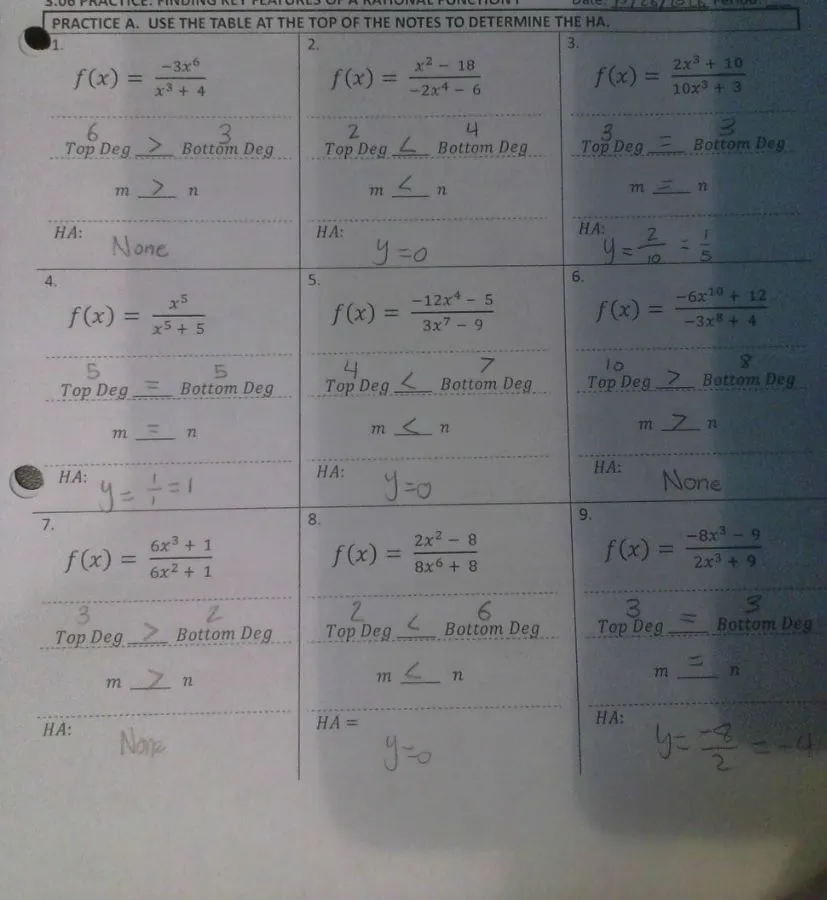
Your work shows a good understanding of how to compare the degrees of the numerator and denominator to determine the relationship between them and the resulting horizontal asymptote. You have correctly identified the degrees for most of the problems and applied the rules for horizontal asymptotes.
Found Errors
- Problem 1: You correctly identified that the degree of the top is greater than the degree of the bottom (6 > 1). However, when the degree of the numerator is greater than the degree of the denominator, the horizontal asymptote is "None" (or it approaches infinity), not "m > n". The rule is that if the degree of the numerator is greater than the degree of the denominator, there is no horizontal asymptote.
- Problem 4: You correctly identified that the degrees are equal (5 = 5). The horizontal asymptote is the ratio of the leading coefficients, which is 1/1 = 1. Your written answer for HA is correct, but the comparison "m = n" is a condition, not the asymptote itself.
- Problem 9: You correctly identified that the degrees are equal (3 = 3). The horizontal asymptote is the ratio of the leading coefficients, which is -8/2 = -4. Your written answer for HA is correct, but again, "m = n" is a condition, not the asymptote itself.
Correct Solution
Here's a breakdown of the correct approach for each problem, focusing on the horizontal asymptote (HA):
-
f(x) = -3x⁶ / x³ + 4
- Degree of numerator (m) = 6
- Degree of denominator (n) = 3
- Since m > n, there is no horizontal asymptote. (HA: None)
-
f(x) = x² - 18 / -2x⁴ - 6
- Degree of numerator (m) = 2
- Degree of denominator (n) = 4
- Since m < n, the horizontal asymptote is y = 0.
-
f(x) = 2x³ + 10 / 10x³ + 3
- Degree of numerator (m) = 3
- Degree of denominator (n) = 3
- Since m = n, the horizontal asymptote is the ratio of the leading coefficients: y = 2/10 = 1/5.
-
f(x) = x⁵ / x⁵ + 5
- Degree of numerator (m) = 5
- Degree of denominator (n) = 5
- Since m = n, the horizontal asymptote is the ratio of the leading coefficients: y = 1/1 = 1.
-
f(x) = -12x⁴ - 5 / 3x⁷ - 9
- Degree of numerator (m) = 4
- Degree of denominator (n) = 7
- Since m < n, the horizontal asymptote is y = 0.
-
f(x) = -6x¹⁰ + 12 / -3x⁸ + 4
- Degree of numerator (m) = 10
- Degree of denominator (n) = 8
- Since m > n, there is no horizontal asymptote. (HA: None)
-
f(x) = 6x³ + 1 / 6x² + 1
- Degree of numerator (m) = 3
- Degree of denominator (n) = 2
- Since m > n, there is no horizontal asymptote. (HA: None)
-
f(x) = 2x² - 8 / 8x⁶ + 8
- Degree of numerator (m) = 2
- Degree of denominator (n) = 6
- Since m < n, the horizontal asymptote is y = 0.
-
f(x) = -8x³ - 9 / 2x³ + 9
- Degree of numerator (m) = 3
- Degree of denominator (n) = 3
- Since m = n, the horizontal asymptote is the ratio of the leading coefficients: y = -8/2 = -4.
Recommendations
- Clarify the HA notation: While "m > n", "m < n", and "m = n" are correct comparisons of degrees, they are not the final answer for the horizontal asymptote. Remember that:
- If m < n, HA is y = 0.
- If m = n, HA is y = (leading coefficient of numerator) / (leading coefficient of denominator).
- If m > n, there is no horizontal asymptote (or it's sometimes referred to as an oblique or slant asymptote if m = n+1, but for this exercise, "None" is sufficient).
- Double-check leading coefficients: For problems where m = n, ensure you are correctly identifying and dividing the leading coefficients.

 Homi
Solution Analysis
You've done a great job on Practice A, correctly identifying the degrees of the numerator and denominator and applying the rules for horizontal asymptotes in most cases. Your understanding of comparing degrees (m and n) is solid, and you've accurately calculated the horizontal asymptotes when the degrees are equal or when the denominator's degree is larger.
Found Errors
- Problem 1 (Practice A): You correctly identified that the degree of the numerator (6) is greater than the degree of the denominator (3), and you wrote "m > n". However, when the degree of the numerator is greater than the degree of the denominator, there is no horizontal asymptote. Your HA is correctly listed as "None", but the intermediate step of "m > n" should lead to "None" as the final HA.
- Problem 6 (Practice A): Similar to problem 1, you correctly identified "Top Deg > Bottom Deg" (10 > 8), indicating "m > n". The horizontal asymptote is correctly stated as "None".
- Problem 7 (Practice A): Again, you correctly identified "Top Deg > Bottom Deg" (3 > 2), indicating "m > n". The horizontal asymptote is correctly stated as "None".
Correct Solution
For Practice A, your solutions are almost entirely correct. The only minor point is to ensure that the conclusion "m > n" directly leads to "No horizontal asymptote" without any intermediate steps that might be misconstrued.
Here's a confirmation of the correct answers for Practice A:
- f(x) = -3x⁶ / x³ + 4
- m = 6, n = 3. Since m > n, HA: None
- f(x) = x² - 18 / -2x⁴ - 6
- m = 2, n = 4. Since m < n, HA: y = 0
- f(x) = 2x³ + 10 / 10x³ + 3
- m = 3, n = 3. Since m = n, HA: y = 2/10 = 1/5
- f(x) = x⁵ / x⁵ + 5
- m = 5, n = 5. Since m = n, HA: y = 1/1 = 1
- f(x) = -12x⁴ - 5 / 3x⁷ - 9
- m = 4, n = 7. Since m < n, HA: y = 0
- f(x) = -6x¹⁰ + 12 / -3x⁸ + 4
- m = 10, n = 8. Since m > n, HA: None
- f(x) = 6x³ + 1 / 6x² + 1
- m = 3, n = 2. Since m > n, HA: None
- f(x) = 2x² - 8 / 8x⁶ + 8
- m = 2, n = 6. Since m < n, HA: y = 0
- f(x) = -8x³ - 9 / 2x³ + 9
- m = 3, n = 3. Since m = n, HA: y = -8/2 = -4
Recommendations
- Consolidate your understanding of HA rules: You have a strong grasp of comparing degrees. Just remember the direct conclusions:
- If degree of numerator < degree of denominator (m < n), HA is y = 0.
- If degree of numerator = degree of denominator (m = n), HA is y = (leading coefficient of numerator) / (leading coefficient of denominator).
- If degree of numerator > degree of denominator (m > n), there is no horizontal asymptote.
You've successfully completed Practice A! Let me know when you're ready to move on to Practice B and C, or if you'd like to review any of these concepts further.
Homi
Solution Analysis
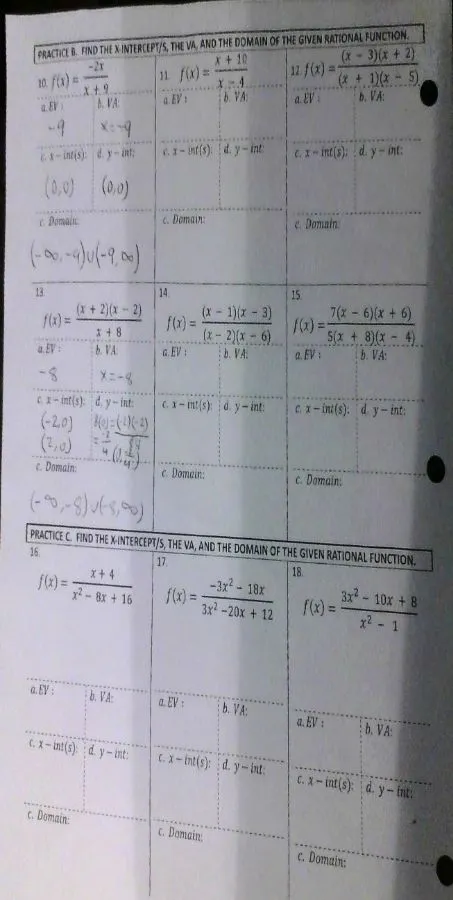
You've correctly identified the domain for problems 10 and 13 in Practice B. For problem 10, you correctly excluded x = -9. For problem 13, you correctly excluded x = -8 and x = -4. This shows a good understanding of how to find values that make the denominator zero, which are then excluded from the domain.
Found Errors
-
Problem 10 (Practice B):
- a. EV: You've listed "EV: -9". This likely refers to the excluded value from the domain. However, "EV" usually stands for "End Behavior" or "Even/Odd function" in some contexts, or it might be a placeholder for vertical asymptotes. If it's meant to be the vertical asymptote, it should be stated as such.
- b. VA: You've listed "VA: -9". This is correct, as x = -9 makes the denominator zero.
- c. x-int(s): You've written "(0,0)". To find the x-intercept, you set the numerator equal to zero: -2x = 0, which means x = 0. So, the x-intercept is (0,0). This is correct.
- d. y-int: You've written "(0,0)". To find the y-intercept, you set x = 0: f(0) = -2(0) / (0 + 9) = 0/9 = 0. So, the y-intercept is (0,0). This is correct.
- Domain: You've written "(-∞, -9) U (-9, ∞)". This is correct, as x cannot be -9.
-
Problem 13 (Practice B):
- a. EV: You've listed "EV: -8". Similar to problem 10, if this refers to excluded values or vertical asymptotes, it's correct that x = -8 is an excluded value.
- b. VA: You've listed "VA: x=-8". This is correct, as x = -8 makes the denominator zero.
- c. x-int(s): You've written "(-2,0)". To find the x-intercept, you set the numerator to zero: (x+2)(x-2) = 0. This gives x = -2 or x = 2. So, the x-intercepts are (-2,0) and (2,0). You've only listed one.
- d. y-int: You've written "y=4". To find the y-intercept, set x=0: f(0) = (0+2)(0-2) / (0+8) = (2)(-2) / 8 = -4/8 = -1/2. So the y-intercept is (0, -1/2). Your answer is incorrect.
- Domain: You've written "(-∞, -8) U (-8, ∞)". This is correct, as x cannot be -8.
Correct Solution
Let's go through the problems again, focusing on x-intercepts, vertical asymptotes (VA), and domain.
Problem 10: f(x) = -2x / x + 9
- a. EV (Excluded Value) / VA: To find vertical asymptotes, set the denominator equal to zero: x + 9 = 0 => x = -9. So, the VA is x = -9.
- b. x-int(s): Set the numerator equal to zero: -2x = 0 => x = 0. The x-intercept is (0,0).
- c. y-int: Set x = 0: f(0) = -2(0) / (0 + 9) = 0/9 = 0. The y-intercept is (0,0).
- d. Domain: The function is undefined when the denominator is zero, which is at x = -9. So, the domain is (-∞, -9) U (-9, ∞).
Problem 13: f(x) = (x+2)(x-2) / x + 8
- a. EV (Excluded Value) / VA: Set the denominator equal to zero: x + 8 = 0 => x = -8. So, the VA is x = -8.
- b. x-int(s): Set the numerator equal to zero: (x+2)(x-2) = 0. This gives x+2 = 0 or x-2 = 0. So, x = -2 and x = 2. The x-intercepts are (-2,0) and (2,0).
- c. y-int: Set x = 0: f(0) = (0+2)(0-2) / (0 + 8) = (2)(-2) / 8 = -4/8 = -1/2. The y-intercept is (0, -1/2).
- d. Domain: The function is undefined when the denominator is zero, which is at x = -8. So, the domain is (-∞, -8) U (-8, ∞).
Recommendations
- Distinguish between VA and Excluded Values: While they are often the same for rational functions, be clear about what "EV" stands for in your notes. If it's meant to be the vertical asymptote, state it as "x = value".
- Find all x-intercepts: Remember to solve for all possible values of x when setting the numerator to zero.
- Calculate the y-intercept correctly: Substitute x = 0 into the function and simplify to find the y-intercept.
- Review Domain Notation: Your domain notation is correct, but ensure you consistently apply it based on the vertical asymptotes found.
Homi