Практика использования артиклей a, an, the в английском языке
 Homi
Homi
Задание 1
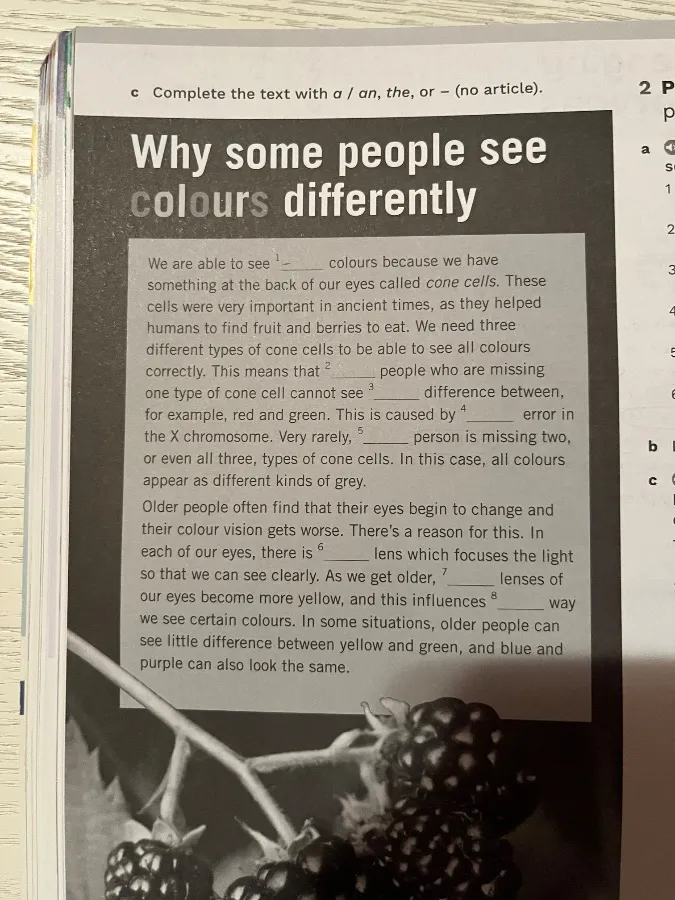
We are able to see (no article) colours because we have something at the back of our eyes called cone cells. These cells were very important in ancient times, as they helped humans to find fruit and berries to eat. We need three different types of cone cells to be able to see all colours correctly. This means that a people who are missing one type of cone cell cannot see the difference between, for example, red and green. This is caused by an error in the X chromosome. Very rarely, a person is missing two, or even all three, types of cone cells. In this case, all colours appear as different kinds of grey.
Older people often find that their eyes begin to change and their colour vision gets worse. There's a reason for this. In each of our eyes, there is a lens which focuses the light so that we can see clearly. As we get older, the lenses of our eyes become more yellow, and this influences the way we see certain colours. In some situations, older people can see little difference between yellow and green, and blue and purple can also look the same.
Объяснение:
- "We are able to see ______ colours": "Colours" здесь используется в общем смысле, как существительное во множественном числе, обозначающее цветовую гамму. В таких случаях артикль не ставится.
- "This means that ______ people": Здесь речь идет о конкретной группе людей, которые характеризуются отсутствием одного типа цветовых рецепторов. Поэтому используется артикль "a".
- "cannot see ______ difference": "Difference" здесь выступает как исчисляемое существительное, и мы говорим о конкретной разнице (между цветами). Используется артикль "the".
- "caused by ______ error": "Error" начинается с гласной буквы, поэтому используется артикль "an".
- "Very rarely, ______ person": Здесь имеется в виду "любой один человек", поэтому используется артикль "a".
- "there is ______ lens": Речь идет об одной линзе в каждом глазу. Используется артикль "a".
- "As we get older, ______ lenses": Здесь имеется в виду "линзы наших глаз" в целом, как обобщение. Используется артикль "the".
- "influences ______ way": "Way" здесь используется в значении "способ", "образ". Мы говорим о конкретном способе видения цветов. Используется артикль "the".
Homi
Понял. Если у вас появятся новые задания или вопросы по этой теме, обращайтесь!
Vuole?
Homi
Mi dispiace, ma non capisco la tua domanda. Potresti riformularla o fornire maggiori dettagli? Se si tratta di un altro esercizio, per favore, caricane l'immagine.
 Homi
Homi
In italiano, la parola "or" non viene utilizzata in questo contesto. Il testo originale è in inglese e richiede di completare le frasi con gli articoli determinativi e indeterminativi (a, an, the) o senza articolo.
Ho già completato il testo con gli articoli corretti in inglese nella mia risposta precedente. Se intendevi un'altra cosa, per favore, fornisci maggiori dettagli o indica a quale parte del testo ti riferisci.
Homi