Упражнения на глагол 'to be' в английском языке
 Homi
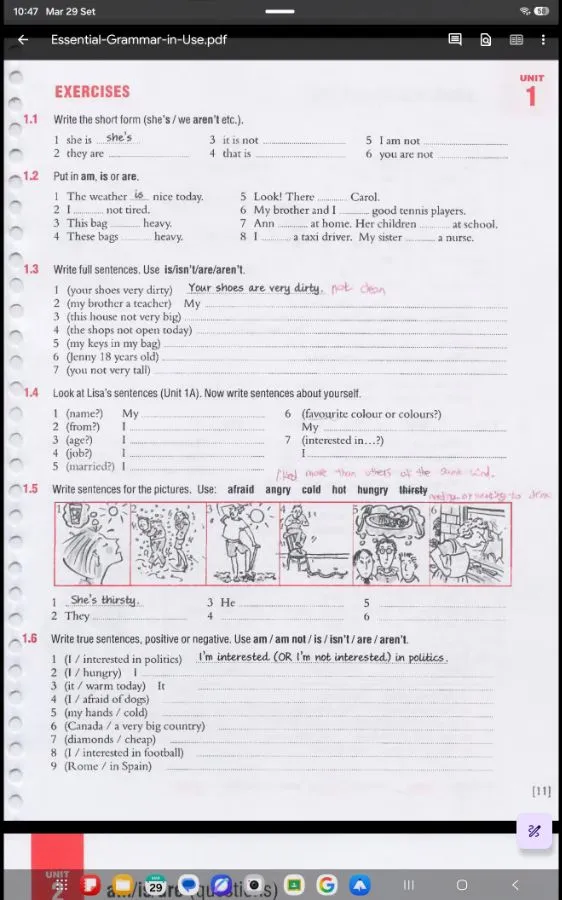
Certamente! Ecco la soluzione degli esercizi presenti nell'immagine, con spiegazioni dettagliate.
Esercizio 1.1: Scrivi la forma abbreviata (she's / we aren't etc.).
Questo esercizio riguarda la contrazione dei verbi essere (to be) e non essere (to be not) in inglese.
- she is → she's
- they are → they're
- it is not → it isn't
- that is → that's
- I am not → I'm not
- you are not → you aren't
Esercizio 1.2: Inserisci am, is o are.
Qui devi usare la forma corretta del verbo "to be" (am, is, are) a seconda del soggetto.
- am si usa solo con "I".
- is si usa con la terza persona singolare: he, she, it, o un nome singolare.
- are si usa con la seconda persona singolare e plurale: you, we, they, o nomi plurali.
- The weather is nice today.
- I am not tired.
- This bag is heavy.
- These bags are heavy.
- Look! There is Carol.
- My brother and I are good tennis players.
- Ann is at home. Her children are at school.
- I am a taxi driver. My sister is a nurse.
Esercizio 1.3: Scrivi frasi complete. Usa is/isn't/are/aren't.
Questo esercizio ti chiede di formare frasi complete usando le forme corrette di "to be" (is, isn't, are, aren't) in base al soggetto e se la frase deve essere affermativa o negativa.
- (your shoes very dirty) → Your shoes are very dirty. (Le tue scarpe sono molto sporche.)
- (my brother a teacher) → My brother is a teacher. (Mio fratello è un insegnante.)
- (this house not very big) → This house isn't very big. (Questa casa non è molto grande.)
- (the shops not open today) → The shops aren't open today. (I negozi non sono aperti oggi.)
- (my keys in my bag) → My keys are in my bag. (Le mie chiavi sono nella mia borsa.)
- (Jenny 18 years old) → Jenny is 18 years old. (Jenny ha 18 anni.)
- (you not very tall) → You aren't very tall. (Tu non sei molto alto.)
Esercizio 1.4: Guarda le frasi di Lisa (Unit 1A). Ora scrivi frasi su di te.
Questo esercizio è personale e richiede di rispondere alle domande usando le forme corrette di "to be" e le informazioni su di te. Ecco degli esempi di come potresti rispondere:
- (name?) My name is [Il tuo nome]. (Oppure: I'm [Il tuo nome].)
- (from?) I am from [Il tuo paese/città].
- (age?) I am [La tua età] years old.
- (job?) I am a student / I am [La tua professione].
- (married?) I am single / I am married.
- (favourite colour or colours?) My favourite colour is [Il tuo colore preferito]. (Oppure: My favourite colours are [I tuoi colori preferiti].)
- (interested in...?) I am interested in [I tuoi interessi].
Esercizio 1.5: Scrivi frasi per le immagini. Usa: afraid, angry, cold, hungry, thirsty.
Per questo esercizio, devi osservare le immagini e descrivere cosa sta succedendo o come si sentono le persone, usando gli aggettivi forniti.
- She's thirsty. (Lei ha sete.) - L'immagine mostra una persona che beve da una fontana.
- They are thirsty. (Loro hanno sete.) - L'immagine mostra un gruppo di persone che bevono.
- He is thirsty. (Lui ha sete.) - L'immagine mostra un uomo che beve da una bottiglia.
- He is hungry. (Lui ha fame.) - L'immagine mostra un uomo che guarda un piatto di cibo.
- They are hungry. (Loro hanno fame.) - L'immagine mostra delle persone che guardano del cibo con desiderio.
- He is angry. (Lui è arrabbiato.) - L'immagine mostra un uomo con un'espressione arrabbiata.
Esercizio 1.6: Scrivi frasi vere, positive o negative. Usa am/am not/is/isn't/are/aren't.
Simile all'esercizio 1.3, ma qui devi creare frasi vere basate sulle tue esperienze o conoscenze, usando le forme corrette del verbo "to be".
- (I / interested in politics) → I am interested in politics. (Oppure: I am not interested in politics.)
- (I / hungry) → I am hungry. (Oppure: I am not hungry.)
- (it / warm today) → It is warm today. (Oppure: It isn't warm today.)
- (I / afraid of dogs) → I am afraid of dogs. (Oppure: I am not afraid of dogs.)
- (my hands / cold) → My hands are cold. (Oppure: My hands aren't cold.)
- (Canada / a very big country) → Canada is a very big country.
- (diamonds / cheap) → Diamonds are cheap. (Oppure: Diamonds aren't cheap.)
- (I / interested in football) → I am interested in football. (Oppure: I am not interested in football.)
- (Rome / in Spain) → Rome is not in Spain. (Rome is in Italy.)
Spero che queste spiegazioni siano chiare e utili!
Present Simple
Homi