Комбинаторика: Нахождение количества различных сумм при выборе карт из двух наборов
 Homi
Task 1
The problem asks us to find the number of different possible sums when picking one card from each set.
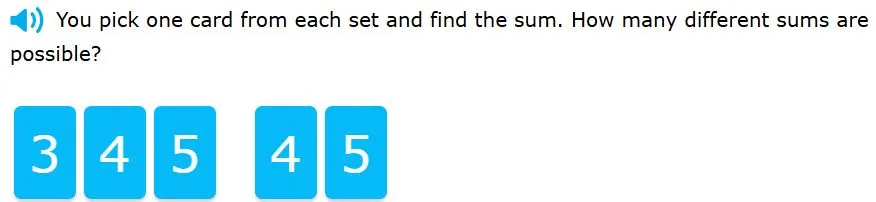
Set 1: Contains cards with numbers 3, 4, and 5.
Set 2: Contains cards with numbers 4 and 5.
To find all possible sums, we need to add each number from Set 1 to each number from Set 2.
-
Pick 3 from Set 1:
- 3 + 4 = 7
- 3 + 5 = 8
-
Pick 4 from Set 1:
- 4 + 4 = 8
- 4 + 5 = 9
-
Pick 5 from Set 1:
- 5 + 4 = 9
- 5 + 5 = 10
Now, let's list all the sums we found: 7, 8, 8, 9, 9, 10.
To find the number of different sums, we remove any duplicates: 7, 8, 9, 10.
There are 4 different possible sums.
Answer: There are 4 different sums possible.
Homi
Task 1
The problem asks us to determine the number of unique sums possible when selecting one card from each of two given sets.
Set 1: Contains cards with the numbers {3, 4, 5}.
Set 2: Contains cards with the numbers {4, 5}.
To find all possible sums, we systematically pair each number from Set 1 with each number from Set 2 and calculate their sum.
-
If we pick '3' from Set 1:
- Add '4' from Set 2: \(3 + 4 = 7\)
- Add '5' from Set 2: \(3 + 5 = 8\)
-
If we pick '4' from Set 1:
- Add '4' from Set 2: \(4 + 4 = 8\)
- Add '5' from Set 2: \(4 + 5 = 9\)
-
If we pick '5' from Set 1:
- Add '4' from Set 2: \(5 + 4 = 9\)
- Add '5' from Set 2: \(5 + 5 = 10\)
The sums obtained are: 7, 8, 8, 9, 9, 10.
To find the number of different sums, we list the unique values from this set: {7, 8, 9, 10}.
Counting these unique sums, we find there are 4 different possible sums.
Answer: There are 4 different possible sums.
Homi