What the Nine of Wands means in Tarot
The upright Nine of Wands is a person who has almost reached the end but cannot yet afford to relax. Behind them is a chain of blows and disappointments; ahead, perhaps, is one more push, but there is frankly little strength left for it. The card is not about the beginning of the journey or its end — it is about the penultimate step, the most thankless part of the distance.
An important nuance that is lost in retellings: The Nine of Wands is not about defeat or victory, but about wary readiness for another blow. The person has already been burned and is now holding the line almost on autopilot, even when there is no direct threat nearby. This is a healthy reaction earned by experience, but it is precisely what prevents one from noticing in time that the fight is actually over.
This is a minor, not a major arcana, and it is not about a life turning point, but about a specific, prolonged episode: a project on its last legs, an argument that has exhausted both sides, or recovery after a specific failure. The scale of the Tower is inappropriate here — the Nine of Wands is not about collapse, but about tired resilience before the finish of one specific story.
Reversed Nine of Wands: meaning
The reversed Nine of Wands most often means that the defensive stance that used to save you has started working against you. The question of the spread helps to choose the exact reading.
- Defense has turned into isolation. The person continues to keep their distance and suspect a catch where there has been no threat for a long time.
- Strength ran out before the finish line. Unlike the upright position, where there is still enough resilience, here a breakdown occurs — giving up a step away from the goal.
- Stubbornness instead of flexibility. Refusal to change tactics even slightly, even when the old one clearly isn't working.
Often, the reversed position points to the physical side of fatigue: not an abstract "worn out," but specific insomnia, stress-induced colds, or the aggravation of an old injury — the body is presenting the bill for a long defense.
Nine of Wands in a "yes or no" spread
In "yes/no" spreads, the upright Nine of Wands is usually read as a cautious yes — but with a condition: it will work out only if you hold on a little longer and don't give up on the penultimate step. The card does not promise ease; it promises that the resource for completion is still there.
If the question sounds like "should I continue to defend myself or fight" — the answer is also yes, provided that the person is soberly assessing the real threat and not fighting a ghost of a past blow.
The reversed position shifts the answer to no or "not in this form": either there is objectively no strength left, or the defense itself prevents you from getting what it was all for. In such a spread, it is worth asking separately not "will it work out," but "is it time to change tactics?"
Nine of Wands in relationships and feelings
In a relationship spread, the upright Nine of Wands usually speaks of a partner — or the querent themselves — who has already been burned in the past and now approaches intimacy with caution. This is not cooling off or loss of interest, but the defensive distance of someone who remembers how a similar story ended last time.
In the position of feelings, the card describes not a bright emotion, but a state of exhausted loyalty: continuing to invest even when there is no strength for a new conflict, simply because too much has already been invested to quit now. There is usually little ease here — rather, a stubborn attachment that is held together by character, not by enthusiasm.
Reversed Nine of Wands in relationships is no longer caution, but a wall: the partner stops letting you in, responds to care with suspicion, and meets any criticism as an attack. If this is about the querent, it is worth honestly asking yourself who the defense is actually coming from — the current partner or someone from the past.
Nine of Wands in work and money
In a career spread, the Nine of Wands is a project or position on the final push: the main work is done, but it is the last stretch that takes more effort than everything that came before. The card often appears to people who have already experienced a similar failure and are now over-insuring at every step, which slows down progress.
In money, the card speaks not of a lack of funds, but of financial caution after a recent blow: a rainy-day fund, an unwillingness to risk even a reasonable amount, and the habit of double-checking every payment. This is a justified reaction, but it also prevents you from taking advantage of a normal opportunity if one comes along.
The card's advice in a work context is simple: separate real risk from the memory of past risk. Not every new project is an old failure in a new wrapper, even though fatigue suggests exactly that.
Nine of Wands as a person: man and woman
When the card describes a person, it is about someone who has already gone through a trial and is now keeping their distance out of habit, not out of hostility. This is not a misanthrope or a saboteur — this is someone who once paid dearly for trust and no longer gives it away for free.
The Nine of Wands man in a spread is reserved, taciturn, and re-evaluating a person or situation before relaxing. The Nine of Wands woman is someone who continues to carry obligations despite fatigue and does not show what it costs her.
It is important not to confuse this caution with coldness. Give such a person time to make sure that there will be no blow — usually, after that, the distance shortens on its own.
Nine of Wands in the thoughts position
In the thoughts position, the Nine of Wands represents a constant internal check: will I be let down again, is it too early to relax, is a new problem hiding behind the calm? The mind is occupied not so much with the current task as with tracking threats, some of which are no longer relevant.
Such thinking is understandable and even useful in a moment of real danger, but it is costly if it drags on for months. Adjacent cards will tell you how justified the anxiety is: next to Swords cards, the mind is likely continuing to fight out of inertia; next to calm Cups cards, there is likely no real threat anymore.
What to do if the Nine of Wands appears
The card's advice is not to suddenly drop your defenses — you don't need to drop them suddenly. It's about stopping the waste of energy on a threat that no longer exists and saving it for the final real push.
What is worth doing in essence:
- Separate the past blow from the current situation. Ask yourself directly: what am I afraid of now — what is happening, or what has already happened once.
- Find the minimum necessary distance. Not "zero trust" and not "complete trust," but exactly as much caution as is justified by the facts.
- Acknowledge the fatigue out loud. At least to yourself — the Nine of Wands often appears to people who do not allow themselves to say "I am exhausted."
- Give yourself one step at a time. Do not overthink the entire distance to the end — one card will not withstand that, and the next one is not about the finish line.
If the fatigue and wariness are related to prolonged stress or anxiety that interferes with living a normal life, this is a reason for a conversation with a doctor or specialist, not just for a reading.
What is depicted on the card
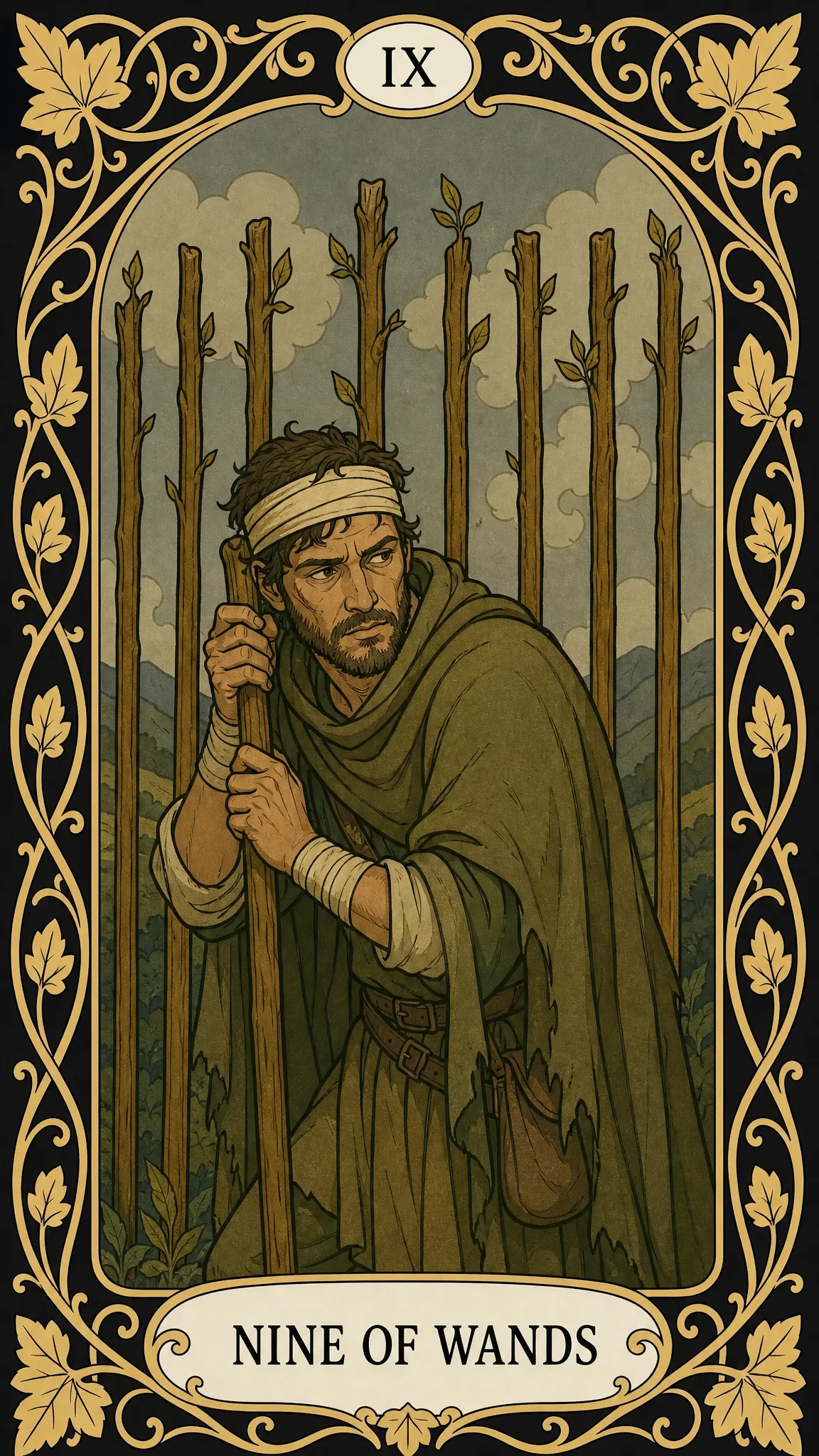
On our Nine of Wands, there is a man with a bandaged head and a bandaged wrist: he stands, leaning on a wooden pole, and looks warily somewhere to the side, as if waiting for the danger to return. Behind his back, in a dense row like a palisade, stand eight similar poles with sprouted leaves — counting the one he is leaning on, exactly nine.
The scene is read as follows:
- Bandaged head and hand — this is not a fresh wound, but a memory of a recent blow: the person has already suffered and now acts with an eye on this experience.
- Eight poles behind, placed in a dense row, — already built defense. The work is almost done, it remains to hold the defense a little longer, holding the ninth pole in his hands as a final reserve.
- Wary look to the side, not directly at the viewer, — the hero looks where he thinks the next threat will come from, rather than relaxed forward.
- Torn cloak and worn clothes — the path was long and not bloodless, but the hero is still standing on his feet, with a belt and a travel bag, meaning he is ready to go further.
- Mountains and cloudy sky in the background — the distance covered behind him is not small.
At the top of the card is the Roman numeral IX, at the bottom is the English name NINE OF WANDS: our deck is drawn in the Rider-Waite tradition, where this card is the ninth in the suit of Wands.
Nine of Wands as the card of the day
The Nine of Wands as the card of the day usually says: today is not yet the time for complete relaxation, but also not the time for a new big push. A reasonable strategy is to finish what is almost done and not get involved in new conflicts out of inertia, expecting a trick where there is none.
It is useful to check yourself at least once a day: am I reacting to what is happening right now, or to the memory of what happened before. If the answer is the latter, this is a hint to lower your defensive stance a little and look at the situation anew.
Frequently asked questions about the Nine of Wands card
Is the Nine of Wands a Major or Minor Arcana?
Minor Arcana, suit of Wands, element of Fire. There are 56 Minor Arcana in the Tarot deck in total — 14 in each of the four suits, and the Nine of Wands is one of them.
How is the Nine of Wands different from the Nine of Swords?
Both cards are about exhaustion, but in different ways. The Nine of Swords is anxiety and insomnia in the head, often without a real reason nearby. The Nine of Wands is fatigue from a very real, already experienced struggle: the person is not inventing a threat, they remember a real blow and are defending against a repetition.
Is the Nine of Wands a yes or no?
More of a cautious yes, if you have enough strength for the final push. In a reading about continuing defense or struggle, the answer is also positive — provided that the threat is real and does not come from the memory of the past.
What does the inverted Nine of Wands mean?
The same fatigue, but at the limit: either defense turns into isolation and suspicion where there is no longer a threat, or strength runs out, and the person gives up just before the finish line.
Nine of Wands in relationships — what does it mean?
The partner or the querent themselves has already been burned in the past and is now keeping distance out of caution, not because of cooling feelings. It is worth distinguishing careful wariness from a real wall — in the latter case, the card more often appears in an inverted position.