타로에서 파이브 오브 완즈는 무엇을 의미하는가
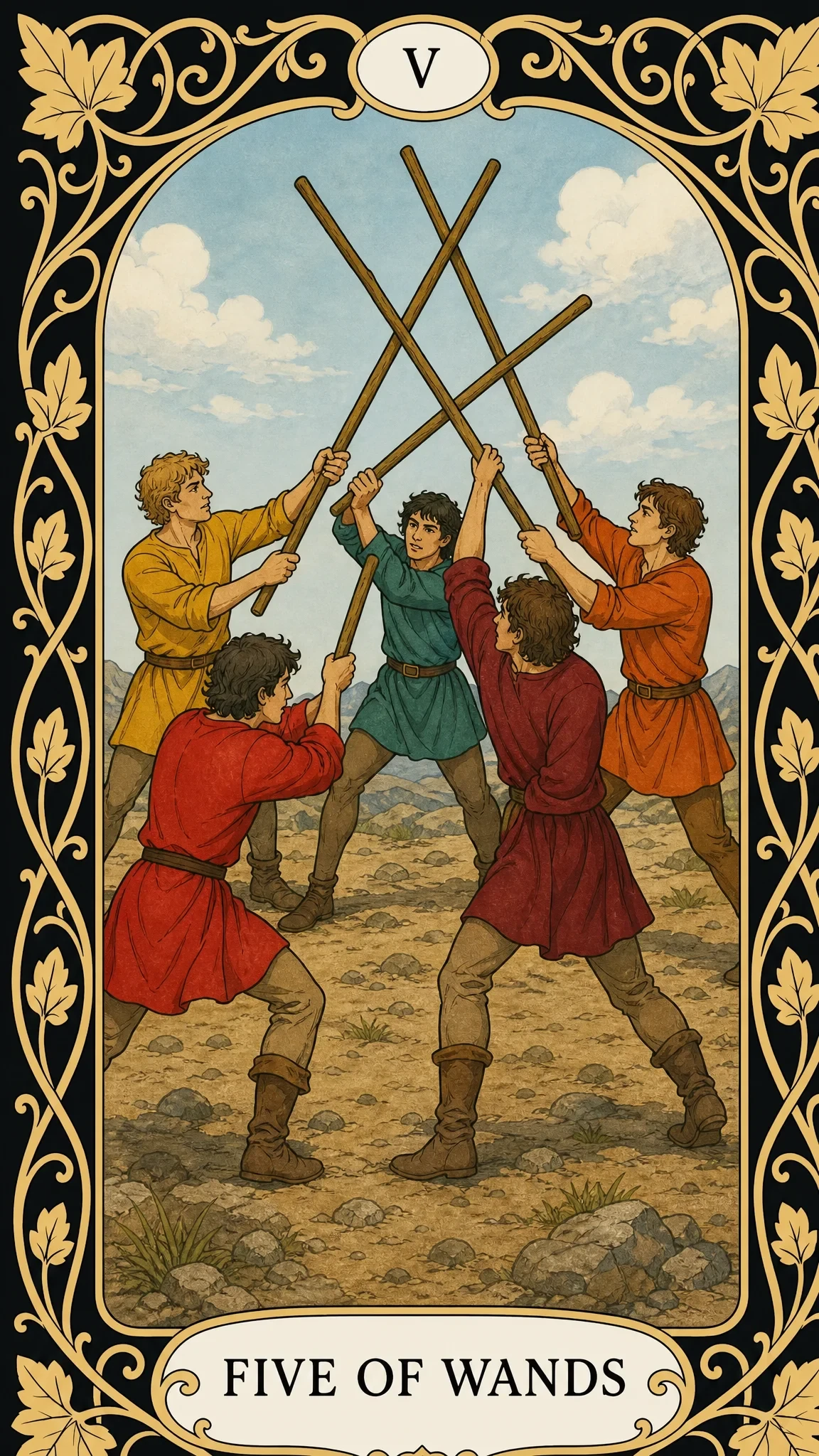
파이브 오브 완즈는 시끄럽지만 치명적이지 않은 충돌을 나타내는 카드입니다. 다섯 명의 사람이 막대기를 교차시키며 각자 자신의 방향으로 끌어당기고 있으며, 어느 쪽도 명확한 우위를 점하지 못하고 있습니다. 이것이 바로 이 카드의 본질입니다. 이것은 전멸을 위한 전쟁이 아니라, 장소, 순서, 누구의 목소리가 먼저 들릴지에 대한 싸움입니다.
이 카드를 메이저 아르카나와 즉시 구분하는 것이 중요합니다. 타워나 악마는 앞으로 몇 년 동안 지속될 큰 주제를 묘사합니다. 파이브 오브 완즈는 규모가 훨씬 작습니다. 이것은 회의에서의 구체적인 논쟁, 채팅에서의 말다툼, 그룹에서의 관심을 끌기 위한 경쟁이지, 운명적인 전환점이 아닙니다. 이것을 '인생에 혼란이 시작될 것'으로 읽는 것은 카드를 과대평가하는 것입니다. 마이너 아르카나는 운명이 아닌 에피소드를 나타냅니다.
불의 원소와 완즈 마이너 카드는 분위기를 설정합니다. 에너지가 많고 밖으로 터져 나오지만 잘못된 방향으로 향합니다. 모두가 서로를 밀고 있으며, 누구도 사전에 규칙에 동의하지 않았습니다. 여기서 고전적인 의미가 나옵니다. 경쟁, 마찰, 사소한 갈등, 분산된 노력입니다. 종종 이 카드는 여러 사람이 각자 옳고 누구도 먼저 양보할 준비가 되지 않은 곳에서 나타납니다.
역방향 파이브 오브 완즈: 의미
역방향 파이브 오브 완즈는 같은 혼잡함이지만, 억눌린 상태입니다. 세 가지 일반적인 해석이 있으며, 스프레드의 질문에 따라 선택됩니다.
- 누군가가 다른 사람을 설득해서가 아니라 모두가 지쳐서 논쟁이 끝났습니다. 실제 동의 없이 형식적인 휴전입니다.
- 갈등이 내면화되었습니다. 겉으로는 조용하지만 짜증과 경쟁은 사라지지 않았습니다. 단지 더 이상 보여주지 않을 뿐입니다.
- 싸움이 공정하지 않습니다. 한 목소리가 다른 목소리를 잠재우고, 정방향의 '동등한 싸움'이라는 환상은 사라집니다. 누군가 혼자 자신의 것을 밀어붙입니다.
역방향은 정방향 카드가 묘사하는 공개적인 충돌이 일어나지 않았거나 의도적으로 피하고 있음을 나타냅니다. 때로는 이것이 더 나은 경우도 있고, 때로는 단지 나중에 연기된 같은 대화일 뿐입니다.
예/아니오 스프레드에서 파이브 오브 완즈
예/아니오 스프레드에서 파이브 오브 완즈는 일반적으로 네, 하지만 싸움 없이 되는 것은 아닙니다. 라는 의미로 해석됩니다. '성공할 수 있을까?'와 같은 질문에 긍정적으로 답하지만, 결과를 즉시 저항 없이 얻는 것이 아니라 스스로 방어해야 합니다.
만약 질문이 평온함에 관한 것이라면 - '싸움 없이 끝날까?', '반대 없이 동의할까?' - 이 카드는 오히려 아니요라고 답합니다. 마찰이 있을 것이고, 누군가는 반드시 반대 의견을 표명할 것입니다.
역방향은 '갈등이 임박하지 않았다' 또는 '당사자들이 이미 논쟁에 지쳤다'는 의미로 답을 완화합니다. 실질적인 의미는 정방향이 약속하는 공개적인 충돌이 가까운 미래에 예상되지 않는다는 것입니다.
관계 및 감정에서 파이브 오브 완즈
관계에서 정방향 파이브 오브 완즈는 끊임없이 약간 경쟁하는 파트너를 나타냅니다. 누가 더 많이 투자했는지, 가정 문제에서 누가 옳은지, 의사 결정 시 누구의 의견이 더 중요한지 등입니다. 이것 자체로 커플에게는 끝이 아닙니다. 많은 커플이 이런 식으로 수년 동안 살고 있으며, 마찰은 흥미를 유지하기도 합니다.
종종 이 카드는 한 사람에게 여러 당사자가 동시에 관심을 보이는 곳에서 나타납니다. 직접적인 경쟁자이거나, 가족, 직장, 오래된 관계 등 여러 방향으로 끌어당기는 경쟁적인 의무일 수 있습니다. 이 카드는 정방향이나 역방향 모두에서 평온하고 차분한 감정을 묘사하지 않습니다.
감정의 위치에서는 부드러움보다는 열정입니다. 자신의 입장을 증명하고 싶고, 들리고 싶고, 실제로는 그만한 열기를 가질 가치가 없는 논쟁에서 양보하고 싶지 않은 욕구입니다.
관계에서 역방향 파이브 오브 완즈는 내면화되어 말하지 않은 논쟁이거나, 또는 반대로 원래 원인을 해결하지 못한 싸움 후의 짧은 휴전입니다.
직업 및 금전에서 파이브 오브 완즈
직업 스프레드에서 이것은 공개적인 경쟁입니다. 여러 사람이 하나의 프로젝트를 놓고 경쟁하고, 예산은 싸움으로 나뉘며, 회의는 토론 대신 고함으로 변합니다. 종종 역할이 명확하게 분배되지 않아 각자가 악의 없이 자신의 몫을 챙기려는 팀입니다. 그렇지 않으면 아무도 자신의 기여를 듣지 못할 것입니다.
금전에서 이 카드는 금액에 대한 논쟁입니다. 누가 얼마를 빚졌는지, 누가 무엇에 대해 지불하는지, 재산이나 지출을 나눌 때의 협상입니다. 이 카드는 직접적인 손실을 약속하지 않습니다. 그것은 현재 가지고 있는 것을 어떻게 나눌지에 대한 싸움을 약속합니다.
파이브 오브 완즈가 본질적으로 조언하는 것은 다음과 같습니다. 더 논쟁하기 전에, 논쟁의 규칙에 동의하십시오. 누가 먼저 말할지, 무엇을 얼마나 나눌지 등입니다. 카드에 있는 혼란은 자원의 부족이 아니라 규정의 부족입니다.
사람으로서의 파이브 오브 완즈: 남성과 여성
파이브 오브 완즈가 사람을 묘사할 때 나타나면, 그것은 어떤 이유로든 논쟁하는 사람입니다. 반드시 악의 때문이 아니라, 자신의 입장을 공개적으로 주장하는 것이 중요하기 때문입니다. 그런 사람 곁에서는 조용한 날이 거의 없습니다. 그는 다른 사람의 주장을 시험하고 같은 것을 되돌려 받기를 기대합니다.
파이브 오브 완즈 남성은 열정적인 논쟁가이며, 경쟁적인 상황을 좋아하고, 쉽게 말다툼에 휘말리지만 상처 없이 쉽게 빠져나옵니다. 파이브 오브 완즈 여성은 불편하거나 지위에 불리하더라도 침묵하지 않고 물러서지 않는 사람입니다.
이것은 갈등적이거나 사악한 사람에 대한 묘사가 아닙니다. 오히려 일반적인 소음 속에서 자신의 목소리를 듣는 것이 중요하며, 이를 위해 싸울 준비가 된 사람입니다.
Five of Wands in the position of thoughts
In the position of thoughts, the Five of Wands represents a mind where several inner voices argue simultaneously: one insists on its own way, another objects, a third doubts everything at once. It's difficult to concentrate precisely because thoughts compete with each other rather than lining up in order.
This is often the state before an important conversation or decision: a person mentally rehearses arguments for all sides at once, preparing for disputes that haven't happened yet. Neighboring cards will indicate whether this internal struggle is productive or just an exhausting waste of energy.
What to do if the Five of Wands appears
The card's advice is simple, though not the most pleasant: don't disengage from the argument, but don't turn it into a war of annihilation. The Five of Wands is about energy scattered on trifles, and the first task is to gather it back.
What is worth doing in essence:
- Name what the argument is really about. Often, a more serious unresolved issue lies behind a squabble over a trifle.
- Agree on the rules, not just the content. Who speaks, in what order, by what deadline is the result needed.
- Don't confuse competition with personal offense. The excitement of an argument doesn't mean the opponent is an enemy.
- Leave room for a draw. Not every clash must have a clear winner.
If the card represents not a domestic squabble but a prolonged, exhausting conflict, the spread describes the dynamics but doesn't resolve them; in such cases, direct conversation or a mediator helps, not another card in the deck.
What is depicted on the card
On our Five of Wands, there are five young men in a rocky wasteland, each holding their own single staff: no one grips two at once, nor shares a staff with a neighbor. All five stand at full height in a loose circle, simultaneously raising their staffs above their heads, so that the staffs converge in the sky in a sweeping cross. Their poses clearly indicate a brawl, not a one-on-one duel: someone is pulling a staff, someone is pushing it away, and the young man in the turquoise tunic in the center holds his with both hands, squeezed by the others' staffs from both sides.
The scene is interpreted as follows:
- Five tunics — five equal positions. Golden-yellow, red, turquoise-green, dark red, and orange. The colors are deliberately mismatched. This is a dispute between equals, not a hierarchy where one is clearly superior.
- Each has exactly one staff. No staff needs to be shared, and no staff is left over: neither on the ground nor in a free hand are there extra staffs — the balance of power in the skirmish is fair, without bias towards anyone.
- The staffs are crossed high above the heads — no blow has been fully delivered, no one is wounded or defeated: it looks more like an excited scuffle than a real fight.
- Rocky, dry ground and bare hills in the background — the setting is resource-poor, and the clash is partly about who gets the little that exists.
- A bright sky with clouds — unlike cards of real disaster, the background here is calm: the storm is only among the people, not around them.
At the top of the card is the Roman numeral V, and at the bottom is the English name FIVE OF WANDS: our deck is drawn in the Rider-Waite tradition, where this card is the fifth in the suit of Wands.
Five of Wands as the card of the day
The Five of Wands as the card of the day signifies a day with increased background friction: someone will definitely argue on a call, in a chat, in line, or at home over a trifle. This in itself is not a bad sign — rather, it's a signal to prepare for having to defend your point of view more often than usual.
A useful mindset for such a day: do not perceive every objection as an attack and do not get involved in other people's arguments that do not directly concern you. The excitement of this day quickly burns out on its own if you don't add fuel to the fire.
Frequently asked questions about the Five of Wands card
Is it a Major or Minor Arcana?
The Five of Wands is a Minor Arcana, suit of Wands, element of Fire. There are 56 Minor Arcana in a Tarot deck — 14 in each of the four suits, and the Five of Wands is one of them.
How does the Five of Wands differ from the Five of Swords?
Both cards are about conflict, but in different ways. The Five of Swords is about a dispute with a clear loser and a lingering feeling after a victory at any cost. The Five of Wands is gentler: it's a noisy competition without a single winner and without real animosity — the parties let off steam, rather than destroying each other.
Does the Five of Wands mean a fight?
Not literally. The card describes the energy of rivalry and friction — arguments, competition, a struggle for attention, not physical violence. The five characters on the card are waving staffs, but none of them are injured: the meaning is in the scuffle itself, not its outcome.
What does the reversed Five of Wands mean?
Usually one of three options: the conflict is resolved out of exhaustion, not by agreement of the parties; the dispute has gone internal and is not verbalized; or, conversely, one person is pushing their agenda, and the appearance of fair competition from the upright position is lost.
Is the Five of Wands a bad card?
No, rather neutral. It describes an energy-consuming but not destructive period: competition, arguments, scattered efforts. The card does not bring real disaster or loss — what a person does with this friction is more important than the fact of its existence.