タロットにおけるソードの6の意味
タロットにおける6は、前のカードである5の困難な一撃の後、均衡が取れる時点を示します。ソードのスートでは、この均衡は非常に文字通りになります。哲学的な悟りではなく、困難な場所から呼吸しやすい場所への物理的な移動です。ソードの6は、街の移動、口論の後の休憩、長らく悪かった場所からついに離れる決断など、「離れる道」を示します。
重要なニュアンスは、伝えられる際に失われがちな点です。このカードは問題が解決したことを約束するのではなく、問題から距離ができたことを示しています。 ボートの中の剣はどこにも行かず、一緒に運ばれています。前の状況からの対立、不安な考え、未解決の言葉はまだその人にありますが、それらと現在の時間との間に水があるだけです。これは降伏でも悪い意味での逃避でもありません。時には、困難なことに対処する唯一の方法は、まずそれから一歩引くことです。
小アルカナは運命ではなくエピソードを描写します。「人生はうまくいく」ではなく、具体的な引っ越し、会話、旅行、または仕事をやめる決断であり、その後に今後数週間で楽になるでしょう。新しい平穏がどれほど続くかは、スプレッドの他のカードが示しますが、ここでは結果ではなく、動きそのものの事実が重要です。
逆位置のソードの6:意味
逆位置のソードの6は、同じ移行ですが、停滞しています。通常、スプレッドは3つの選択肢のいずれかを意味し、質問自体が選択を助けます。
- 去りたいのに、留まることしかできない。 状況、お金、義務、または恐怖が、去るべき場所から人を引き止めています。
- 出発はしたが、問題は解決していない。 仕事、街、またはパートナーを変えたが、問題に対処せずに装飾だけを変えたため、まったく同じ対立を内面に抱えています。
- かつて離れたものへの回帰。 かつては離れたと思っていた状況が再び引きずり込んできます。これは、移行が準備ができる前に始まったためであることがよくあります。
より穏やかな解釈もあります。時には、逆位置のソードの6は、動くことを拒否するのではなく、急いで出発するには時期尚早な、正直な一時停止を示します。
「イエスかノーか」スプレッドにおけるソードの6
「イエスかノーか」スプレッドにおいて、ソードの6は「はい、ただしすぐではありません」と解釈されます。変化は可能であり、おそらく起こるでしょうが、楽になるのが実感できる前に、時間、労力、そしておそらく一時的な不快感が必要になります。
引っ越し、環境の変化、または困難な時期からの脱却についての質問であれば、答えは肯定的です。問題が最終的に解決するかどうかの質問に対しては、このカードは答えません。それは困難からの距離についてのものであり、その消滅についてではありません。
このスプレッドでの逆位置は、「いいえ、まだ状況が整っていません」に近い解釈になります。尋ねられている移行は延期されます。状況が整っていないためか、あるいは人が認めている以上に古いものにしがみついているためかのどちらかです。
人間関係と感情におけるソードの6
人間関係のスプレッドにおいて、正位置のソードの6は、しばしば二人で困難な時期を乗り越えることを意味します。カップルは対立や危機を経験し、徐々に、一歩ずつ、より穏やかな段階へと進んでいきます。時には文字通り環境を変えることで、新たに始めるのが容易になります。
感情の位置では、このカードは燃えるような情熱ではなく、静かで少し悲しい安定を示します。人はまだ痛みを完全に手放していませんが、後ろ向きではなく前向きに見ることができるようになっています。これは、激しい別れではなく、両者が徐々に落ち着いていく別れを描写するのに適したカードです。急激な別れは、むしろソードの10に近いです。
人間関係における逆位置のソードの6は、もはや機能していないものを維持しようとする試み、または、古い不満を抱えたまま移動したため、何の救済ももたらさなかった別れを意味します。
仕事とお金におけるソードの6
キャリアのスプレッドにおいて、ソードの6はしばしば、より穏やかな条件のために、引っ越し、仕事や部署の変更を示唆します。有害な職場環境からの離脱、移転、ストレスの少ないプロジェクトへの移行などです。この決断は衝動的ではなく、蓄積された疲労の後の論理的な次のステップとして行われます。
お金に関しては、正位置は困難な財政的期間後の徐々に回復を示します。借金はゆっくりと返済され、収入は急激ではなく、少しずつ安定していきます。これは突然の幸運ではなく、正しい方向への動きを示すカードです。
仕事における逆位置のソードの6は、とっくに離れるべき場所に留まっていること、または、新しい役職に同じ問題を抱えて移動したため、改善をもたらさなかった移行を示します。
人物としてのソードの6:男性と女性
人物の位置にソードの6が出た場合、それは性格全体を描写するのではなく、困難な時期を乗り越えるための案内人の役割を描写します。自分自身も同じくらい疲れているにもかかわらず、状況をより穏やかな流れへと導き、周りの人々を落ち着かせようと努める人です。
ソードの6の男性は、控えめで、あまり話さず、他の人がまだショックから回復していない間に状況を主導します。ソードの6の女性は、経験した重荷を静かに背負い、どれほどの犠牲を払っているかを見せずに、周りの人々を守ります。
どちらにも共通するのは、表に出さない疲労です。そのような人々のそばでは、ドラマはありませんが、軽快さもまだあまりありません。
Six of Swords in the thoughts position
In the thoughts position, the Six of Swords signifies the gradual calming of an inner storm: anxious thoughts are still present, but they no longer overwhelm as they did before. The person begins to mentally distance themselves from the conflict or upheaval, assessing what happened more calmly.
This is a state of 'not yet let go, but already feeling lighter.' If other Swords appear nearby in the reading, anxiety may return stronger; near Cups or Pentacles, the transition to calmness is likely to solidify.
What to do if the Six of Swords appears
The card's advice is simple: move forward, even if the burden hasn't been fully processed. The Six of Swords doesn't demand immediate resolution of everything—it allows you to first step back to a safe distance and then, from a calmer place, reflect on what you've experienced.
What to do practically:
- Take a step aside, even a small one. A change of scenery, a pause in communication, a break from the usual routine—it doesn't have to be a drastic decision.
- Don't expect instant relief. The transition with this card is gradual: you'll feel better not on the first day, but after some time.
- Don't confuse leaving with solving the problem. If the conflict or anxiety has moved with you, it's worth addressing them separately once your head is clearer.
- Acknowledge fatigue, don't hide it. The burden of the Six of Swords is real, and pretending it doesn't exist is not the same as truly dealing with it.
If the reason for the reading is a heavy loss, a prolonged crisis, or a situation that's difficult to navigate alone, the card doesn't replace talking to a specialist: it describes the movement towards calmness, not the path to achieving it.
What is depicted on the card
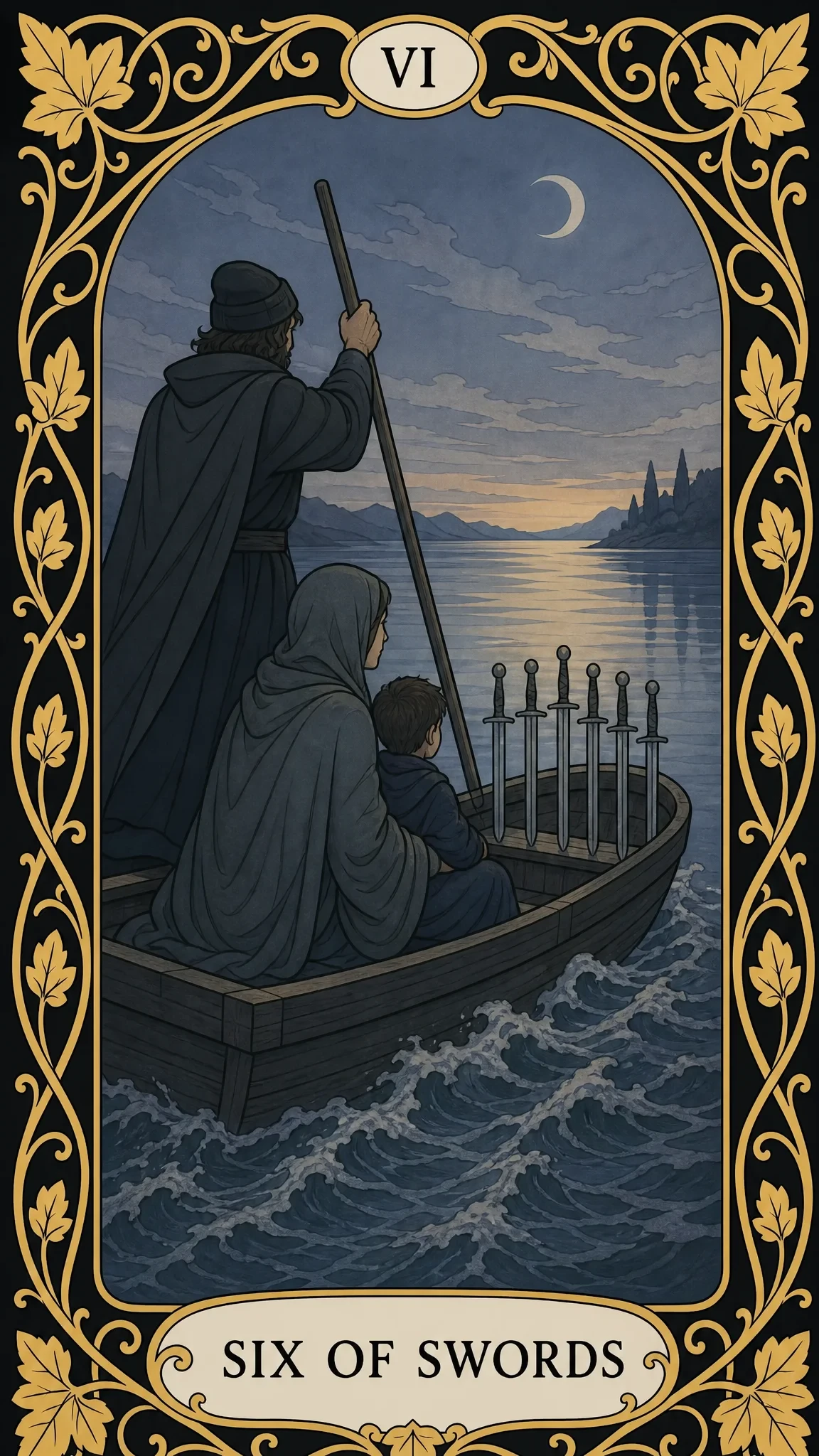
On our card, there's a wooden boat on the water at dusk: a man in a dark cloak stands at the stern, pushing the boat with a long pole. In front of him, with their backs to the viewer, sit a woman shrouded in a hood and a child nestled against her. Six swords are stuck into the side of the boat between the passengers and the bow, handles up—they are traveling with the people, not left behind.
The scene can be interpreted as follows:
- Turbulent water behind and smooth water ahead—the most direct image of the card: a turbulent, stormy stretch of the journey is left behind, and ahead lies a calm surface reflecting the evening light.
- Six swords in the boat—a burden not thrown overboard: experiences, anxieties, unresolved issues travel with the passengers, not disappearing with departure.
- The shrouded figures of the woman and child—the part of the person that is tired and needs protection; they are not rowing themselves but are guided by someone who can still hold the direction.
- A crescent moon and twilight sky—the transition occurs at dusk, under the light of a thin moon: a time when the journey has begun, but the destination is not yet reached.
- A dark shore in the distance with silhouettes of mountains and pointed trees—the destination is not yet discernible in detail, but it is visible and closer than the place from which the boat departed.
At the top of the card is the Roman numeral VI, and at the bottom is a plaque with the English title SIX OF SWORDS. The entire composition is framed by a golden pattern of grapevines on a black background.
Six of Swords as the card of the day
The Six of Swords as the card of the day is a good reason to step away from what has been exhausting: change your surroundings for at least an hour, postpone a difficult conversation until a calmer moment, physically leave the place where tension has accumulated. The day is not about solving the problem entirely, but about moving away from it to a safe distance.
If the card appears reversed, the day is more about being stuck: you want to move forward, but you keep returning to the same point. A helpful mindset is not to demand a sudden leap from yourself, but to take one small step towards calmness.
Frequently asked questions about the Six of Swords card
Is it a Major or Minor Arcana?
Minor Arcana, suit of Swords, element of Air. There are 56 Minor Arcana cards in a Tarot deck—14 cards for each of the four suits, and the Six of Swords is the sixth in this row.
How does the Six of Swords differ from the Six of Pentacles?
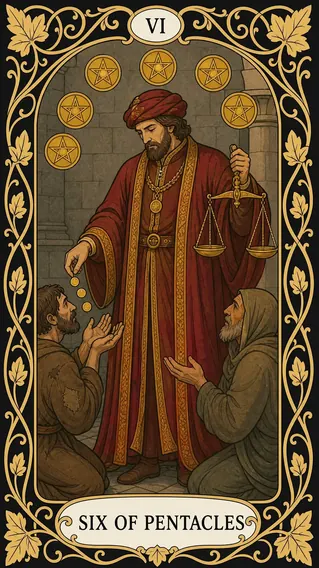
Both cards are about alignment after difficulties, but of different natures. Swords are the element of air, thoughts and words: the Six of Swords is about transitioning from a storm to calmness through departure, distance, and a change of scenery. Pentacles are the element of earth, the material: the Six of Pentacles is about balance in finances, help, and resource exchange. If the reading concerns moving or exiting a difficult period—it's about Swords; if it's about distributing money or support—it's about Pentacles.
Is the Six of Swords a yes or no?
More likely yes, but not immediately: a change for the better is possible, but it will require time and likely some intermediate discomfort. If the question is about the fact of the transition itself—the answer is affirmative. If it's about whether the problem will be fully resolved, the card doesn't answer that.
What does the reversed Six of Swords mean?
Being stuck in a place you should have left, or a departure that brought no relief because the old problem moved with the person. Sometimes it's just a pause before a transition for which conditions are not yet favorable.
Can the Six of Swords signify moving or parting?
Yes, this is one of its most frequent interpretations: changing cities, jobs, or relationships for a calmer life. However, the card doesn't specify details or promise a particular outcome—it only indicates the direction of movement, from difficulty towards calmness.