Apa Arti Lima Tongkat dalam Tarot
Lima Tongkat adalah kartu bentrokan yang riuh tetapi tidak mematikan. Lima orang menyilangkan tongkat, masing-masing menarik ke arah mereka sendiri, tidak ada yang memiliki keunggulan yang jelas — dan inilah inti dari kartu ini: ini bukan perang pemusnahan, tetapi perebutan tempat, giliran, untuk mendengar versi siapa terlebih dahulu.
Penting untuk memisahkan kartu ini dari Arcana Mayor segera. Menara atau Iblis menggambarkan tema besar untuk tahun-tahun mendatang; Lima Tongkat jauh lebih sederhana skalanya. Ini adalah perselisihan konkret dalam panggilan konferensi, pertengkaran dalam obrolan, persaingan untuk mendapatkan perhatian dalam kelompok, bukan titik balik yang menentukan nasib. Membacanya sebagai 'kekacauan akan dimulai dalam hidup' berarti melebih-lebihkan kartu: arcana minor adalah tentang episode, bukan takdir.
Elemen Api dan suit Tongkat menentukan nada: ada banyak energi, ia ingin keluar, tetapi diarahkan secara keliru — semua orang saling mendorong, tidak ada yang menyepakati aturan terlebih dahulu. Dari sini makna klasiknya: persaingan, gesekan, konflik kecil, upaya yang tersebar. Seringkali kartu muncul di mana beberapa orang benar dengan cara mereka sendiri pada saat yang sama dan tidak ada yang mau mengalah terlebih dahulu.
Lima Tongkat Terbalik: Makna
Lima Tongkat terbalik adalah dorongan yang sama, hanya saja ditekan. Tiga interpretasi umum, di mana pilihan dibuat berdasarkan pertanyaan pembacaan:
- Perselisihan telah berakhir — tetapi bukan karena seseorang meyakinkan orang lain, melainkan karena semua orang lelah. Gencatan senjata formal tanpa persetujuan nyata.
- Konflik telah bergeser ke dalam. Di luar tenang, tetapi kekesalan dan persaingan tidak hilang — mereka hanya tidak lagi ditampilkan.
- Perjuangan itu tidak adil. Satu suara membungkam yang lain, dan ilusi perjuangan 'setara' dari posisi tegak menghilang — seseorang memaksakan kehendaknya.
Posisi terbalik adalah sinyal bahwa bentrokan terbuka, yang dijelaskan oleh kartu tegak, tidak terjadi atau sengaja dihindari. Terkadang ini lebih baik, terkadang — hanya percakapan yang sama, ditunda untuk nanti.
Lima Tongkat dalam Pembacaan 'Ya atau Tidak'
Dalam pembacaan 'ya atau tidak', Lima Tongkat biasanya diartikan sebagai ya, tetapi tidak tanpa perjuangan. Pertanyaan seperti 'apakah itu akan berhasil' dijawab dengan afirmatif — hanya saja hasilnya harus diperjuangkan, bukan diterima segera dan tanpa perlawanan.
Jika pertanyaannya tentang ketenangan — 'apakah akan tanpa perselisihan', 'apakah mereka akan setuju tanpa keberatan' — kartu lebih cenderung menjawab tidak: akan ada gesekan, seseorang pasti akan menyuarakan ketidaksetujuan.
Versi terbalik melembutkan jawaban menjadi 'konflik belum matang' atau 'pihak-pihak sudah lelah berdebat': arti praktisnya adalah bahwa perjuangan terbuka, yang dijanjikan oleh posisi tegak, tidak mungkin terjadi dalam waktu dekat.
Lima Tongkat dalam Hubungan dan Perasaan
Dalam hubungan, Lima Tongkat tegak berarti pasangan yang terus-menerus sedikit bersaing: siapa yang berkontribusi lebih banyak, siapa yang benar dalam perselisihan rumah tangga, pendapat siapa yang lebih berat dalam pengambilan keputusan. Ini sendiri bukanlah hukuman bagi pasangan — banyak pasangan hidup seperti ini selama bertahun-tahun, dan gesekan bahkan menjaga minat tetap hidup.
Seringkali kartu muncul di mana satu orang diklaim oleh beberapa pihak sekaligus: saingan langsung untuk mendapatkan perhatian atau sekadar kewajiban yang bersaing — keluarga, pekerjaan, hubungan lama, — yang menarik ke arah yang berbeda. Kartu ini tidak menggambarkan perasaan yang stabil dan tenang, baik dalam posisi tegak maupun terbalik.
Dalam posisi perasaan, ini lebih tentang semangat daripada kelembutan: keinginan untuk membuktikan, untuk didengar, untuk tidak menyerah dalam perselisihan yang sebenarnya tidak sepadan dengan intensitasnya.
Lima Tongkat terbalik dalam hubungan adalah perselisihan yang ditekan ke dalam dan tidak diungkapkan, atau sebaliknya, gencatan senjata singkat setelah pertengkaran yang tidak menyelesaikan akar masalah.
Lima Tongkat dalam Pekerjaan dan Uang
Dalam pembacaan pekerjaan, ini adalah persaingan terbuka: beberapa orang mengklaim satu proyek, anggaran dibagi dengan sengit, rapat berubah menjadi teriakan alih-alih diskusi. Seringkali ini adalah tim di mana peran tidak terdistribusi dengan jelas, dan setiap orang menarik selimut untuk diri mereka sendiri bukan karena niat buruk, tetapi karena sebaliknya tidak ada yang akan mendengar kontribusi mereka.
Dalam hal uang, kartu ini adalah tentang perselisihan mengenai jumlah: siapa berutang berapa, siapa membayar apa, tawar-menawar saat membagi properti atau pengeluaran. Kartu ini tidak menjanjikan kerugian langsung — ia menjanjikan perjuangan tentang bagaimana apa yang ada akan didistribusikan.
Apa yang disarankan Lima Tongkat pada intinya: sebelum melanjutkan perselisihan, sepakati aturan perselisihan — siapa yang berbicara terlebih dahulu, apa yang dibagi dan menjadi berapa bagian. Kekacauan pada kartu bukanlah kurangnya sumber daya, tetapi kurangnya peraturan.
Lima Tongkat sebagai Orang: Pria dan Wanita
Ketika Lima Tongkat muncul sebagai deskripsi seseorang, itu adalah orang yang berdebat tentang segala hal — tidak harus karena jahat, tetapi karena penting baginya untuk mempertahankan posisinya secara lisan. Jarang ada ketenangan di dekat orang seperti itu: dia menguji argumen orang lain untuk kekuatan dan mengharapkan hal yang sama sebagai balasannya.
Pria Lima Tongkat — seorang pendebat yang bersemangat, menyukai situasi kompetitif, mudah terlibat dalam pertengkaran dan sama mudahnya keluar darinya tanpa dendam. Wanita Lima Tongkat — seseorang yang tidak akan mundur atau diam, bahkan jika perselisihan itu tidak nyaman atau tidak menguntungkan secara status.
Ini bukan deskripsi orang yang konfrontatif atau jahat — lebih seperti seseorang yang penting baginya untuk didengar di tengah keramaian, dan dia siap untuk memperjuangkannya.
Five of Wands in the position of thoughts
In the position of thoughts, the Five of Wands is the mind where several inner voices argue simultaneously: one insists on its own version, another objects, a third doubts everything at once. It is difficult to concentrate precisely because thoughts compete with each other, rather than lining up in order.
This is often a state before an important conversation or decision: a person mentally rehearses arguments that have not yet occurred, preparing arguments for all sides at once. Neighboring cards will suggest whether this internal struggle is productive or just exhausting in vain.
What to do if the Five of Wands appears
The card's advice is simple, though not the most pleasant: don't disengage from the argument, but don't turn it into a war of annihilation. The Five of Wands is about energy that has been scattered on trifles, and the first task is to gather it back.
What is worth doing in essence:
- Name what the argument is actually about. Often, behind a squabble over a trifle lies one unresolved, more serious issue.
- Agree on the rules, not just the content. Who speaks, in what order, by what deadline is the result needed.
- Don't confuse competition with personal offense. The excitement of an argument does not mean that the opponent is an enemy.
- Leave room for a draw. Not every clash must have a clear winner.
If the card represents not a domestic squabble, but a prolonged exhausting conflict, the spread describes the dynamics but does not resolve it; in such cases, direct conversation or a mediator helps, not another card in the deck.
What is depicted on the card
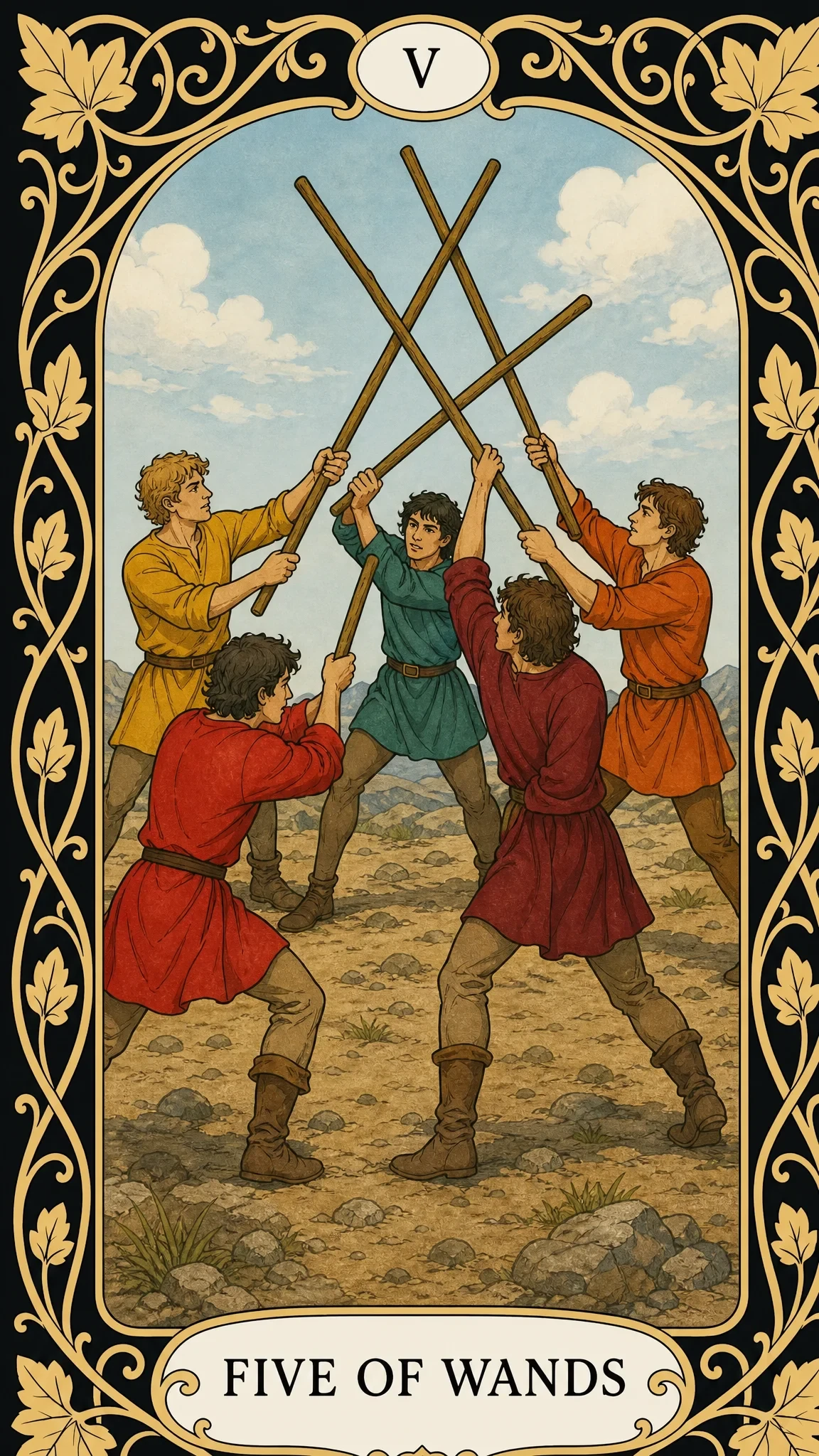
On our Five of Wands, there are five young people in a rocky wasteland, and each holds their own single wand: no one grips two at once, nor shares a wand with a neighbor. All five stand at full height in a loose circle, simultaneously raising their wands above their heads, so that the wands converge in the sky in a sweeping cross. The poses show that it is a brawl, not a one-on-one duel: someone pulls a wand towards them, someone pushes it away, and the young man in the turquoise tunic in the center holds his with both hands, squeezed by the other wands from both sides.
The scene is read as follows:
- Five tunics — five equal positions. Golden-yellow, red, turquoise-green, dark red, and orange. The colors are deliberately mismatched. This is a dispute between equals, not a hierarchy where one is clearly in charge.
- Each has exactly one wand. No wand has to be shared by two, and no wand is left over: there are no extra wands on the ground or in free hands — the balance of power in the skirmish is fair, without tilting in anyone's favor.
- Wands are crossed high above the heads — no blow has been fully delivered, no one is wounded or defeated: it looks more like an excited scuffle than a real fight.
- Rocky dry land and bare hills in the background — the setting is resource-poor, and the skirmish is partly about who gets the little that is available.
- Light sky with clouds — unlike cards of real misfortune, the background here is calm: the storm is only between people, not around them.
At the top of the card is the Roman numeral V, and at the bottom is the English name FIVE OF WANDS: our deck is drawn in the Rider-Waite tradition, where this card is the fifth in the suit of Wands.
Five of Wands as the card of the day
The Five of Wands as the card of the day signifies a day with increased background friction: someone will definitely argue on a call, in a chat, in line, or at home over trifles. This in itself is not a bad sign — rather, it's a signal to prepare for having to defend your point of view more often than usual.
A useful mindset for such a day: do not perceive every objection as an attack and do not get involved in other people's arguments that do not directly concern you. The excitement of this day quickly burns out on its own if you don't add extra fuel to it.
Frequently asked questions about the Five of Wands card
Is it a Major or Minor Arcana?
The Five of Wands is a Minor Arcana, suit of Wands, element of Fire. There are 56 Minor Arcana in the Tarot deck — 14 in each of the four suits, and the Five of Wands is one of them.
How does the Five of Wands differ from the Five of Swords?
Both cards are about conflict, but in different ways. The Five of Swords is about a dispute with a clear loser and a lingering aftertaste of victory at any cost. The Five of Wands is softer: it's a noisy competition without a single winner and without real enmity — the parties let off steam, rather than destroying each other.
Does the Five of Wands mean a fight?
Not literally. The card describes the energy of rivalry and friction — arguments, competition, a struggle for attention, not physical violence. The five characters on the card are waving wands, but none of them are injured: the meaning is in the scuffle itself, not its outcome.
What does the reversed Five of Wands mean?
Usually one of three options: the conflict has been exhausted out of fatigue, not by agreement of the parties; the dispute has gone inward and has not been voiced; or, conversely, one person is pushing their agenda, and the appearance of a fair fight from the upright position is lost.
Is the Five of Wands a bad card?
No, rather neutral. It describes an energy-consuming but not destructive period: competition, arguments, scattered efforts. The card does not bring real misfortune or loss — what matters more is what a person does with this friction, not the fact of its existence.