Mida tähendab ViieЖезлов Tarot's
ViieЖезлов on lärmaka, kuid mitte surmava kokkupõrke kaart. Viis inimest ristavad pulki, igaüks tõmbab oma poole, kellelgi pole selget ülekaalu – ja selles on kaardi olemus: see pole hävitussõda, vaid võitlus koha, järjekorra, selle üle, kelle versiooni kuuldakse esimesena.
Oluline on eraldada see kaart kohe vanematest arkaanadest. Torn või Kurat kirjeldavad suurt teemat aastateks ette; ViieЖезлов on palju tagasihoidlikum. See on konkreetne vaidlus kõnes, tülitsemine vestluses, konkurents tähelepanu eest seltskonnas, mitte saatuslik pööre. Selle tõlgendamine kui „elus algab kaos“ tähendab kaardi ülehindamist: nooremad arkaanad räägivad episoodist, mitte saatusest.
Element Tuli ja mast Pulgad annavad tooni: energiat on palju, see tormab välja, kuid on valesti suunatud – kõik lükkavad, keegi ei leppinud reeglites eelnevalt kokku. Siit klassikaline tähendus: konkurents, hõõrdumine, väikesed konfliktid, hajutatud pingutused. Sageli ilmub kaart seal, kus mitu inimest on korraga omal moel õigel teel ja keegi ei taha esimesena järele anda.
Tagurpidi ViieЖезлов: tähendus
Tagurpidi ViieЖезлов on sama trügimine, ainult et lämmatatud. Kolm sagedast tõlgendust, mille vahel valida vastavalt ennustuse küsimusele:
- Vaidlus on lõppenud – aga mitte sellepärast, et keegi oleks kedagi veennud, vaid sellepärast, et kõik on väsinud. Formaalsus vaherahu ilma tegeliku kokkuleppeta.
- Konflikt on läinud sissepoole. Väljaspool on vaikne, kuid ärritus ja konkurents pole kuhugi kadunud – neid lihtsalt ei näidata enam.
- Tülitsemine käib ebaausalt. Üks hääl summutab teised ja võrdses võitluses näiline võrdsus otsesest asendist kaob – keegi surub oma tahtmist peale.
Tagurpidi asend on signaal, et otsest kokkupõrget, mida kirjeldab otsene kaart, pole juhtunud või seda teadlikult välditakse. Mõnikord on see parem, mõnikord – lihtsalt sama vestlus, edasi lükatud.
ViieЖезлов ennustuses „jah või ei“
Ennustuses „jah või ei“ loetakse ViieЖезлов tavaliselt kui jah, aga mitte ilma võitluseta. Küsimusele nagu „kas see õnnestub“ vastatakse jaatavalt – ainult tulemust tuleb kaitsta, mitte kohe ja vastupanuta saada.
Kui küsimus on rahust – „kas see möödub ilma vaidluseta“, „kas nad nõustuvad ilma vastuväideteta“ – vastab kaart pigem ei: hõõrdumised tulevad, keegi kindlasti ütleb vastu.
Tagurpidi versioon pehmendab vastust „konflikt pole veel tekkinud“ või „pooled on vaidlemisest juba väsinud“: praktiline tähendus on see, et otsest võitlust, mida lubab otsene asend, lähiajal ei paista.
ViieЖезлов suhetes ja tunnetes
Suhetes on otsene ViieЖезлов partnerid, kes pidevalt natuke võistlevad: kes rohkem panustas, kes on argitülis õigus, kelle arvamus on otsuste tegemisel kaalukam. Iseenesest pole see paarile kohtuotsus – paljud paarid elavad nii aastaid ja hõõrdumine isegi hoiab huvi elus.
Sageli ilmub kaart seal, kus ühele inimesele pretendeerivad korraga mitu poolt: otsene rivaal tähelepanu eest või lihtsalt konkureerivad kohustused – pere, töö, vanad suhted –, mis tõmbavad erinevatesse suundadesse. Tasast, rahulikku tunnet see kaart ei kirjelda ei otseses ega tagurpidi asendis.
Tundete positsioonis on see pigem põnevus kui hellus: soov tõestada, olla kuuldud, mitte järele anda vaidluses, mis tegelikult pole nii suure pinge väärt.
Tagurpidi ViieЖезлов suhetes – kas vaidlus, mis on sisse surutud ja läbi rääkimata, või vastupidi, lühike vaherahu pärast tülitsemist, mis ei lahendanud algpõhjust.
ViieЖезлов töös ja rahas
Töö ennustustes on see avatud konkurents: mitu inimest pretendeerivad ühele projektile, eelarvet jagatakse võitlusega, koosolek muutub arutelu asemel karjumiseks. Sageli on see meeskond, kus rollid pole selgelt jaotatud ja igaüks tõmbab tekki enda poole mitte pahatahtlikkusest, vaid sellepärast, et muidu keegi tema panust ei kuule.
Rahades on kaart summa pärast vaidlus: kes palju võlgneb, kes mille eest maksab, vara või kulude jagamisel kauplemine. Otsest kahju kaart ei luba – lubab võitlust selle üle, kuidas seda, mis on, jagatakse.
Mida ViieЖезлов sisuliselt soovitab: enne edasist vaidlemist leppige kokku vaidluse reeglites – kes räägib esimesena, mida üldse jagatakse ja mitmeks osaks. Kaardi kaos ei ole ressursi puudumine, vaid eeskirjade puudumine.
ViieЖезлов kui inimene: mees ja naine
Kui ViieЖезлов ilmub inimese kirjelduseks, on see see, kes vaidleb iga asja pärast – mitte tingimata pahatahtlikkusest, vaid sellepärast, et talle on oluline oma seisukohta valjult kaitsta. Tema kõrval pole harva vaikne: ta kontrollib teiste argumentide tugevust ja ootab sama vastutasuks.
Meessoost ViieЖезлов – hasartne vaidleja, armastab võistlussituatsioone, satub kergesti tülli ja lahkub sealt sama kergesti ilma solvumiseta. Naisest ViieЖезлов – see, kes ei anna alla ega vaikib, isegi kui vaidlus on ebamugav või ebameeldiv staatuse poolest.
See ei ole konflikti või kurja inimese kirjeldus – pigem see, kellele on oluline olla üldises müras kuuldud, ja ta on valmis selle eest võitlema.
Five of Wands in the thoughts position
In the thoughts position, the Five of Wands represents a mind where several inner voices argue simultaneously: one insists on its own way, another objects, a third doubts everything at once. Focusing is difficult precisely because thoughts compete with each other rather than lining up in order.
This is often the state before an important conversation or decision: a person mentally rehearses arguments that haven't happened yet, preparing counter-arguments for all sides at once. Neighboring cards will indicate whether this internal struggle is productive or just an exhausting waste of energy.
What to do if the Five of Wands appears
The card's advice is simple, though not the most pleasant: don't disengage from the argument, but don't turn it into a war of annihilation. The Five of Wands is about energy scattered on trifles, and the first task is to gather it back.
What to do specifically:
- Name the real reason for the argument. Often, a dispute over a trifle hides one more serious unresolved issue.
- Agree on rules, not just content. Who speaks, in what order, by what deadline the result is needed.
- Don't confuse competition with personal offense. The excitement of an argument doesn't mean the opponent is an enemy.
- Leave room for a draw. Not every clash must have a clear winner.
If the card represents not a petty squabble but a prolonged, exhausting conflict, the spread describes the dynamics but doesn't resolve them; in such cases, direct conversation or a mediator helps, not another card in the deck.
What is depicted on the card
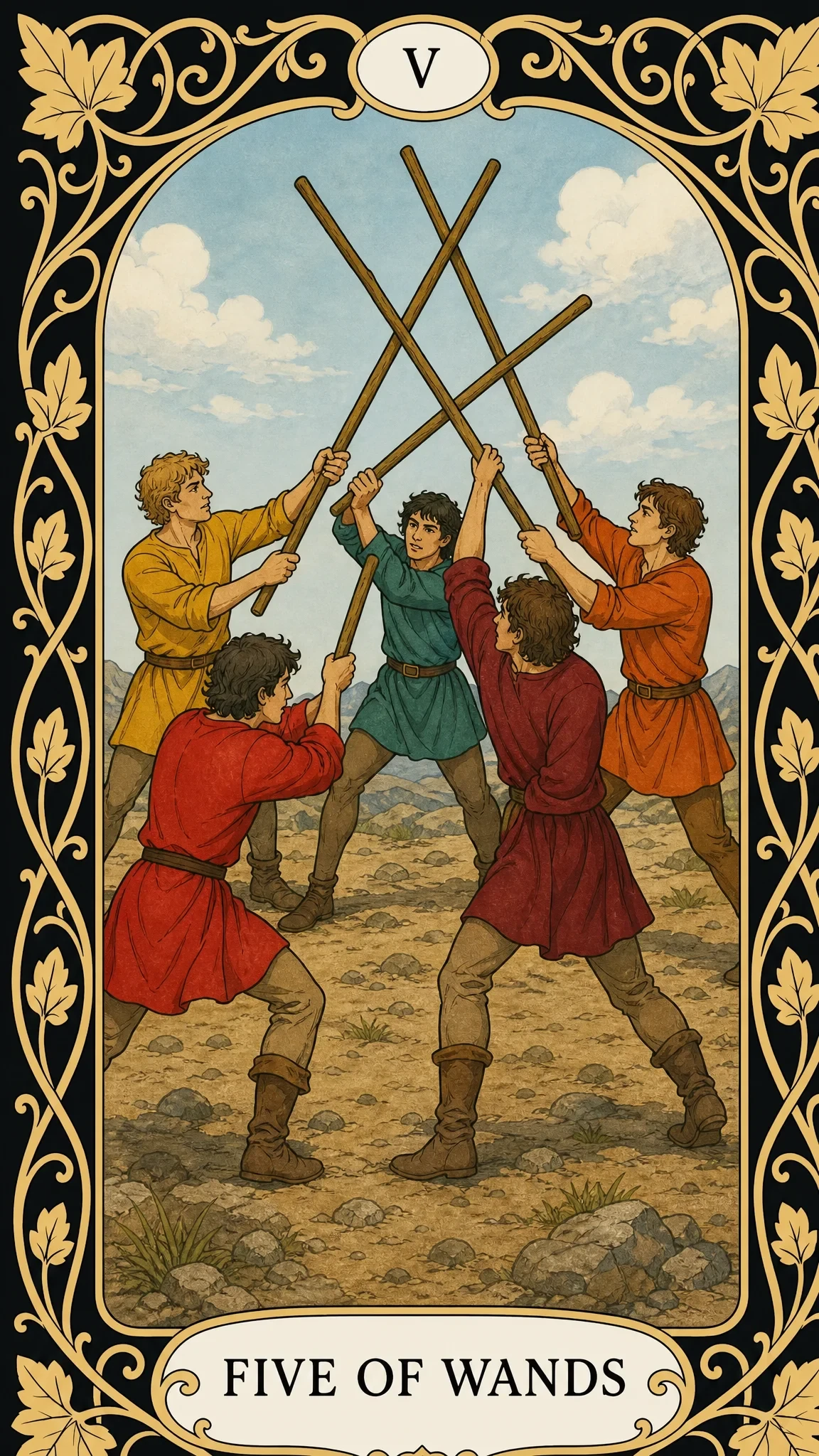
On our Five of Wands, there are five young men in a rocky wasteland, each holding a single wand: no one grips two at once, nor do they share a wand with a neighbor. All five stand at full height in a loose circle, simultaneously raising their wands above their heads, so that the wands form a sweeping cross in the sky. Their poses indicate a brawl rather than a one-on-one duel: some pull their wands towards themselves, some push them away, and the young man in the turquoise tunic in the center holds his with both hands, squeezed by others' wands from both sides.
The scene reads as follows:
- Five tunics — five equal positions. Golden-yellow, red, turquoise-green, dark red, and orange. The colors are deliberately mismatched. This is a dispute among equals, not a hierarchy where one is clearly superior.
- Each has exactly one wand. No wand needs to be shared, and no extra wands are left over: neither on the ground nor in a free hand are there any spare wands — the balance of power in the skirmish is fair, without bias.
- Wands crossed high above heads — no blow is fully delivered, no one is injured or defeated: it looks more like an excited scuffle than a real fight.
- Rocky, dry ground and bare hills in the background — the setting is resource-poor, and the clash is partly about who gets the little that exists.
- Light sky with clouds — unlike cards of true disaster, the background here is calm: the storm is only among people, not around them.
At the top of the card is the Roman numeral V, and at the bottom is the English name FIVE OF WANDS: our deck is drawn in the Rider-Waite tradition, where this card is the fifth in the suit of Wands.
Five of Wands as the card of the day
The Five of Wands as the card of the day signifies a day with increased background friction: someone will inevitably argue on a call, in chat, in line, or at home over a trifle. This in itself is not a bad sign — rather, it's a signal to prepare for having to defend your point of view more often than usual.
A useful mindset for such a day: don't perceive every objection as an attack, and don't get involved in other people's arguments that don't directly concern you. The excitement of this day quickly burns out on its own if you don't add fuel to the fire.
Frequently asked questions about the Five of Wands card
Is it a Major or Minor Arcana?
The Five of Wands is a Minor Arcana, suit of Wands, element of Fire. There are 56 Minor Arcana in a Tarot deck — 14 in each of the four suits, and the Five of Wands is one of them.
How does the Five of Wands differ from the Five of Swords?
Both cards are about conflict, but in different ways. The Five of Swords is about a dispute with a clear loser and lingering resentment after a victory at any cost. The Five of Wands is gentler: it's a noisy competition without a single winner and without real animosity — the parties let off steam rather than destroy each other.
Does the Five of Wands mean a fight?
Not literally. The card describes the energy of rivalry and friction — arguments, competition, a struggle for attention, not physical violence. The five figures on the card are waving wands, but none of them are injured: the meaning is in the scuffle itself, not its outcome.
What does the reversed Five of Wands mean?
Usually one of three options: the conflict has ended due to exhaustion, not mutual agreement; the dispute has gone internal and is not verbalized; or, conversely, one person is pushing their agenda, and the appearance of fair competition from the upright position is lost.
Is the Five of Wands a bad card?
No, rather neutral. It describes an energy-consuming but not destructive period: competition, arguments, scattered efforts. The card does not bring real disaster or loss — what matters more is what a person does with this friction, not the fact of its existence.