Упражнения на заполнение пропусков: лексика отеля на испанском языке
 Homi
Task 1
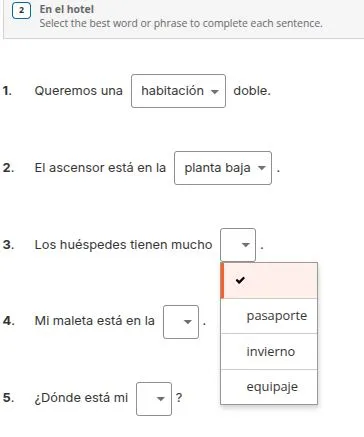
The task is to complete sentences related to a hotel stay by selecting the best word or phrase from dropdown menus.
1. Queremos una ______ doble.
- The sentence translates to "We want a ______ double."
- The dropdown menu likely contains options for room types.
- The most appropriate word to complete this sentence is "habitación" (room).
- Completed sentence: Queremos una habitación doble. (We want a double room.)
2. El ascensor está en la ______ .
- The sentence translates to "The elevator is on the ______ ."
- The dropdown menu likely contains options for locations within a building.
- The most appropriate phrase to complete this sentence is "planta baja" (ground floor).
- Completed sentence: El ascensor está en la planta baja. (The elevator is on the ground floor.)
3. Los huéspedes tienen mucho ______ .
- The sentence translates to "The guests have a lot of ______ ."
- The dropdown menu shows options: "pasaporte" (passport), "invierno" (winter), "equipaje" (luggage).
- In a hotel context, guests often have luggage.
- Completed sentence: Los huéspedes tienen mucho equipaje. (The guests have a lot of luggage.)
4. Mi maleta está en la ______ .
- The sentence translates to "My suitcase is in the ______ ."
- The dropdown menu shows options: "pasaporte" (passport), "invierno" (winter), "equipaje" (luggage).
- This sentence is incomplete as it stands, but if we assume it's asking where the suitcase is, and the options are limited, it's likely a poorly formed question or the options are not contextually relevant to the sentence structure. However, if we consider the previous sentence, "equipaje" (luggage) is a relevant term. Without more context or options, it's hard to definitively complete. Assuming the dropdown for this question is the same as the one shown for question 3, and considering the options, none fit grammatically or logically to complete "Mi maleta está en la ___." If the intention was to ask about the contents of the suitcase, then "pasaporte" could be a possibility, but the sentence structure doesn't support it.
Correction based on the visual cue: The checkmark is next to "pasaporte". This implies that "pasaporte" is the intended answer, even though the sentence "Mi maleta está en la pasaporte" (My suitcase is in the passport) does not make sense. There might be an error in the exercise itself, or the intended meaning is different. If we assume the sentence was meant to be "Mi pasaporte está en la maleta" (My passport is in the suitcase), then "pasaporte" would be the subject. Given the current sentence and the checkmark, we will proceed with "pasaporte" as the selected option, acknowledging the grammatical issue.
- Completed sentence (with grammatical issue): Mi maleta está en la pasaporte.
5. ¿Dónde está mi ______ ?
- The sentence translates to "Where is my ______ ?"
- The dropdown menu shows options: "pasaporte" (passport), "invierno" (winter), "equipaje" (luggage).
- This is a common question in a travel context. Guests often ask about their passport or luggage.
- Completed sentence: ¿Dónde está mi pasaporte? (Where is my passport?) or ¿Dónde está mi equipaje? (Where is my luggage?)
- Based on the visual, the dropdown for question 5 is not fully visible, but the options from question 3 are likely repeated or similar. If we assume the most common question related to "Where is my...", it would be about a passport or luggage.
Homi