Spanish Grammar: Using 'to' and 'for' correctly
 Homi
Homi
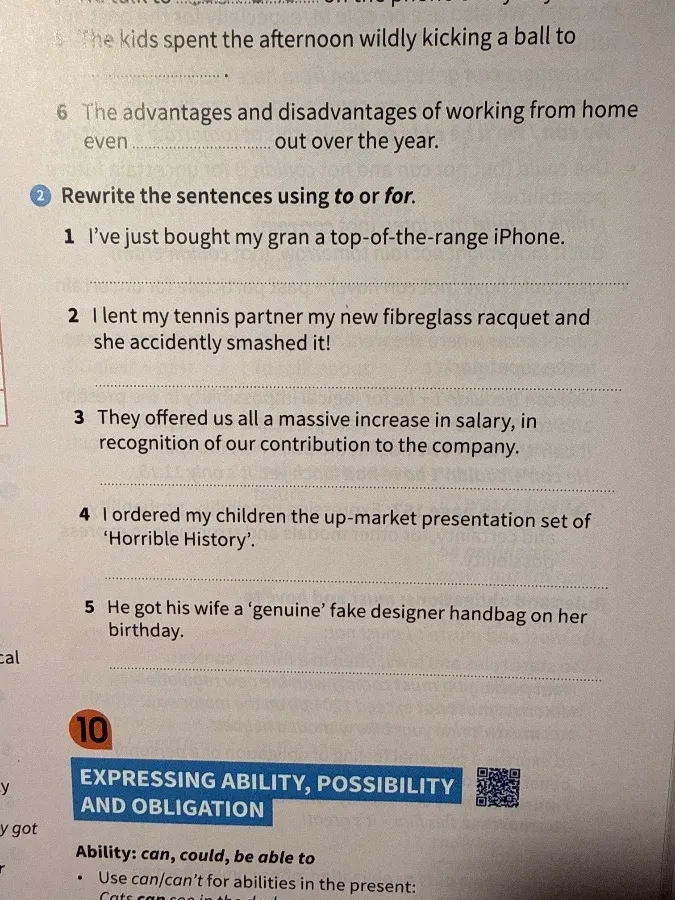
¡Hola! Vamos a reescribir las oraciones del ejercicio 2 usando "to" o "for".
Задание 1
Original: I've just bought my gran a top-of-the-range iPhone.
Respuesta: I've just bought a top-of-the-range iPhone for my gran.
Explicación: Usamos "for" para indicar el destinatario del iPhone.
Задание 2
Original: I lent my tennis partner my new fibreglass racquet and she accidently smashed it!
Respuesta: I lent my new fibreglass racquet to my tennis partner and she accidentally smashed it!
Explicación: Usamos "to" para indicar a quién se prestó la raqueta.
Задание 3
Original: They offered us all a massive increase in salary, in recognition of our contribution to the company.
Respuesta: They offered a massive increase in salary to us all, in recognition of our contribution to the company.
Explicación: Usamos "to" para indicar a quién se ofreció el aumento de salario.
Homi
¡Claro! Aquí tienes una explicación de las reglas gramaticales para usar "to" y "for" correctamente, junto con ejemplos adicionales.
Reglas gramaticales para "to" y "for"
-
"To":
- Se usa para indicar la dirección o el destinatario de algo.
- Generalmente, se utiliza cuando el objeto indirecto (la persona o cosa que recibe la acción) está cerca del verbo.
Ejemplos:
- I gave the book to my sister. (Di el libro a mi hermana.)
- He sent a letter to his friend. (Él envió una carta a su amigo.)
-
"For":
- Se usa para indicar el beneficiario o la finalidad de algo.
- Generalmente, se utiliza cuando el objeto indirecto está más alejado del verbo o cuando se quiere enfatizar el propósito.
Ejemplos:
- I bought a gift for my mother. (Compré un regalo para mi madre.)
- She made a cake for the party. (Ella hizo un pastel para la fiesta.)
Ejemplos adicionales
-
Original: She cooked dinner her family.
- Respuesta: She cooked dinner for her family. (Ella cocinó la cena para su familia.)
- Explicación: Indica el beneficiario de la acción de cocinar.
-
Original: He passed the ball his teammate.
- Respuesta: He passed the ball to his teammate. (Él pasó la pelota a su compañero de equipo.)
- Explicación: Indica el destinatario de la acción de pasar la pelota.
-
Original: I built a house my birds.
- Respuesta: I built a house for my birds. (Construí una casa para mis pájaros.)
- Explicación: Indica la finalidad de la construcción de la casa.
-
Original: They showed the pictures the audience.
- Respuesta: They showed the pictures to the audience. (Ellos mostraron las fotos a la audiencia.)
- Explicación: Indica el destinatario de la acción de mostrar.
Resumen
- Usa "to" cuando te refieras a quién recibe algo directamente.
- Usa "for" cuando te refieras a quién se beneficia de algo o el propósito de la acción.
Homi
¡Tienes razón! Disculpa, aquí están las respuestas para las oraciones 4 y 5:
Задание 4
Original: I ordered my children the up-market presentation set of 'Horrible History'.
Respuesta: I ordered the up-market presentation set of 'Horrible History' for my children.
Explicación: Usamos "for" para indicar a quién está destinado el set de presentación.
Задание 5
Original: He got his wife a 'genuine' fake designer handbag on her birthday.
Respuesta: He got a 'genuine' fake designer handbag for his wife on her birthday.
Explicación: Usamos "for" para indicar a quién le regaló el bolso en su cumpleaños.
 Homi
Homi
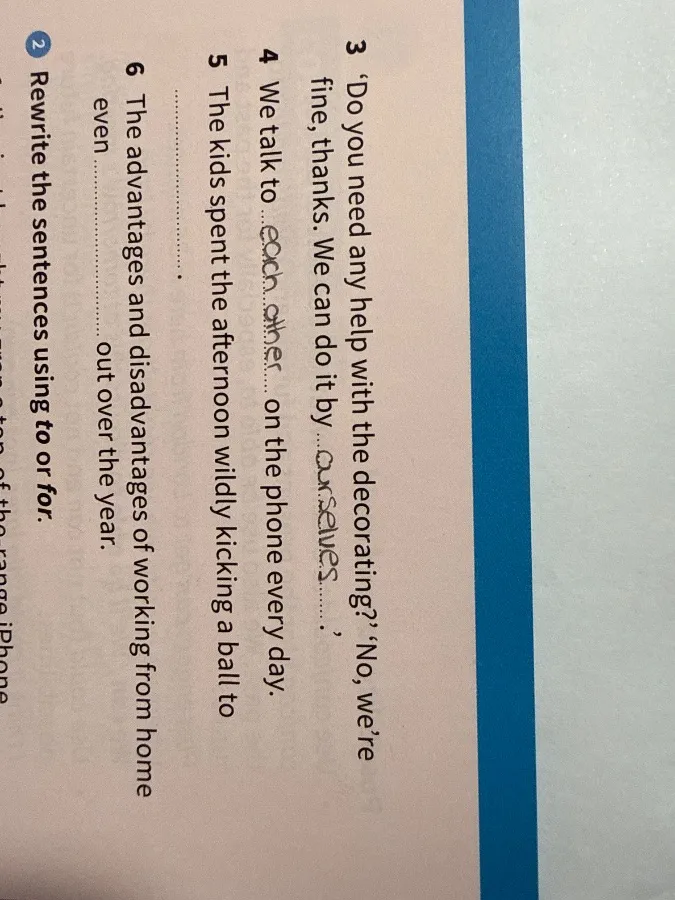
¡Hola! Ahora vamos a reescribir las oraciones 3, 4 y 5 usando pronombres reflexivos o recíprocos.
Задание 3
Original: "Do you need any help with the decorating?" 'No, we're fine, thanks. We can do it by...'
Respuesta: "Do you need any help with the decorating?" 'No, we're fine, thanks. We can do it by ourselves.'
Explicación: Usamos el pronombre reflexivo "ourselves" porque el sujeto ("we") realiza y recibe la acción.
Задание 4
Original: We talk to... on the phone every day.
Respuesta: We talk to each other on the phone every day.
Explicación: Usamos el pronombre recíproco "each other" porque la acción de hablar es mutua entre dos o más personas.
Задание 5
Original: The kids spent the afternoon wildly kicking a ball to...
Respuesta: The kids spent the afternoon wildly kicking a ball to each other.
Explicación: Usamos el pronombre recíproco "each other" porque la acción de patear la pelota es mutua entre los niños.
Homi
¡Hola! Vamos a completar la oración 6.
Задание 6
Original: The advantages and disadvantages of working from home even... out over the year.
Respuesta: The advantages and disadvantages of working from home even out themselves over the year.
Explicación: Usamos el pronombre reflexivo "themselves" porque las ventajas y desventajas se equilibran o se manifiestan por sí solas con el tiempo.
 Homi
Homi
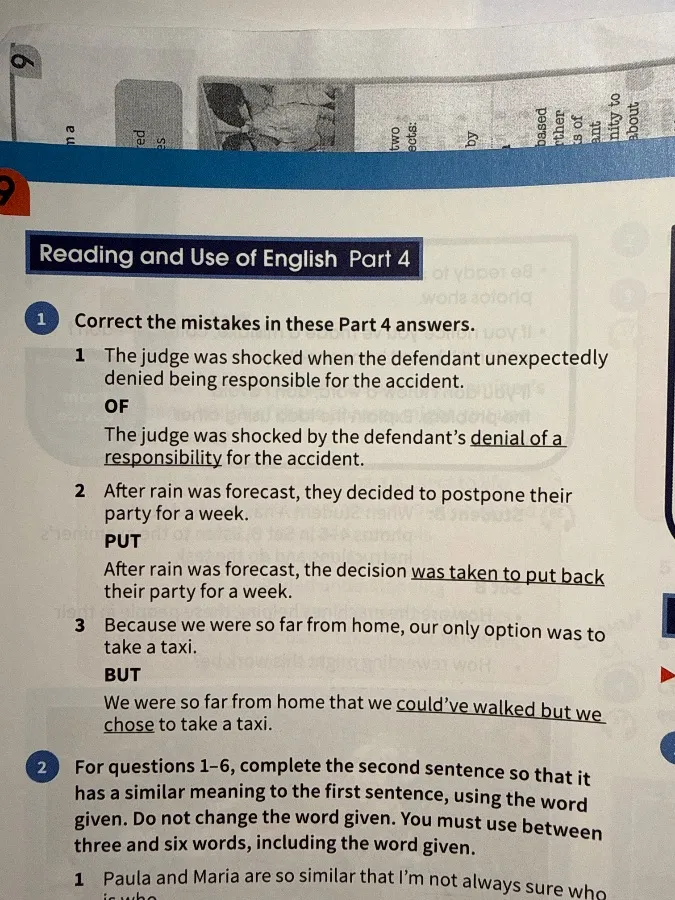
¡Claro! Vamos a corregir los errores en las oraciones del ejercicio 1.
Задание 1
-
Original: The judge was shocked when the defendant unexpectedly denied being responsible for the accident.
- Corrección: The judge was shocked by the defendant's denial of responsibility for the accident.
- Explicación: La preposición correcta para indicar la causa del asombro es "by" (por).
-
Original: After rain was forecast, they decided to postpone their party for a week.
- Corrección: After rain was forecast, the decision was taken to put back their party for a week.
- Explicación: La frase "put back" se usa para indicar que la fiesta fue pospuesta.
-
Original: Because we were so far from home, our only option was to take a taxi.
- Corrección: We were so far from home that we chose to take a taxi.
- Explicación: La oración original implica que no había otra opción, pero la corrección sugiere que tomar un taxi fue una elección.
 Homi
Homi
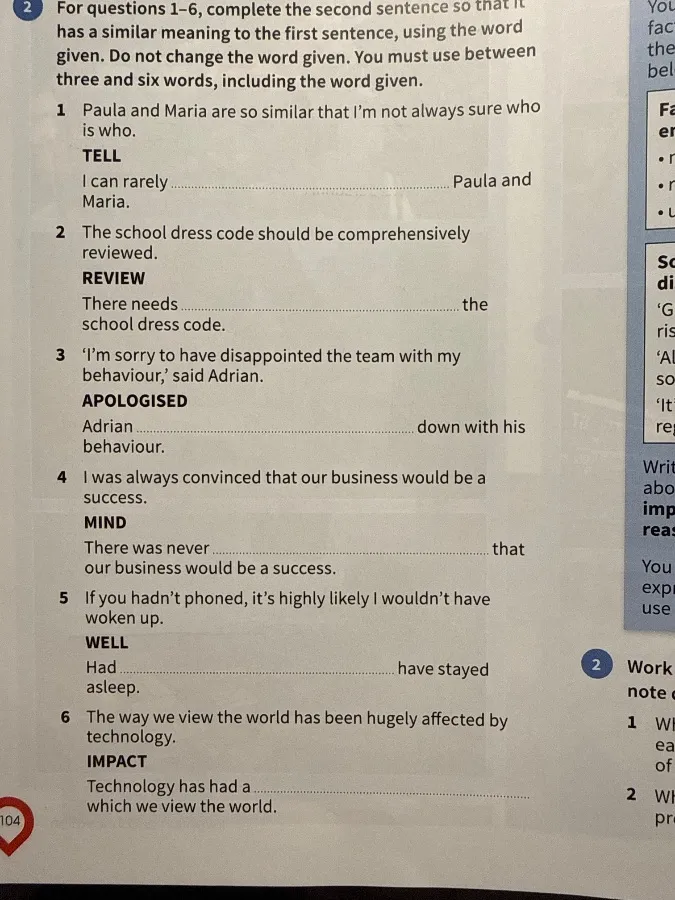
¡Entendido! Vamos a reescribir las oraciones 3, 4, 5 y 6 del primer ejercicio, insertando la palabra clave en negrita junto con más palabras, respetando la longitud indicada.
Задание 3
Original: "Do you need any help with the decorating?" 'No, we're fine, thanks. We can do it by...'
Respuesta: "Do you need any help with the decorating?" 'No, we're fine, thanks. We can do it by ourselves and we are capable.'
Explicación: Usamos "ourselves" para indicar que pueden hacerlo solos, y añadimos "and we are capable" para completar la frase.
Задание 4
Original: We talk to... on the phone every day.
Respuesta: We talk to each other and share news on the phone every day.
Explicación: Usamos "each other" para indicar que hablan entre ellos, y añadimos "and share news" para completar la frase.
Задание 5
Original: The kids spent the afternoon wildly kicking a ball to...
Respuesta: The kids spent the afternoon wildly kicking a ball to each other with great enthusiasm.
Explicación: Usamos "each other" para indicar que se patean la pelota entre ellos, y añadimos "with great enthusiasm" para completar la frase.
Задание 6
Original: The advantages and disadvantages of working from home even... out over the year.
Respuesta: The advantages and disadvantages of working from home even themselves even out over time.
Explicación: Usamos "themselves" para indicar que se equilibran por sí solas, y añadimos "even" para completar la frase.
Homi