A chemical reaction equation is a representation of a reaction using substance formulas, where the number of atoms of each element is the same on both the left and right sides. To turn a scheme into an equation, coefficients are placed before the formulas: this is required by the law of conservation of mass. This section explains the difference between a scheme and an equation, provides a step-by-step algorithm for balancing (metal → nonmetal → hydrogen → oxygen), a table of reaction types, common mistakes, and an interactive trainer to reinforce the topic immediately.
Reaction Scheme vs. Reaction Equation: What's the Difference
When iron burns in oxygen to form iron(III) oxide, the first representation looks like this: formulas of the reactants on the left, formulas of the products on the right, with an arrow in between. This is a reaction scheme.
A scheme is not yet an equation. It states what turns into what, but not how much of each substance is involved: the number of iron and oxygen atoms is different on the left and right sides. According to the law of conservation of mass, this cannot be the case.
The representation becomes a reaction equation when coefficients are placed before the formulas – numbers that equalize the number of atoms of each element. Compare the two representations of the same reaction.
| Atom | Left | Right |
|---|---|---|
| $\mathrm{Fe}$ | 1 | 2 |
| $\mathrm{O}$ | 2 | 3 |
| Atom | Left | Right |
|---|---|---|
| $\mathrm{Fe}$ | 4 | 4 |
| $\mathrm{O}$ | 6 | 6 |
Law of Conservation of Mass: Why Coefficients Are Needed
The law of conservation of mass was formulated by M. V. Lomonosov (1748) and later independently confirmed by A. Lavoisier: the mass of the substances that reacted is equal to the mass of the substances that were formed.
The reason is simple: during a chemical reaction, atoms do not disappear or appear out of nowhere. Old bonds break, new ones form, and the atoms themselves merely rearrange. The number of iron atoms before the reaction will be the same as after – they simply become part of a different substance.
Hence, the main requirement for an equation: the number of atoms of each element on the left must equal the number of atoms of that element on the right. The only valid way to achieve this is by adjusting coefficients.
A coefficient is placed before the formula and multiplies all atoms in it, including those within parentheses. For example, the notation \(\mathrm{3Ca(OH)_2}\) means three formula units of calcium hydroxide: 3 atoms of \(\mathrm{Ca}\), 6 atoms of \(\mathrm{O}\), and 6 atoms of \(\mathrm{H}\). A coefficient of 1 is not written but is implied.
How to Balance a Reaction Equation: The Algorithm
Balancing coefficients is not a random guess but a short procedure. The order is important: first, balance elements that appear in exactly one substance on the left and one on the right, and only then hydrogen and oxygen – they are usually distributed among several substances and are adjusted last.
The school order can be remembered by the chain: metal → nonmetal → hydrogen → oxygen. The six steps of the algorithm are below.
If you get a fractional coefficient at any step (e.g., 3/2 before a diatomic gas molecule), it's not an error or a dead end: complete the balancing, and then multiply all coefficients by 2 – the fractions will disappear, and the balance will be maintained.
In higher grades, for redox reactions, a more powerful method is introduced – the electron balance method. It relies on oxidation states, but double displacement and combination reactions are still balanced using this simple algorithm.
Why You Can't Change Subscripts in Substance Formulas
This is the number one mistake for eighth graders. In the scheme \(\mathrm{Na + Cl_2 \rightarrow NaCl}\), chlorine doesn't balance: 2 atoms on the left, 1 on the right. The temptation is great – to add a subscript and get \(\mathrm{NaCl_2}\). The atoms will formally balance, but the written substance does not exist: sodium chloride has the composition \(\mathrm{NaCl}\), and no other.
A subscript is part of a formula. It is determined by the composition of the substance, i.e., the valency and oxidation state of the elements, and you cannot change it at will. By changing a subscript, you change the substance itself: \(\mathrm{H_2O}\) is water, while \(\mathrm{H_2O_2}\) is hydrogen peroxide, a completely different compound with different properties.
A coefficient is a multiplier before the formula. It only indicates the number of particles, not their composition, so balancing is only allowed using coefficients.
The correct answer for the scheme above is: \(\mathrm{2Na + Cl_2 \rightarrow 2NaCl}\). Sodium 2 and 2, chlorine 2 and 2, formulas are unchanged.
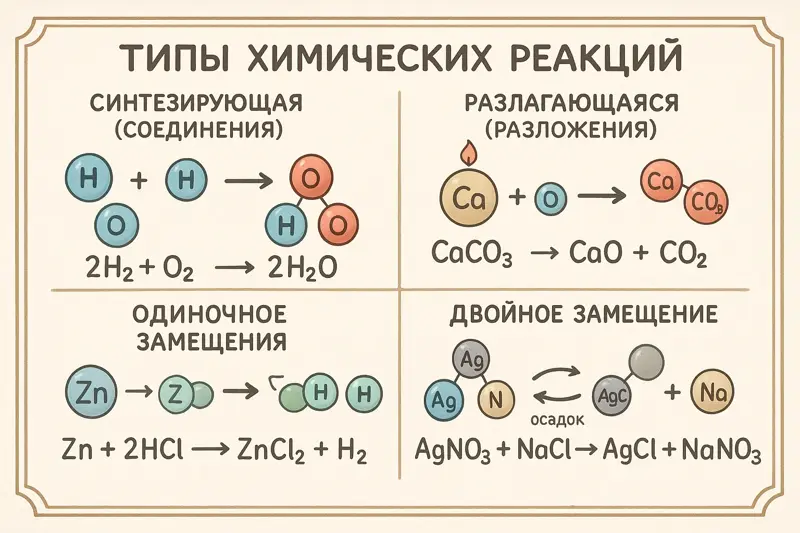
Types of Chemical Reactions
Equations are classified by the number and type of initial substances and products. In basic school, four types are distinguished: combination, decomposition, displacement, and double displacement.
Determining the type before balancing coefficients is useful: it suggests which substances will be on the right side and how many there will be, thus helping to avoid errors in the scheme itself.
| Type of Reaction | General Scheme and Example |
|---|---|
| Combination | $\mathrm{A + B \rightarrow AB}$$\mathrm{4P + 5O_2 \rightarrow 2P_2O_5}$ |
| Decomposition | $\mathrm{AB \rightarrow A + B}$$\mathrm{2H_2O \rightarrow 2H_2 + O_2}$ |
| Displacement | $\mathrm{A + BC \rightarrow AC + B}$$\mathrm{Fe + CuSO_4 \rightarrow FeSO_4 + Cu}$ |
| Double Displacement | $\mathrm{AB + CD \rightarrow AD + CB}$$\mathrm{NaOH + HCl \rightarrow NaCl + H_2O}$ |
Sum of Coefficients in a Chemical Reaction Equation
In tests and quizzes, the question is often not about the entire equation but about the sum of coefficients – this is a quick way to check if it's balanced correctly. It's calculated simply: add up all the coefficients in the left and right sides.
For the equation \(\mathrm{4Fe + 3O_2 \rightarrow 2Fe_2O_3}\), the sum is 4 + 3 + 2 = 9.
Three common places where points are lost:
- The invisible '1' counts too. In the equation \(\mathrm{CaO + H_2O \rightarrow Ca(OH)_2}\), all three coefficients are 1, so the sum is 3;
- Subscripts are not included in the sum – only the numbers before the formulas are added;
- Coefficients must be the smallest possible integers. The notation \(\mathrm{4Na + 2Cl_2 \rightarrow 4NaCl}\) is balanced in terms of atoms, but all numbers are divisible by 2, so it's reduced to 2, 1, 2 – and the correct sum is 5, not 10.
Calculations Based on Chemical Reaction Equations: Coefficients Represent Moles
Coefficients are needed not only for balancing atoms. They show the ratio of substance amounts (in moles) in which substances react and are formed. This is the bridge to calculation problems.
The equation \(\mathrm{N_2 + 3H_2 \rightarrow 2NH_3}\) is read as: 1 mole of nitrogen reacts with 3 moles of hydrogen to produce 2 moles of ammonia. The ratio 1 : 3 : 2 is maintained regardless of the amount of substance.
Hence, the usual calculation scheme based on an equation: convert the given mass or volume to the amount of substance, find the amount of the desired substance using the coefficients, and convert back to mass or volume. The calculation problems themselves are a separate large topic, but it always starts here: if the coefficients are incorrectly balanced, any such calculation will yield an incorrect answer.
Examples of Balancing Coefficients
Example 1. Methane Combustion
Problem: Balance the coefficients in the scheme \(\mathrm{CH_4 + O_2}\) \(\rightarrow\) \(\mathrm{CO_2 + H_2O}\).
Steps 1–2. Count atoms. Left: 1 carbon, 4 hydrogen, 2 oxygen. Right: 1 carbon, 2 hydrogen, 2 + 1 = 3 oxygen.
Step 3. No metals in the scheme – proceed directly to nonmetals.
Step 4. Carbon: 1 on the left and 1 on the right, already balanced.
Step 5. Hydrogen: 4 on the left, 2 on the right – place coefficient 2 before water, making the right side have 4 hydrogen atoms. Now oxygen: on the right, 2 (in \(\mathrm{CO_2}\)) + 2 (in two \(\mathrm{H_2O}\)) = 4 atoms; on the left, 2 – place 2 before \(\mathrm{O_2}\).
Step 6. No fractions. Check: carbon 1 and 1, hydrogen 4 and 4, oxygen 4 and 4.
Answer: \(\mathrm{CH_4 + 2O_2 \rightarrow CO_2 + 2H_2O}\), sum of coefficients 1 + 2 + 1 + 2 = 6.
Example 2. Aluminum and Sulfuric Acid
Problem: Balance the coefficients in the scheme \(\mathrm{Al + H_2SO_4}\) \(\rightarrow\) \(\mathrm{Al_2(SO_4)_3 + H_2}\).
Step 3. Start with the metal. Aluminum: 1 on the left, 2 on the right – place 2 before \(\mathrm{Al}\).
Step 4. Consider the sulfate group \(\mathrm{SO_4}\) as a single unit: 3 on the right, 1 on the left – place 3 before \(\mathrm{H_2SO_4}\).
Step 5. Hydrogen: there are now 3 · 2 = 6 atoms on the left, so you need 3 molecules of \(\mathrm{H_2}\) on the right. Check oxygen last: 3 · 4 = 12 on the left, 3 · 4 = 12 on the right.
Step 6. Check all elements: aluminum 2 and 2, sulfur 3 and 3, oxygen 12 and 12, hydrogen 6 and 6.
Answer: \(\mathrm{2Al + 3H_2SO_4}\) \(\rightarrow\) \(\mathrm{Al_2(SO_4)_3 + 3H_2}\), sum of coefficients 2 + 3 + 1 + 3 = 9.
Example 3. When a Fraction Appears
Problem: Balance the coefficients in the scheme \(\mathrm{Fe + Cl_2 \rightarrow FeCl_3}\).
Step 3. Metal: one iron atom on the left and one on the right – balanced for now.
Step 4. Chlorine: atoms come in pairs on the left, and there are 3 on the right. To get 3 atoms, you need a coefficient of 3/2 before \(\mathrm{Cl_2}\) – resulting in \(\mathrm{Fe + 1.5Cl_2 \rightarrow FeCl_3}\). The atoms balance, but fractional coefficients are not usually left in the final answer.
Step 6. Multiply all coefficients by 2: iron 1 · 2 = 2, chlorine 1.5 · 2 = 3, product 1 · 2 = 2.
Check: iron 2 and 2, chlorine 6 and 6.
Answer: \(\mathrm{2Fe + 3Cl_2 \rightarrow 2FeCl_3}\), sum of coefficients 2 + 3 + 2 = 7.
Common Mistakes in Balancing Coefficients
-
"Balanced" by changing the substance's formula: to balance atoms in the hydrogen combustion scheme, a subscript is added, resulting in hydrogen peroxide instead of water.
\(\mathrm{H_2O_2}\) is a different substance, and the reaction would be different. Subscripts are inviolable; they are determined by the substance's composition. The correct answer is achieved only with coefficients: \(\mathrm{2H_2 + O_2 \rightarrow 2H_2O}\).
-
Placing the coefficient inside the formula: writing $\mathrm{Na2Cl}$ instead of $\mathrm{2NaCl}$.
A coefficient is placed only before the entire formula and applies to the whole substance. A number inside a formula is a subscript, meaning a different composition. If nothing is written before a formula, the coefficient is 1.
-
Forgetting that a coefficient multiplies all atoms in the formula: in the notation $\mathrm{2H_2SO_4}$, counting only 2 hydrogen atoms.
You must multiply every subscript: in \(\mathrm{2H_2SO_4}\), there are 2 · 2 = 4 hydrogen atoms, 2 · 1 = 2 sulfur atoms, and 2 · 4 = 8 oxygen atoms. The same applies to parentheses: in \(\mathrm{2Ca(NO_3)_2}\), there are 2 · 2 = 4 nitrogen atoms and 2 · 6 = 12 oxygen atoms.
-
Starting to balance with oxygen or hydrogen.
Oxygen and hydrogen are part of several substances, so their coefficients will change after each subsequent step. The order metal → nonmetal → hydrogen → oxygen saves time: only one element remains to be adjusted at the end.
-
Giving up when seeing a fractional coefficient, or leaving a fraction in the answer.
A fraction is a normal intermediate result. Complete the balancing, and then multiply all coefficients by the denominator of the fraction, usually by 2. The atom balance will remain unchanged, and the numbers will become integers.
-
Summing coefficients while skipping invisible ones.
A coefficient of 1 is not written but is included in the sum. In the equation \(\mathrm{2Na + Cl_2 \rightarrow 2NaCl}\), the sum is 2 + 1 + 2 = 5, not 4.
-
Not performing a final check and submitting an equation where not every element is balanced.
The last step of the algorithm is mandatory: go through all elements sequentially and compare the number of atoms on the left and right. The error is most often hidden in oxygen because it's counted last.
Questions and Answers
How does a reaction scheme differ from a reaction equation?
A reaction scheme only shows which substances react and which are formed: formulas on the left, formulas on the right, with an arrow in between. It becomes an equation after balancing coefficients, when the number of atoms of each element on the left equals the number of atoms on the right. Simply put, a scheme answers the question 'what turns into what,' while an equation also answers 'how much.'
What is a coefficient in a reaction equation, and how does it differ from a subscript?
A coefficient is a number before a substance's formula; it indicates the number of particles and multiplies all atoms in the formula, including those in parentheses. A subscript is a small number at the bottom right within a formula; it indicates the composition of the substance itself. When balancing, coefficients are adjusted, but subscripts cannot be changed: changing a subscript results in a different substance and a different reaction.
How to find the sum of coefficients in a chemical reaction equation?
First, balance the coefficients correctly, then add up all the numbers before the formulas on both the left and right sides. A coefficient of 1 is not written but is included in the sum. Subscripts are not included in the sum. Also, coefficients must be the smallest possible integers: if they are all divisible by a common factor, the equation must be simplified, otherwise the sum will be inflated.
Which element should you start balancing coefficients with?
Start with the element that appears in exactly one substance on the left and one on the right. In practice, this is the order: metal → nonmetal (except hydrogen and oxygen) → hydrogen → oxygen. Oxygen and hydrogen are left for last because they are part of several substances and are adjusted based on the coefficients already found.
Is it permissible to use fractional coefficients?
In intermediate calculations, yes, it's a convenient technique: 3/2 or 5/2 often appears before a diatomic gas molecule. However, in the final answer, coefficients must be integers, so at the end, all coefficients in the equation are multiplied by the denominator of the fraction, usually by 2. The atom balance is preserved.
What are the types of chemical reactions?
Based on the number and composition of reactants and products, four main types are distinguished: combination (several substances form one), decomposition (one substance forms several), displacement (a simple substance replaces an element in a compound), and double displacement (two compounds exchange parts). Reactions are also classified as redox and non-redox (without changes in oxidation states), and as exothermic and endothermic.
How to perform a calculation based on a chemical reaction equation?
The coefficients in an equation define the molar ratio of substances. The process is as follows: write the equation and balance the coefficients, convert the known mass or volume to the amount of substance, find the amount of the desired substance using the coefficient ratio, and then convert it back to mass or volume. If the coefficients are balanced incorrectly, the entire calculation will be erroneous.
Why is an equals sign used in an equation, and an arrow in a scheme?
An arrow means 'transforms into' and allows for unbalanced atoms. An equals sign indicates that both sides are indeed equal in the number of atoms of each element, meaning the law of conservation of mass is satisfied, so the equals sign is used only after balancing coefficients. In school practice, the arrow is often retained in the final equation – this is not an error if the atom balance is achieved.