The Pythagorean Theorem is the most important formula in 8th-grade geometry: in a right triangle, the sum of the squares of the legs is equal to the square of the hypotenuse, i.e., \(a^2 + b^2 = c^2\). It is used to derive formulas for finding the hypotenuse, any leg, the diagonal of a rectangle, and the distance between points. This page covers the definition and formula, a visual proof using areas, the converse theorem, the 3-4-5 Egyptian triangle, step-by-step problem solving, and an interactive quiz to test yourself.
What is the Pythagorean Theorem and what is the formula
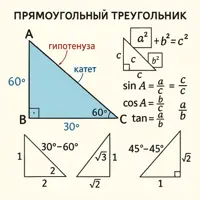
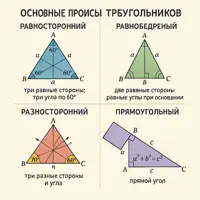
The Pythagorean Theorem works only in a right triangle — a triangle where one angle is \(90°\). The sides of such a triangle have specific names:
- legs — the two sides that form the right angle;
- hypotenuse — the side opposite the right angle, which is the longest side of the triangle.
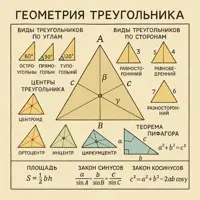
Theorem Statement: in a right triangle, the square of the hypotenuse is equal to the sum of the squares of the legs.
Here \(a\) and \(b\) are the legs, and \(c\) is the hypotenuse. Sometimes the theorem is stated "geometrically": the area of the square built on the hypotenuse is equal to the sum of the areas of the squares built on the legs. It is the same theorem, just expressed in terms of areas rather than numbers.
A simple rule helps remember the letter order: the longest side is always hidden under the big letter \(c\). If you confuse the hypotenuse with a leg in a problem, the answer will be incorrect.
Proof of the Pythagorean Theorem
There are over a hundred known proofs of the Pythagorean Theorem. In school, we study the most intuitive one — proof by area. We take two identical squares with side length \(a + b\) and place four identical right triangles with legs \(a\) and \(b\) inside each, but arranged differently.
- In the first square, we shift the triangles to the corners so that two squares remain empty: one with side \(a\) and one with side \(b\). Their areas are \(a^2\) and \(b^2\).
- In the second square, we arrange the same four triangles in a "pinwheel" pattern. One slanted square with side \(c\) remains empty, its area is \(c^2\).
- The areas of the large squares are equal: each is \((a+b)^2\). The total area of the triangles is also the same: each occupies \(\frac{ab}{2}\), and all four together occupy \(2ab\).
Since both the whole and the subtracted parts match, the remainders must also be equal: \(a^2 + b^2 = c^2\). The theorem is proven — the area balances for both squares are shown below the diagram.
How to find the hypotenuse and leg using the Pythagorean Theorem
All the working formulas for this topic are derived from the single formula \(a^2 + b^2 = c^2\): the unknown side is expressed from the equality, and the square root is taken. There is only one difference between the two cases — and it is where mistakes are most often made:
- the hypotenuse is found by adding the squares of the legs — it must result in a value longer than either leg;
- a leg is found by subtracting: the square of the known leg is subtracted from the square of the hypotenuse, and the result must be shorter than the hypotenuse.
If you get a negative number under the square root, it means you confused the hypotenuse with a leg — go back to the diagram and find the right angle. One more detail: taking the square root at the end is mandatory; this is where points are lost most often.
A handy cheat sheet with all the formulas is below.
| What we are finding | Formula and explanation |
|---|---|
| Hypotenuse | c = √a2 + b2square root of the sum of the squares of the legs |
| Leg a | a = √c2 − b2square root of the difference of the squares of the hypotenuse and the other leg |
| Leg b | b = √c2 − a2symmetrically: subtract the square of the other leg |
| Check | a2 + b2 = c2 ?equality holds → triangle is right-angled (converse theorem) |
Converse of the Pythagorean Theorem and the Egyptian triangle
Converse of the Pythagorean Theorem: if the square of one side of a triangle is equal to the sum of the squares of the other two sides, then this triangle is a right triangle, and the right angle lies opposite the longest side.
This is a practical tool: you can determine the type of triangle from three numbers without using a protractor. The steps are:
- find the longest side — it is the candidate for the hypotenuse;
- square the other two sides and add them together;
- compare with the square of the longest side.
If you get an equality, the triangle is a right triangle. For example, sides 6, 8, and 10: \(6^2 + 8^2 = 36 + 64 = 100 = 10^2\), so the triangle is a right triangle.
Sets of integers for which the equality holds are called Pythagorean triples. The most famous is 3, 4, 5: such a triangle is called an Egyptian triangle because builders in Ancient Egypt would measure 12 equal parts on a rope and form a triangle with sides 3, 4, and 5 to get an exact right angle on a construction site. This technique is still used today.
Where the Pythagorean Theorem is used: real-life and geometry problems
The Pythagorean Theorem is needed whenever you can see a right triangle in a figure:
- Rectangle diagonal. The diagonal divides a rectangle into two right triangles, so \(d = \sqrt{a^2 + b^2}\). This is how you calculate the diagonal of a TV screen or the size of a room.
- Height of an isosceles triangle. The height drawn to the base divides it in half and creates a right triangle — then the same formula works.
- Square diagonal. If the side is \(a\), then \(d = \sqrt{a^2 + a^2} = a\sqrt{2}\).
- Distance between points on a coordinate plane. The formula \(d = \sqrt{(x_2-x_1)^2 + (y_2-y_1)^2}\) is the Pythagorean Theorem for a triangle built on the differences of the coordinates.
- Practical problems. A ladder leaning against a wall; the height of a tree based on its shadow; the length of a cable, guy wire, or rope — in all these problems, you construct a right triangle and apply the formula.
It is important to remember the main limitation: the Pythagorean Theorem is valid only for a right triangle. If there is no right angle, the sides are related by the Law of Cosines, which is studied in the 9th grade.
Examples of solving problems using the Pythagorean Theorem
Example 1. Find the hypotenuse
Problem. The legs of a right triangle are \(9\) cm and \(12\) cm. Find the hypotenuse.
Step 1. Write down the theorem for our triangle: \(c^2 = a^2 + b^2\).
Step 2. Square the legs and add them:
Step 3. Take the square root: \(c = \sqrt{225} = 15\) cm.
Answer: \(15\) cm. Check for logic: the hypotenuse is longer than each leg — as it should be.
Example 2. Find a leg
Problem. The hypotenuse of a right triangle is \(25\) cm, one leg is \(7\) cm. Find the second leg.
Step 1. Express the unknown leg from the formula \(a^2 + b^2 = c^2\): \(b^2 = c^2 - a^2\). Here we use subtraction, not addition — we are looking for a leg, not the hypotenuse.
Step 2. Substitute the numbers:
Step 3. Take the square root: \(b = \sqrt{576} = 24\) cm.
Answer: \(24\) cm. We also found the \(7 - 24 - 25\) Pythagorean triple.
Example 3. Ladder problem
Problem. A ladder \(5\) m long is leaning against a wall. Its bottom end is \(3\) m from the wall. At what height does the ladder touch the wall?
Step 1. Draw a diagram: the wall and the ground form a right angle, the ladder is the hypotenuse. So, \(c = 5\) m, one leg \(a = 3\) m, height \(h\) is the second leg.
Step 2. Find the leg by subtraction:
Step 3. \(h = \sqrt{16} = 4\) m.
Answer: \(4\) m. We have the classic \(3 - 4 - 5\) Egyptian triangle.
Example 4. Check a triangle using the converse theorem
Problem. The sides of a triangle are \(10\), \(24\), and \(26\). Is it a right triangle?
Step 1. Find the longest side — it is \(26\). If the triangle is right-angled, this must be the hypotenuse.
Step 2. Calculate the sum of the squares of the two shorter sides: \(10^2 + 24^2 = 100 + 576 = 676\).
Step 3. Compare with the square of the longest side: \(26^2 = 676\). The numbers match.
Answer: yes, the triangle is a right triangle, the right angle lies opposite the side \(26\). This is a \(5 - 12 - 13\) triple multiplied by \(2\).
Example 5. Rectangle diagonal
Problem. The sides of a rectangle are \(8\) cm and \(15\) cm. Find its diagonal.
Step 1. The diagonal divides the rectangle into two equal right triangles: the sides of the rectangle become the legs, and the diagonal becomes the hypotenuse.
Step 2. Apply the formula: \(d = \sqrt{a^2 + b^2} = \sqrt{8^2 + 15^2} = \sqrt{64 + 225} = \sqrt{289}\).
Step 3. \(d = 17\) cm.
Answer: \(17\) cm. The \(8 - 15 - 17\) Pythagorean triple works here.
Common mistakes in Pythagorean Theorem problems
-
Confusing a leg with the hypotenuse: substituting the longest side as a leg and getting a negative number under the square root.
The hypotenuse is always the side opposite the right angle and is always the longest. Start your solution with a diagram: mark the right angle, and it will be clear which side lies opposite it.
-
Adding the sides themselves instead of their squares: writing $a + b = c$ and getting 14 for legs 6 and 8.
The theorem relates the squares: \(6^2 + 8^2 = 36 + 64 = 100\), so \(c = 10\). The sum of the legs themselves is always greater than the hypotenuse — this is not the answer, but a sign of an error.
-
Forgetting to take the square root and writing $c^2$ as the answer instead of $c$: "the hypotenuse is 225".
After calculations, you are always left with the square of the side. The last step is the square root: \(c = \sqrt{225} = 15\). Make it a rule to re-read the problem question before writing down the answer.
-
Finding a leg by addition: $b = \sqrt{c^2 + a^2}$.
You only find the hypotenuse by addition. Find a leg by subtraction: \(b = \sqrt{c^2 - a^2}\). The check is simple: the leg must be shorter than the hypotenuse.
-
Applying the theorem to a triangle without a right angle — for example, an isosceles triangle or an arbitrary one with sides 5, 6, 7.
The Pythagorean Theorem works only in a right triangle. If there is no right angle, you first "create" one — by drawing an altitude — or use the Law of Cosines from the 9th-grade curriculum.
-
In the converse theorem, comparing with the wrong side: squaring two arbitrary sides and adding them.
The square of the longest side must equal the sum of the squares of the other two. For sides 6, 8, 11, we compare \(6^2 + 8^2 = 100\) and \(11^2 = 121\): there is no equality, the triangle is not a right triangle.
Questions and Answers
What is the formula for the Pythagorean Theorem?
a² + b² = c², where a and b are the legs of a right triangle, and c is the hypotenuse. In words: the square of the hypotenuse equals the sum of the squares of the legs.
How do I find the hypotenuse if the legs are known?
Square the legs, add them, and take the square root: c = √(a² + b²). For example, with legs 6 and 8, we get c = √(36 + 64) = √100 = 10.
How do I find a leg if the hypotenuse and the other leg are known?
By the difference of squares: a = √(c² − b²). For example, with a hypotenuse of 13 and a leg of 5, the second leg is √(169 − 25) = √144 = 12.
In which grade is the Pythagorean Theorem taught?
In the 8th grade during geometry lessons, in the "Right Triangle" unit. The converse theorem and Pythagorean triples are also studied there, and the theorem is used later in the 9th grade and in OGE and EGE exams.
What is the converse of the Pythagorean Theorem?
It is the statement in reverse: if the square of one side of a triangle equals the sum of the squares of the other two sides, then the triangle is a right triangle. It allows you to determine the type of triangle from three numbers, without measuring angles.
What is an Egyptian triangle?
A triangle with sides 3, 4, and 5: 3² + 4² = 9 + 16 = 25 = 5². In Ancient Egypt, using a rope divided into 12 equal parts, they used it to obtain an exact right angle when laying out buildings.
Does the Pythagorean Theorem work in a non-right triangle?
No. The equality a² + b² = c² holds only with a right angle. For an arbitrary triangle, the Law of Cosines is used: c² = a² + b² − 2ab·cos C, which turns exactly into the Pythagorean Theorem at a 90° angle.
How can I prove the Pythagorean Theorem simply?
The most intuitive school proof is by area. Take two identical squares with side a + b and place four equal right triangles with legs a and b in each. In the first, squares a² and b² remain empty; in the second, square c² remains empty. Since the large squares and the triangles are identical, a² + b² = c².