Ohm's Law for a circuit segment connects the three main electrical circuit quantities: current, voltage, and resistance. It states: the current in a circuit segment is directly proportional to the voltage across that segment and inversely proportional to its resistance. The formula is \(I=\frac{U}{R}\). This page covers the definition of Ohm's Law, its formula and all three variations, units of measurement, the difference between a circuit segment and a complete circuit, problem-solving examples, and an interactive simulator to test your knowledge.
What is Ohm's Law and its formula
Ohm's Law was discovered in 1826 by the German physicist Georg Ohm. It describes how the current in a conductor depends on the voltage applied to it and the resistance of the conductor itself.
The basic formula for Ohm's Law for a circuit segment is:
where I is current, U is voltage across the segment, and R is the resistance of the segment.
From this single formula, two others can be derived, allowing you to find any of the three quantities if the other two are known:
- current: \(I=\dfrac{U}{R}\);
- voltage: \(U=I\cdot R\);
- resistance: \(R=\dfrac{U}{I}\).
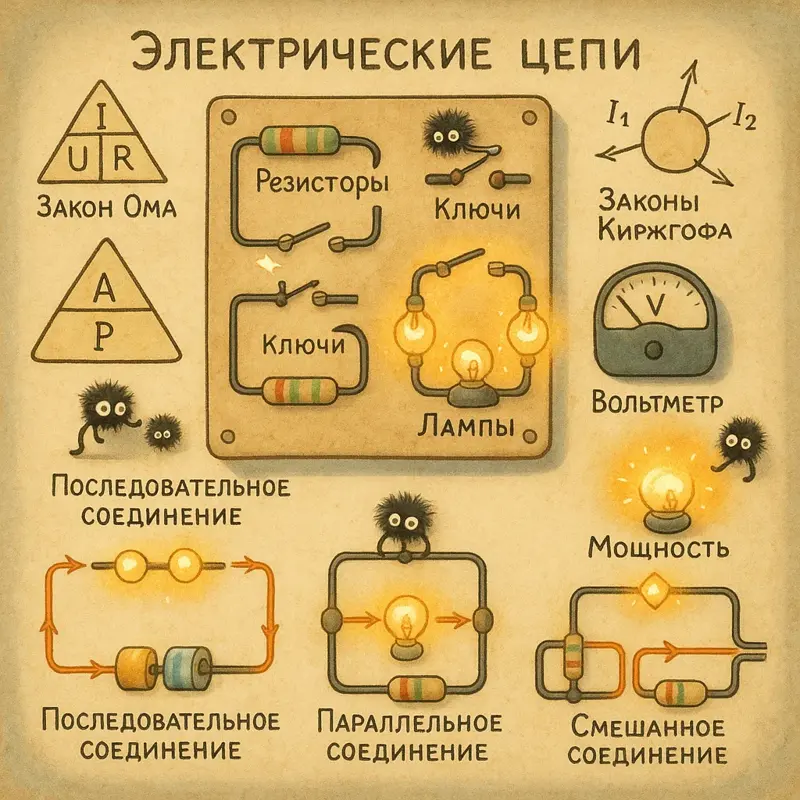
To avoid memorizing three formulas, it is convenient to use the "Ohm's Law triangle": cover the unknown quantity with your finger, and you will immediately see how to calculate it.
Ohm's Law triangle
In the triangle, voltage U is at the top, while current I and resistance R are at the bottom. Cover the quantity you are looking for: if U and R remain side-by-side horizontally, multiply them (\(U=I\cdot R\)); if one quantity is above the other, divide the top by the bottom (\(I=\frac{U}{R}\), \(R=\frac{U}{I}\)).
Units of measurement and instruments
All three Ohm's Law quantities are measured in SI units. Current is in amperes, voltage in volts, and resistance in ohms. It is important to use these specific units in the formula: if resistance is given in kilo-ohms (kΩ) or current in milliamperes (mA), convert them to the base units first.
| Quantity | Symbol | Unit (SI) | Instrument |
|---|---|---|---|
| Voltage | U | volt, V | voltmeter |
| Current | I | ampere, A | ammeter |
| Resistance | R | ohm, Ω | ohmmeter |
1 kΩ = 1000 Ω, 1 MΩ = 1,000,000 Ω, 1 mA = 0.001 A.Circuit segment and complete circuit
Ohm's Law is formulated in two ways, and it is important not to confuse them.
Ohm's Law for a circuit segment describes a separate part of a circuit without a power source (e.g., a single resistor): \(I=\dfrac{U}{R}\), where U is the voltage across that segment only.
Ohm's Law for a complete circuit describes the entire closed circuit including the source. Every source has an internal resistance r, so an additional term appears in the denominator:
Here ε (epsilon) is the EMF of the source, R is the external resistance of the circuit, and r is the internal resistance of the source. For a circuit segment, only external resistance is considered, while for a complete circuit, the "resistance inside the battery" is also included.
Series and parallel connection
Ohm's Law works for a single resistor as well as for an entire segment consisting of multiple resistors — you just need to find their total (equivalent) resistance first.
- Series connection (resistors in a "chain"): resistances add up — \(R=R_1+R_2+\dots\). The current through all resistors is the same, and voltages add up.
- Parallel connection (resistors in a "branch"): reciprocal values add up — \(\dfrac{1}{R}=\dfrac{1}{R_1}+\dfrac{1}{R_2}+\dots\). The voltage across all branches is the same, and currents add up.
Once you have found the total R, apply the standard Ohm's Law for a circuit segment: \(I=\dfrac{U}{R}\).
Examples of solving Ohm's Law problems
Example 1. Finding current
Condition. A voltage of \(U=12\) V is applied to a circuit segment with a resistance of \(R=4\) Ω. Find the current \(I\).
Solution. We write down Ohm's Law for a circuit segment:
Answer: current \(I=3\) A.
Example 2. Finding voltage
Condition. A current of \(I=0.5\) A flows through a resistor \(R=100\) Ω. Find the voltage \(U\) across the resistor.
Solution. We express voltage from Ohm's Law:
Answer: voltage \(U=50\) V.
Example 3. Finding resistance (with unit conversion)
Condition. A lamp is connected to a \(U=220\) V network, the current through it is \(I=2\) A. Find the resistance \(R\).
Solution.
If the current were given in milliamperes, for example \(I=200\) mA, we would convert it first: \(200\ \text{mA}=0.2\) A, and only then divide.
Answer: resistance \(R=110\) Ω.
Example 4. Segment with two resistors
Condition. Two resistors \(R_1=3\) Ω and \(R_2=6\) Ω are connected in series, the voltage across the segment is \(U=18\) V. Find the current.
Solution. With a series connection, resistances add up:
Now we apply Ohm's Law for the entire segment:
If the same resistors were connected in parallel, the total resistance would be calculated differently: \(\frac{1}{R}=\frac{1}{3}+\frac{1}{6}=\frac{1}{2}\), which means \(R=2\) Ω.
Answer: \(I=2\) A.
Common mistakes in solving problems
-
Confusing what to divide by what: writing R = I / U instead of R = U / I.
Stick to the Ohm's Law triangle. Voltage U is at the top, current I and resistance R are at the bottom. Divide the top quantity by the bottom one: I = U/R and R = U/I. And U = I·R — because I and R are side-by-side.
-
Substituting kilo-ohms and milliamperes into the formula without converting to base units.
Before substituting, convert everything to SI: 1 kΩ = 1000 Ω, 1 MΩ = 1,000,000 Ω, 1 mA = 0.001 A. Otherwise, the answer will be off by thousands.
-
Confusing voltage and current, labeling them with the same letter, or swapping them.
Voltage is U (volts, voltmeter is connected in parallel). Current is I (amperes, ammeter is connected in series). These are different quantities with different instruments.
-
Applying the I = U/R formula for a complete circuit and forgetting about the internal resistance of the source.
For a circuit segment (without a source), I = U/R is correct. For a complete circuit with a source, you must account for its internal resistance r: I = ε/(R+r).
-
Assuming that for a series connection, reciprocal values add up (like in parallel).
It's the opposite: in series, the resistances themselves add up (R = R₁ + R₂), in parallel, their reciprocals add up (1/R = 1/R₁ + 1/R₂).
Questions and answers
What is Ohm's Law for a circuit segment?
The current in a circuit segment is directly proportional to the voltage across that segment and inversely proportional to its resistance. Formula: I = U/R, where I is current (A), U is voltage (V), R is resistance (Ω).
How does Ohm's Law for a circuit segment differ from Ohm's Law for a complete circuit?
The law for a circuit segment (I = U/R) describes a separate piece of a circuit without a source and considers only its resistance R. The law for a complete circuit (I = ε/(R+r)) describes the entire closed circuit including the source and additionally considers the internal resistance of the source r and its EMF ε.
What is EMF in simple terms?
EMF (electromotive force, denoted by ε) is a quantity that shows the work a power source (battery, accumulator) performs to "push" a charge through the entire circuit. Simply put, it is the "source voltage" in an open circuit when no current is flowing yet. It is measured in volts.
How to express voltage and resistance from the formula I = U/R?
Voltage: U = I·R (current multiplied by resistance). Resistance: R = U/I (voltage divided by current). All three formulas are the same equality written for different quantities.
What are the units of measurement for the quantities in Ohm's Law?
Current is in amperes (A), voltage in volts (V), resistance in ohms (Ω). Kilo-ohms (kΩ) and milliamperes (mA) must be converted to base units before substituting into the formula: 1 kΩ = 1000 Ω, 1 mA = 0.001 A.
How will the current change if resistance is increased?
Current is inversely proportional to resistance. If the voltage remains the same and resistance is increased 2 times, the current will decrease 2 times. If resistance is halved, the current will double.