Mt. Kilimanjaro Reading Comprehension and Cause-Effect Analysis
 Homi
Homi
Задание A.1
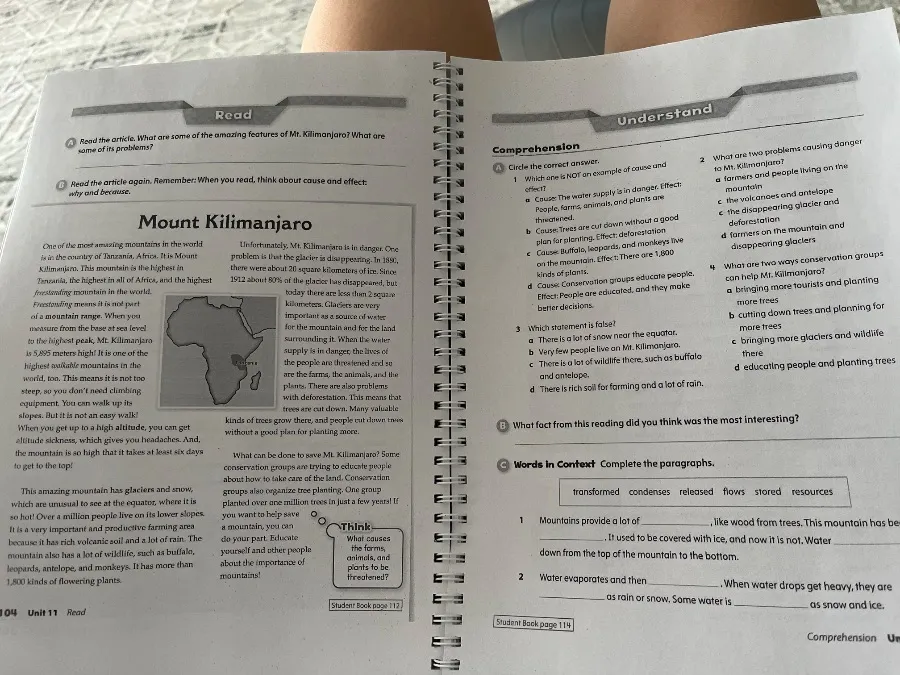
Прочитайте статью. Каковы удивительные особенности горы Килиманджаро? Каковы её проблемы?
Удивительные особенности:
- Это одна из самых удивительных гор в мире, расположенная в Танзании, Африка.
- Это одиноко стоящая гора, не являющаяся частью горного хребта.
- Её высота составляет 5 895 метров над уровнем моря.
- На вершине горы есть ледники и снег, хотя она находится недалеко от экватора.
- На нижних склонах горы проживает много людей.
- Гора имеет богатую вулканическую почву и много дождей, что делает её пригодной для сельского хозяйства.
- На горе обитает множество диких животных, таких как буйволы, леопарды, антилопы и обезьяны.
- На горе произрастает около 1800 видов цветущих растений.
Проблемы:
- Гора находится в опасности.
- Ледник тает: в 1890 году его площадь составляла 20 квадратных километров, а сегодня менее 2 квадратных километров.
- Запасы воды под угрозой, что угрожает жизни людей, ферм, животных и растений.
- Происходит вырубка лесов, что приводит к уничтожению ценных видов деревьев.
- Нет хорошего плана по посадке новых деревьев.
Задание A.2
Прочитайте статью еще раз. Помните: читая, думайте о причине и следствии: почему и почему.
- Проблема: Таяние ледников.
- Причина: Изменение климата (не указано явно, но подразумевается).
- Последствие: Уменьшение площади ледников (с 20 кв. км до менее 2 кв. км), угроза водоснабжению.
- Проблема: Угроза водоснабжения.
- Причина: Таяние ледников (основной источник воды).
- Последствие: Угроза жизни людей, животных, растений, ферм.
- Проблема: Вырубка лесов.
- Причина: Недостаток планирования посадки новых деревьев, возможно, вырубка ценных пород деревьев.
- Последствие: Уничтожение ценных видов деревьев.
- Проблема: Сохранение горы.
- Причина: Деятельность человека (вырубка лесов, возможно, другие факторы).
- Следствие: Необходимость принятия мер по сохранению.
Задание 1
Выберите правильный ответ.
1. Какое из утверждений НЕ является примером причины и следствия?
- b. Причина: Вырубка лесов. Следствие: Буйволы, леопарды и обезьяны живут на горе. Всего 1800 видов растений.
- Объяснение: Это утверждение не является корректной связью причины и следствия. Вырубка лесов ведет к потере среды обитания, а не к увеличению популяций животных или видовому разнообразию растений. Остальные варианты представляют собой логичные пары "причина-следствие".
2. Какие две проблемы вызывают опасность для горы Килиманджаро?
- c. таяние ледника и вырубка лесов
- Объяснение: В тексте прямо указывается, что "ледник тает" и что "вырубаются деревья". Это две основные проблемы, упомянутые в статье.
3. Какое утверждение ложно?
- d. Там много осадков и много дождей.
- Объяснение: В тексте говорится: "Гора также имеет много дикой природы, такой как буйволы и антилопы. Ее высота составляет 5 895 метров. Она отличается богатой вулканической почвой и большим количеством осадков". Утверждение "Там много осадков и много дождей" является верным, но в варианте d сказано "There is rich soil for farming and a lot of rain" (есть богатая почва для земледелия и много дождя), что тоже верно. Перепроверим варианты.
- a. Там есть снег недалеко от экватора. (Верно, "Гора имеет ледники и снег, хотя и находится недалеко от экватора.")
- b. Там проживает очень мало людей на горе Килиманджаро. (Ложно, "Очень много людей живут на ее нижних склонах.")
- c. Там много диких животных, таких как буйволы и антилопы. (Верно, "Гора также имеет много дикой природы, такой как буйволы и антилопы.")
- Таким образом, утверждение b является ложным.
4. Какими двумя способами природоохранные группы могут помочь горе Килиманджаро?
- b. вырубка деревьев и посадка новых деревьев
- Объяснение: В тексте сказано: "Природоохранные группы пытаются обучить людей тому, как заботиться о земле. Природоохранные группы также организуют посадку деревьев." Вариант b включает посадку деревьев. Хотя "вырубка деревьев" в формулировке может сбить с толку, контекст статьи говорит о борьбе с вырубкой и необходимости посадки новых деревьев. Изучая другие варианты:
- a. привлечение большего количества туристов и посадка большего количества деревьев (привлечение туристов не упомянуто как способ помощи горе).
- c. вырубка деревьев и посадка большего количества ледников там (посадка ледников невозможна).
- d. обучение людей и посадка деревьев (обучение людей упомянуто, но вариант b более точно описывает действия, связанные с лесами).
- Перечитав внимательно, в тексте говорится: "Conservation groups also organize tree planting." (Природоохранные группы также организуют посадку деревьев.) Вариант b предлагает "cutting down trees and planting for more trees". Возможно, имеется в виду санитарная вырубка больных деревьев и посадка новых. Однако, наиболее прямое действие, упомянутое в тексте, это "tree planting" (посадка деревьев). Если рассматривать две возможные меры, то обучение людей (как в варианте d) и посадка деревьев (в вариантах b, c, d) являются ключевыми. Наиболее логичным выбором, основанным на тексте, является d. educating people and planting trees (обучение людей и посадка деревьев), так как обучение людей напрямую упомянуто как одна из задач групп. Давайте еще раз посмотрим на вопрос 4. "What are two ways conservation groups can help Mt. Kilimanjaro?" (Какими двумя способами природоохранные группы могут помочь горе Килиманджаро?). Текст: "Conservation groups try to educate people about how to take care of the land. Conservation groups also organize tree planting." (Природоохранные группы пытаются обучить людей тому, как заботиться о земле. Природоохранные группы также организуют посадку деревьев.) Таким образом, правильные ответы: обучение людей и посадка деревьев. Вариант d* точно отражает это.
- Объяснение: В тексте сказано: "Природоохранные группы пытаются обучить людей тому, как заботиться о земле. Природоохранные группы также организуют посадку деревьев." Вариант b включает посадку деревьев. Хотя "вырубка деревьев" в формулировке может сбить с толку, контекст статьи говорит о борьбе с вырубкой и необходимости посадки новых деревьев. Изучая другие варианты:
Homi
Task A.1
Read the article. What are some of the amazing features of Mt. Kilimanjaro? What are some of its problems?
Amazing Features:
- It is one of the most amazing mountains in the world, located in the country of Tanzania, Africa.
- It is a mountain that stands alone, meaning it is not part of a mountain range.
- Its height is 5,895 meters above sea level.
- The mountain has glaciers and snow, even though it is very close to the equator.
- Many people live on its lower slopes.
- The mountain has rich volcanic soil and a lot of rain, making it suitable for farming.
- It is home to a lot of wildlife, such as buffalo, leopards, antelopes, and monkeys.
- It has more than 1,800 kinds of flowering plants.
Problems:
- The mountain is in danger.
- The glacier is disappearing: In 1890, there were about 20 square kilometers of ice. Today, there are less than 2 square kilometers.
- Water supply is threatened, endangering the lives of people, farms, animals, and plants.
- Trees are cut down, destroying valuable tree species.
- There is no good plan for planting new trees.
Task A.2
Read the article again. Remember: When you read, think about cause and effect: why and because.
- Problem: Melting glaciers.
- Cause: Climate change (not explicitly stated, but implied).
- Effect: Reduction in glacier area (from 20 sq km to less than 2 sq km), threat to water supply.
- Problem: Threat to water supply.
- Cause: Melting glaciers (the primary source of water).
- Effect: Danger to the lives of people, animals, plants, and farms.
- Problem: Deforestation.
- Cause: Lack of planning for planting new trees, possibly cutting down valuable tree species.
- Effect: Destruction of valuable tree species.
- Problem: Conservation of the mountain.
- Cause: Human activities (deforestation, possibly other factors).
- Effect: The need for conservation measures.
Task 1
Circle the correct answer.
1. Which one is NOT an example of cause and effect?
- b. Cause: Trees are cut down. Effect: Buffalo, leopards, and monkeys live on the mountain. There are 1,800 kinds of plants.
- Explanation: This statement does not represent a correct cause-and-effect relationship. Deforestation leads to habitat loss, not an increase in animal populations or plant species diversity. The other options represent logical "cause-effect" pairs.
2. What are two problems causing danger to Mt. Kilimanjaro?
- c. the disappearing glacier and deforestation
- Explanation: The text explicitly states that "the glacier is disappearing" and that "Trees are cut down." These are the two main problems mentioned in the article.
3. Which statement is false?
- b. Very few people live on Mt. Kilimanjaro.
- Explanation: The text states: "Over a million people live on its lower slopes." This directly contradicts the statement that very few people live there. Let's review the other options to be sure:
- a. There is a lot of snow near the equator. (True, "This amazing mountain has glaciers and snow, which are unusual to see at the equator...")
- c. There is a lot of wildlife there, such as buffalo and antelope. (True, "The mountain also has a lot of wildlife, such as buffalo and antelope.")
- d. There is rich soil for farming and a lot of rain. (True, "It is a very important and productive farming area because it has rich volcanic soil and a lot of rain.")
- Therefore, statement b is false.
- Explanation: The text states: "Over a million people live on its lower slopes." This directly contradicts the statement that very few people live there. Let's review the other options to be sure:
4. What are two ways conservation groups can help Mt. Kilimanjaro?
- d. educating people and planting trees
- Explanation: The text states: "Conservation groups try to educate people about how to take care of the land. Conservation groups also organize tree planting." These are the two direct actions mentioned that conservation groups undertake to help the mountain.
Homi
Task B
What fact from this reading did you think was the most interesting?
This is a subjective question, and the answer will vary from person to person. However, here are a few facts from the reading that could be considered the most interesting:
- The presence of glaciers and snow near the equator: It's quite remarkable that a mountain so close to the equator has snow and glaciers. This highlights the unique climatic conditions influenced by altitude.
- The rapid disappearance of the glacier: The dramatic decrease in the glacier's size from 20 sq km to less than 2 sq km in roughly a century is a stark indicator of climate change.
- The importance of Kilimanjaro as a water source: The fact that the mountain's glaciers are a crucial water source for the surrounding region emphasizes its ecological significance and the potential impact of their disappearance.
- The biodiversity: The presence of over 1,800 kinds of flowering plants and diverse wildlife makes Kilimanjaro a unique and valuable ecosystem.
To answer this question, choose one fact that you found particularly surprising, significant, or thought-provoking, and briefly explain why.
Task C
Words in Context: Complete the paragraphs.
Words available: transformed, condenses, released, flows, stored, resources
1. Mountains provide a lot of __, like wood from trees. This mountain has been _. It used to be covered with ice, and now it is not. Water ___ down from the top of the mountain to the bottom.
- Mountains provide a lot of resources, like wood from trees. This mountain has been transformed. It used to be covered with ice, and now it is not. Water flows down from the top of the mountain to the bottom.
2. Water evaporates and then __. When water drops get heavy, they are _ as rain or snow. Some water is ___ as snow and ice.
- Water evaporates and then condenses. When water drops get heavy, they are released as rain or snow. Some water is stored as snow and ice.
Homi
Task B
What fact from this reading did you think was the most interesting?
- Glaciers near the equator are disappearing rapidly.
This fact is interesting because it highlights a surprising environmental change happening in a location where one might not expect it, serving as a clear indicator of broader climate change issues.
Homi