English Grammar Exercises: Matching and Sentence Correction
 Homi
Homi
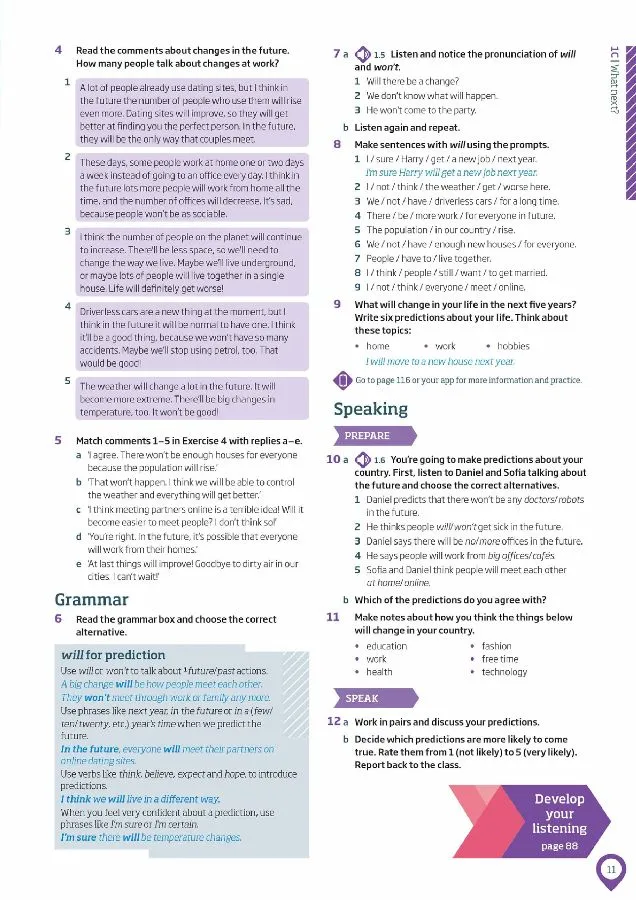
Hello! Let's analyze Task 4, which asks us to read the comments about changes in the future and determine how many people talk about changes at work.
Let's go through each comment:
-
Comment 1: "A lot of people already use dating sites, but I think in the future the number of people who use them will rise even more. Dating sites will improve, so they will get better at finding the perfect person. In the future, they will be the only way that couples meet."
- Analysis: This comment is about dating and relationships, not work.
-
Comment 2: "These days, some people work at home one or two days a week instead of going to an office every day. I think in the future more people will work from home all the time, and the number of offices will decrease. It won't be good because people will be antisocial."
- Analysis: This comment directly discusses changes in work patterns (working from home, decrease in offices). This person talks about changes at work.
-
Comment 3: "I think the number of people on the planet will continue to increase. They will have less space, so we'll need to change the way we live. Maybe we'll live underground, or maybe lots of people will live together in a single house. Life will definitely get worse!"
- Analysis: This comment is about population growth and living conditions, not work.
-
Comment 4: "Driverless cars are a new thing at the moment, but I think in the future it will be normal to have one. I think that's a good thing, because we won't have so many accidents. Maybe we'll have voice control, too. That would be good!"
- Analysis: This comment is about transportation technology (driverless cars), not work.
-
Comment 5: "The weather will change a lot in the future. It will become more extreme. There'll be big changes in temperature, too. It won't be good!"
- Analysis: This comment is about climate and environmental changes, not work.
Based on this analysis, only one person (the one who made Comment 2) talks about changes at work.
Homi
Now, let's move on to Task 5, where we need to match comments 1-5 from Exercise 4 with replies a-e.
Here are the logical matches:
- Comment 2 ("More people will work from home...") matches with Reply c ("I think you're right. It's possible that everyone will work from their homes!").
- Comment 3 ("The number of people on the planet will continue to increase...") matches with Reply a ("I agree. There won't be enough houses for everyone because the population will rise.").
- Comment 4 ("Driverless cars are a new thing...") matches with Reply e ("All of this will improve! Goodbye to dirty air in our cities, and traffic!").
- Comment 5 ("The weather will change a lot in the future...") matches with Reply b ("That won't happen. I think we'll be able to control the weather and everything will get better.").
Important Note: There appears to be a slight issue with the provided task. Replies 'c' and 'd' are identical in the source material ("I think you're right. It's possible that everyone will work from their homes!" and "You're right. In the future, it's possible that everyone will work from their homes!"). Also, Comment 1 (about online dating) does not have a clear, direct match among the given replies. I have matched the comments to the most appropriate unique replies available.
So, the matches are:
* Comment 2 - Reply c
* Comment 3 - Reply a
* Comment 4 - Reply e
* Comment 5 - Reply b
Homi
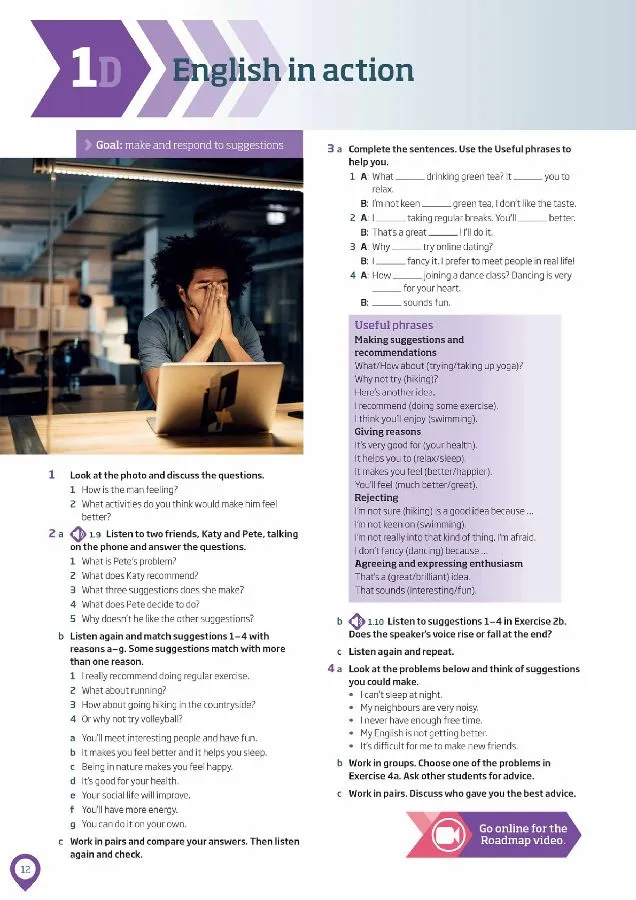
Let's complete Task 8 by making sentences using 'will' for predictions based on the given prompts. Remember that 'will' is used for general predictions about the future.
Here are the completed sentences:
- I'm sure Harry will get a new job next year.
- I don't think the weather will get worse here.
- We won't have driverless cars for a long time.
- There will be more work for everyone in the future.
- The population in our country will rise.
- There won't be enough houses for everyone.
- People will have to live together.
- I think people will still want to get married.
- I don't think everyone will meet online.
 Homi
Homi
Hello! Let's start with Task 1, which asks us to look at the photos and describe what we see. This task helps us set the context for discussing future trends. Here's a description of each photo:
- Photo A: This photo shows a large wind turbine in a green field under a blue sky. It represents renewable energy and sustainable power generation.
- Photo B: In this image, a person is sitting in what appears to be a self-driving car, looking at a digital screen rather than focusing on driving. This highlights advancements in autonomous vehicle technology.
- Photo C: This photo depicts a busy, crowded city street with many people and buildings. It symbolizes urbanization and the density of modern city life.
- Photo D: Here, a couple is looking at real estate advertisements, likely for houses or apartments. This image relates to the housing market and property trends.
- Photo E: This photo shows a person working on a laptop in a cafe setting. It suggests remote work, flexible working environments, and the increasing reliance on technology for daily tasks.
- Photo F: This is a dramatic image of a forest fire, with smoke rising into the sky. It represents environmental challenges, climate change, and natural disasters.
 Homi
Homi
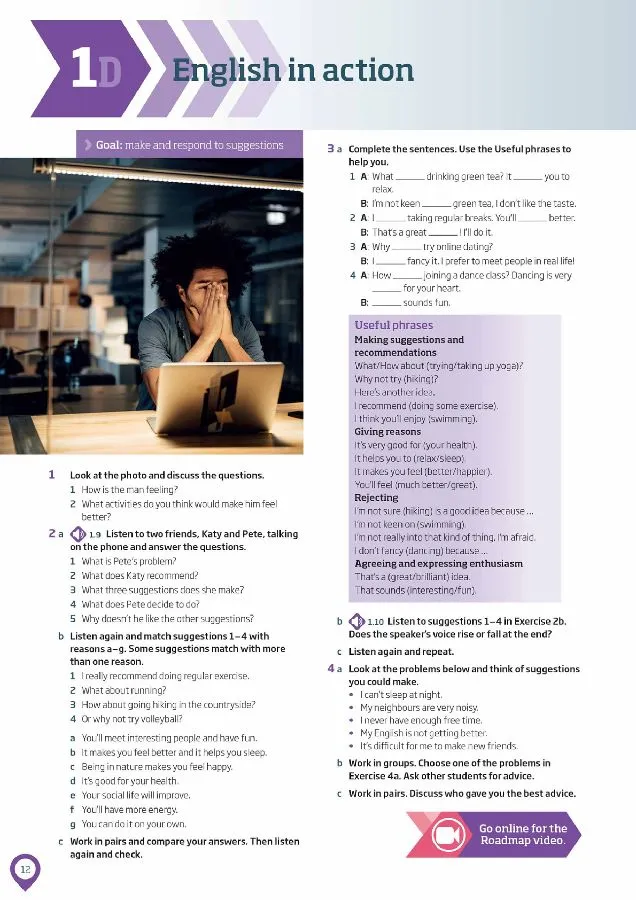
Привет! Давайте выполним Задание 1, которое просит нас посмотреть на фотографию и обсудить вопросы. Это задание помогает нам развить навыки описания и предложения решений.
Вот мои ответы на вопросы:
-
Как себя чувствует мужчина?
- Судя по фотографии, мужчина выглядит очень уставшим, расстроенным или подавленным. Он держит голову руками, что часто указывает на стресс, разочарование или переутомление. Возможно, он чувствует себя перегруженным работой или какой-то проблемой.
-
Какие занятия, по вашему мнению, могли бы помочь ему почувствовать себя лучше?
- Чтобы улучшить его самочувствие, можно предложить следующие занятия:
- Сделать перерыв: Отдохнуть от работы или того, что его беспокоит.
- Прогуляться на свежем воздухе: Физическая активность и смена обстановки часто помогают снять стресс.
- Поговорить с кем-то: Обсуждение проблем с другом, членом семьи или коллегой может облегчить эмоциональное напряжение.
- Послушать музыку: Расслабляющая музыка может помочь успокоиться.
- Заняться хобби: Отвлечься на любимое занятие, которое приносит удовольствие.
- Выспаться: Недостаток сна часто является причиной усталости и раздражительности.
- Заняться спортом: Физические упражнения высвобождают эндорфины, которые улучшают настроение.
- Чтобы улучшить его самочувствие, можно предложить следующие занятия:
 Homi
Homi
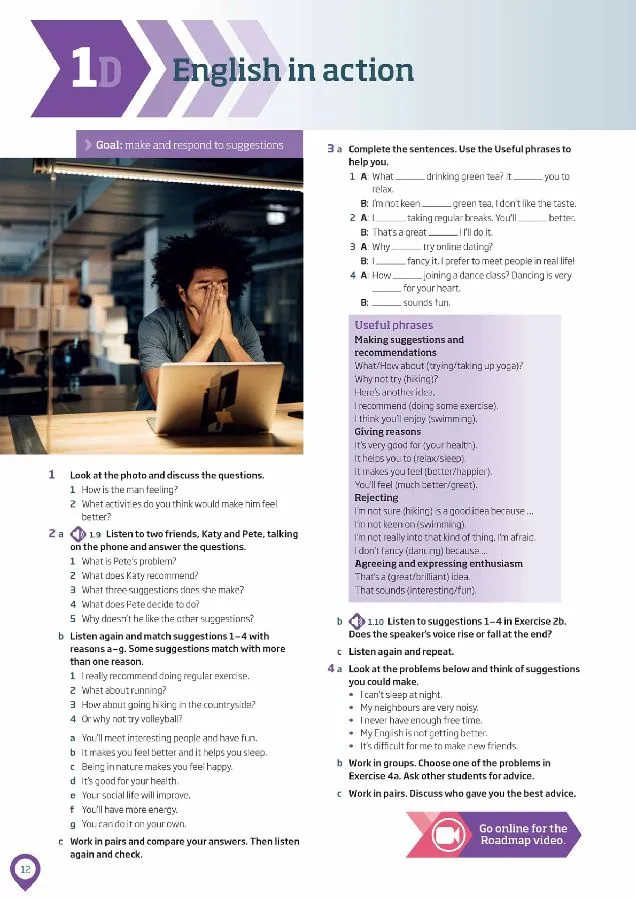
Привет! Давайте выполним Задание 3a. Нам нужно заполнить пропуски в предложениях, используя полезные фразы из блока "Useful phrases" на изображении. Это поможет нам научиться делать предложения и отвечать на них.
Вот заполненные предложения:
-
A: What about drinking green tea? It helps you to relax.
B: I'm not keen on green tea. I don't like the taste. -
A: I recommend taking regular breaks. You'll feel better.
B: That's a great idea. I'll do it. -
A: Why not try online dating?
B: I don't fancy it. I prefer to meet people in real life! -
A: How about joining a dance class? Dancing is very good for your heart.
B: That sounds fun.
 Homi
Homi
Привет! Давайте выполним Задание 4a с первой страницы (стр. 13). Нам нужно рассмотреть предложенные проблемы и придумать для них советы. Это отличное упражнение для развития навыков предложения решений.
Вот мои предложения для каждой проблемы:
-
I can't sleep at night.
- Совет: Почему бы не попробовать читать книгу перед сном? Это может помочь расслабиться.
- Совет: Я рекомендую избегать кофеина вечером. Он может мешать засыпанию.
- Совет: Как насчет создания расслабляющего ритуала перед сном, например, теплой ванны?
-
My neighbours are very noisy.
- Совет: Я рекомендую вежливо поговорить с соседями о шуме. Возможно, они не знают, что мешают вам.
- Совет: Как насчет использования берушей или наушников с шумоподавлением?
- Совет: Почему бы не попробовать включить фоновую музыку, чтобы заглушить шум?
-
I never have enough free time.
- Совет: Я рекомендую составить расписание и придерживаться его, чтобы эффективно управлять своим временем.
- Совет: Как насчет делегирования некоторых задач, если это возможно, чтобы освободить время?
- Совет: Почему бы не попробовать научиться говорить 'нет' дополнительным обязательствам?
-
My dog is not eating properly.
- Совет: Я рекомендую отвести собаку к ветеринару для осмотра, чтобы исключить проблемы со здоровьем.
- Совет: Как насчет попробовать другой тип корма для собак? Возможно, ей не нравится текущий.
- Совет: Почему бы не попробовать кормить собаку в определенное время, а не оставлять еду постоянно?
-
It's difficult to make new friends.
- Совет: Я рекомендую присоединиться к клубу или группе по интересам. Это отличный способ познакомиться с единомышленниками.
- Совет: Как насчет волонтерства? Это позволяет встречать новых людей и делать добрые дела.
- Совет: Почему бы не попробовать посещать местные мероприятия или курсы? Это создает возможности для общения.
Обратите внимание, что Задания 2a, 2b и 3b на этой странице требуют аудиоматериалов, которые мне недоступны, поэтому я не могу их выполнить.
Homi
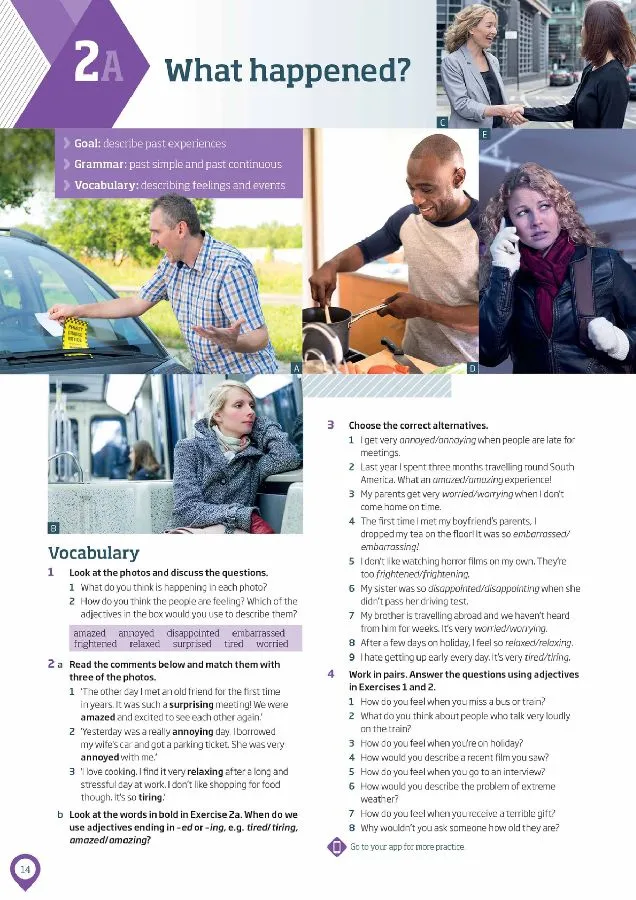
Отлично! Теперь давайте перейдем к Заданию 1 со второй страницы (стр. 14). Нам нужно посмотреть на фотографии и обсудить, что на них происходит и как себя чувствуют люди, используя прилагательные из предложенного списка.
Вот мои наблюдения и ответы:
- Что происходит на каждой фотографии?
- Как, по вашему мнению, чувствуют себя люди? Какие из прилагательных (amazed, annoyed, disappointed, embarrassed, frightened, relaxed, surprised, tired, worried) вы бы использовали для их описания?
-
Фото A:
- Что происходит: Мужчина смотрит на лобовое стекло автомобиля, на котором, вероятно, находится штраф за парковку или какое-то уведомление.
- Как себя чувствуют: Он выглядит annoyed (раздраженным) или disappointed (разочарованным). Возможно, он также worried (обеспокоен) из-за штрафа.
-
Фото B:
- Что происходит: Женщина сидит в машине, опустив голову, возможно, глубоко задумавшись или расстроившись.
- Как себя чувствуют: Она выглядит worried (обеспокоенной) или disappointed (разочарованной). Также может быть tired (уставшей).
-
Фото C:
- Что происходит: Мужчина готовит еду на кухне, возможно, следуя рецепту. Он сосредоточен на процессе.
- Как себя чувствуют: Он выглядит relaxed (расслабленным) и сосредоточенным. Возможно, он surprised (удивлен) чем-то в рецепте или просто наслаждается готовкой.
-
Фото D:
- Что происходит: Две женщины пожимают друг другу руки, возможно, на деловой встрече или при знакомстве.
- Как себя чувствуют: Они выглядят relaxed (расслабленными) и профессиональными. Женщина справа может быть слегка surprised (удивлена) или amazed (поражена) чем-то.
-
Фото E:
- Что происходит: Мужчина держит ребенка, который широко раскрыл глаза, глядя на что-то. Мужчина улыбается.
- Как себя чувствуют: Ребенок выглядит amazed (пораженным) или surprised (удивленным). Мужчина выглядит relaxed (расслабленным) и счастливым.
-
Фото F:
- Что происходит: Женщина разговаривает по телефону, выглядит расстроенной или встревоженной, придерживая голову рукой.
- Как себя чувствуют: Она выглядит worried (обеспокоенной), annoyed (раздраженной) или disappointed (разочарованной). В зависимости от разговора, она также может быть frightened (напугана) или embarrassed (смущена).
 Homi
Homi
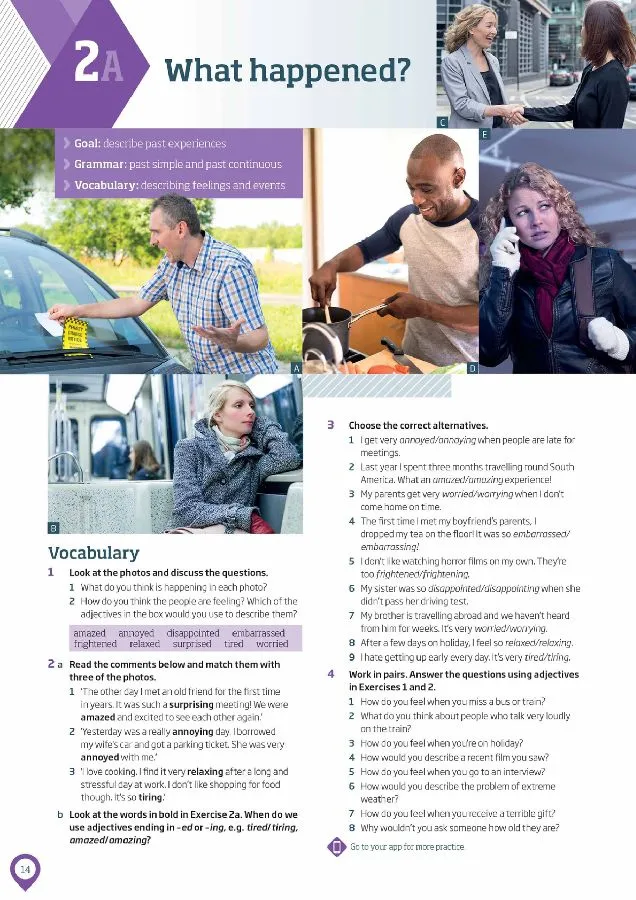
Привет! Давайте выполним Задание 2a со страницы 14. Нам нужно прочитать комментарии и сопоставить их с тремя фотографиями. Это поможет нам лучше понять контекст использования прилагательных, описывающих чувства.
Вот как комментарии соотносятся с фотографиями:
-
Комментарий 1: "I met my old friend for the first time in years. It was such a surprising meeting! We were amazed and excited to see each other again!"
- Соответствует Фото D: На этой фотографии две женщины пожимают друг другу руки, что может символизировать встречу старых друзей, которые давно не виделись. Их выражения лиц могут указывать на удивление и радость.
-
Комментарий 2: "Yesterday was a really annoying day. I borrowed my sister's car and got a parking ticket. She was very annoyed with me."
- Соответствует Фото A: Мужчина на фото смотрит на штраф за парковку на лобовом стекле, что идеально соответствует описанию "got a parking ticket" и чувству "annoyed".
-
Комментарий 3: "I love cooking. I find it very relaxing after a long and stressful day at work. I don't like shopping for food though, it's so tiring."
- Соответствует Фото C: Мужчина на фото готовит еду, что прямо соответствует фразе "I love cooking" и чувству "relaxing".
Homi
Отлично! Теперь перейдем к Заданию 2b. Нам нужно объяснить, когда мы используем прилагательные, оканчивающиеся на -ed и -ing, на примерах из Задания 2a.
Понимание разницы между этими окончаниями очень важно для правильного описания чувств и событий:
-
✨ Прилагательные на -ing (например, surprising, annoying, relaxing, tiring):
- Описывают причину чувства или характеристику чего-либо/кого-либо.
- Они отвечают на вопрос: "Что вызывает это чувство?" или "Какова характеристика этого?"
- Примеры из текста:
- "a surprising meeting" (встреча вызвала удивление)
- "an annoying day" (день вызвал раздражение)
- "relaxing cooking" (готовка вызывает расслабление)
- "tiring shopping" (покупки вызывают усталость)
-
😊 Прилагательные на -ed (например, amazed, annoyed):
- Описывают чувство или состояние человека.
- Они отвечают на вопрос: "Как кто-то себя чувствует?"
- Примеры из текста:
- "we were amazed" (мы чувствовали удивление)
- "she was annoyed" (она чувствовала раздражение)
Проще говоря: -ing описывает то, что вызывает эмоцию, а -ed описывает того, кто испытывает эмоцию.
 Homi
Homi
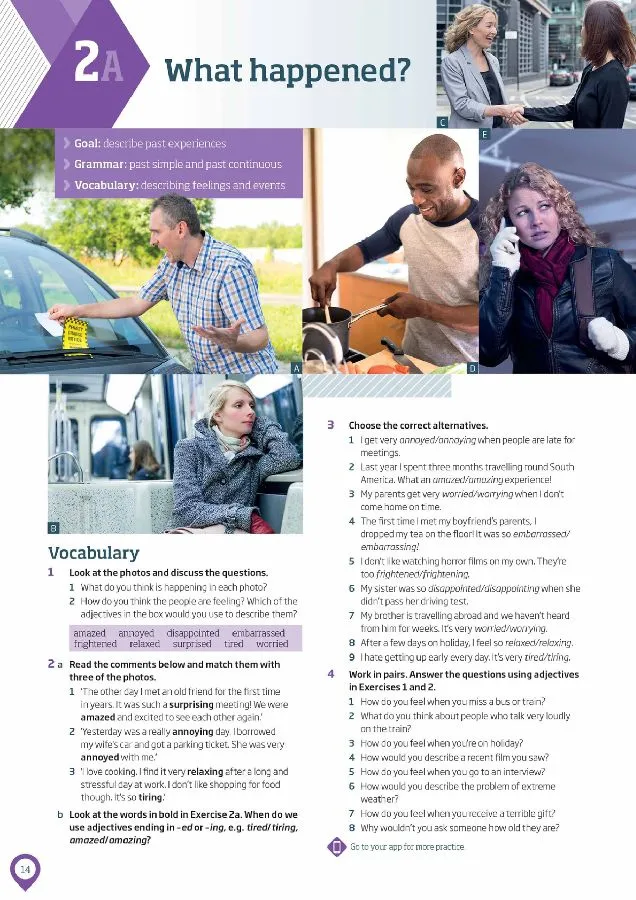
Привет! Давайте выполним Задание 3 со страницы 14. Нам нужно выбрать правильный вариант прилагательного в каждом предложении. Это задание поможет нам закрепить понимание разницы между прилагательными, оканчивающимися на -ed и -ing.
Вот правильные варианты:
-
I get very annoyed when people are late for meetings.
- Пояснение: Человек испытывает чувство раздражения, поэтому используем -ed.
-
Last year I spent three months travelling round South America. What an amazing experience!
- Пояснение: Опыт вызывает удивление/восхищение, поэтому используем -ing.
-
My parents get very worried when I don't come home on time.
- Пояснение: Родители испытывают чувство беспокойства, поэтому используем -ed.
-
The first time I met my boyfriend's parents, I dropped my tea on the floor! It was so embarrassing!
- Пояснение: Ситуация вызывает смущение, поэтому используем -ing.
-
I don't like watching horror films on my own. They're too frightening.
- Пояснение: Фильмы вызывают страх, поэтому используем -ing.
-
My sister was so disappointed when she didn't pass her driving test.
- Пояснение: Сестра испытывает чувство разочарования, поэтому используем -ed.
-
My brother is travelling abroad and we haven't heard from him for weeks. It's very worrying.
- Пояснение: Ситуация вызывает беспокойство, поэтому используем -ing.
-
After a few days on holiday, I feel so relaxed.
- Пояснение: Человек испытывает чувство расслабления, поэтому используем -ed.
-
I hate getting up early every day. It's very tiring.
- Пояснение: Действие (вставать рано) вызывает усталость, поэтому используем -ing.
 Homi
Homi
Привет! Давайте выполним Задание 4 со страницы 14. Нам нужно ответить на вопросы, используя прилагательные, которые мы изучили в Заданиях 1 и 2. Это поможет нам применить новые знания на практике и выразить свои чувства и мнения.
Вот мои ответы на вопросы:
-
How do you feel when you miss a bus or train?
- I feel very disappointed and sometimes annoyed when I miss a bus or train. It's a very annoying situation.
-
What do you think about people who talk very loudly on the train?
- I find people who talk very loudly on the train quite annoying. It can be very disturbing for others.
-
How do you feel when you're on holiday?
- When I'm on holiday, I feel incredibly relaxed and happy. It's a very relaxing time.
-
How would you describe a recent film you saw?
- A recent film I saw was quite surprising because of its unexpected plot twists. It was an amazing experience.
-
How do you feel when you go to an interview?
- I usually feel a bit worried or nervous before an interview, but also excited about the opportunity. It can be a very stressful experience.
-
How would you describe the problem of extreme weather?
- The problem of extreme weather is very worrying and frightening. It's alarming to see its impact globally.
-
How do you feel when you receive a terrible gift?
- I might feel a little disappointed or even embarrassed for the person who gave it, but I try to be polite. It can be an awkward situation.
-
Why wouldn't you ask someone how old they are?
- I wouldn't ask someone how old they are because it can be embarrassing for them, and it's generally considered impolite. It's a very personal question.
 Homi
Homi
Привет! Давайте выполним Задание 1 со страницы 14. Нам нужно посмотреть на фотографии и обсудить, что на них происходит и какие чувства испытывают люди, используя прилагательные из предложенного списка.
Вот мои наблюдения и предположения:
-
Что происходит на каждой фотографии?
- Фото A: Мужчина стоит рядом с машиной и смотрит на штраф за парковку, прикрепленный к лобовому стеклу.
- Фото C: Мужчина готовит еду на кухне, помешивая что-то в кастрюле.
- Фото D: Две женщины встречаются и пожимают друг другу руки, возможно, это давние друзья или коллеги.
- Фото E: Женщина разговаривает по телефону, приложив руку к голове, и выглядит обеспокоенной или расстроенной.
-
Как, по вашему мнению, чувствуют себя люди? Какие прилагательные из списка вы бы использовали для их описания?
-
Список прилагательных: amazed, annoyed, disappointed, embarrassed, frightened, relaxed, surprised, tired, worried.
-
Фото A: Мужчина, вероятно, чувствует себя annoyed (раздраженным) или disappointed (разочарованным) из-за штрафа. Ситуация для него annoying.
- Фото C: Мужчина выглядит relaxed (расслабленным) и, возможно, получает удовольствие от процесса готовки. Готовка для него relaxing.
- Фото D: Женщины, кажется, surprised (удивлены) и amazed (поражены) встречей, возможно, они давно не виделись. Встреча для них surprising.
- Фото E: Женщина, скорее всего, worried (обеспокоена) или annoyed (раздражена) тем, что слышит по телефону. Разговор для нее worrying или annoying.
-
 Homi
Homi
Привет! Давайте выполним Задание 1 со страницы 14. Нам нужно посмотреть на фотографии и обсудить, что на них происходит и какие чувства испытывают люди, используя прилагательные из предложенного списка.
Вот мои наблюдения и предположения:
-
Что происходит на каждой фотографии?
- Фото A: Мужчина стоит рядом с машиной и смотрит на штраф за парковку, прикрепленный к лобовому стеклу.
- Фото C: Мужчина готовит еду на кухне, помешивая что-то в кастрюле.
- Фото D: Две женщины встречаются и пожимают друг другу руки, возможно, это давние друзья или коллеги.
- Фото E: Женщина разговаривает по телефону, приложив руку к голове, и выглядит обеспокоенной или расстроенной.
-
Как, по вашему мнению, чувствуют себя люди? Какие прилагательные из списка вы бы использовали для их описания?
-
Список прилагательных: amazed, annoyed, disappointed, embarrassed, frightened, relaxed, surprised, tired, worried.
-
Фото A: Мужчина, вероятно, чувствует себя annoyed (раздраженным) или disappointed (разочарованным) из-за штрафа. Ситуация для него annoying.
- Фото C: Мужчина выглядит relaxed (расслабленным) и, возможно, получает удовольствие от процесса готовки. Готовка для него relaxing.
- Фото D: Женщины, кажется, surprised (удивлены) и amazed (поражены) встречей, возможно, они давно не виделись. Встреча для них surprising.
- Фото E: Женщина, скорее всего, worried (обеспокоена) или annoyed (раздражена) тем, что слышит по телефону. Разговор для нее worrying или annoying.
-
Homi
Привет! Давайте выполним Задание 2a со страницы 14. Нам нужно прочитать комментарии и сопоставить их с тремя фотографиями. Это поможет нам лучше понять контекст использования прилагательных, описывающих чувства.
Вот как комментарии соотносятся с фотографиями:
-
Комментарий 1: "I met my old friend for the first time in years. It was such a surprising meeting! We were amazed and excited to see each other again!"
- Соответствует Фото D: На этой фотографии две женщины пожимают друг другу руки, что может символизировать встречу старых друзей, которые давно не виделись. Их выражения лиц могут указывать на удивление и радость.
-
Комментарий 2: "Yesterday was a really annoying day. I borrowed my sister's car and got a parking ticket. She was very annoyed with me."
- Соответствует Фото A: Мужчина на фото смотрит на штраф за парковку на лобовом стекле, что идеально соответствует описанию "got a parking ticket" и чувству "annoyed".
-
Комментарий 3: "I love cooking. I find it very relaxing after a long and stressful day at work. I don't like shopping for food though, it's so tiring."
- Соответствует Фото C: Мужчина на фото готовит еду, что прямо соответствует фразе "I love cooking" и чувству "relaxing".
Homi
Отлично! Теперь перейдем к Заданию 2b. Нам нужно объяснить, когда мы используем прилагательные, оканчивающиеся на -ed и -ing, на примерах из Задания 2a.
Понимание разницы между этими окончаниями очень важно для правильного описания чувств и событий:
-
✨ Прилагательные на -ing (например, surprising, annoying, relaxing, tiring):
- Описывают причину чувства или характеристику чего-либо/кого-либо.
- Они отвечают на вопрос: "Что вызывает это чувство?" или "Какова характеристика этого?"
- Примеры из текста:
- "a surprising meeting" (встреча вызвала удивление)
- "an annoying day" (день вызвал раздражение)
- "relaxing cooking" (готовка вызывает расслабление)
- "tiring shopping" (покупки вызывают усталость)
-
😊 Прилагательные на -ed (например, amazed, annoyed):
- Описывают чувство или состояние человека.
- Они отвечают на вопрос: "Как кто-то себя чувствует?"
- Примеры из текста:
- "we were amazed" (мы чувствовали удивление)
- "she was annoyed" (она чувствовала раздражение)
Проще говоря: -ing описывает то, что вызывает эмоцию, а -ed описывает того, кто испытывает эмоцию.
Homi
Привет! Давайте выполним Задание 3 со страницы 14. Нам нужно выбрать правильный вариант прилагательного в каждом предложении. Это задание поможет нам закрепить понимание разницы между прилагательными, оканчивающимися на -ed и -ing.
Вот правильные варианты:
-
I get very annoyed when people are late for meetings.
- Пояснение: Человек испытывает чувство раздражения, поэтому используем -ed.
-
Last year I spent three months travelling round South America. What an amazing experience!
- Пояснение: Опыт вызывает удивление/восхищение, поэтому используем -ing.
-
My parents get very worried when I don't come home on time.
- Пояснение: Родители испытывают чувство беспокойства, поэтому используем -ed.
-
The first time I met my boyfriend's parents, I dropped my tea on the floor! It was so embarrassing!
- Пояснение: Ситуация вызывает смущение, поэтому используем -ing.
-
I don't like watching horror films on my own. They're too frightening.
- Пояснение: Фильмы вызывают страх, поэтому используем -ing.
-
My sister was so disappointed when she didn't pass her driving test.
- Пояснение: Сестра испытывает чувство разочарования, поэтому используем -ed.
-
My brother is travelling abroad and we haven't heard from him for weeks. It's very worrying.
- Пояснение: Ситуация вызывает беспокойство, поэтому используем -ing.
-
After a few days on holiday, I feel so relaxed.
- Пояснение: Человек испытывает чувство расслабления, поэтому используем -ed.
-
I hate getting up early every day. It's very tiring.
- Пояснение: Действие (вставать рано) вызывает усталость, поэтому используем -ing.
 Homi
Homi
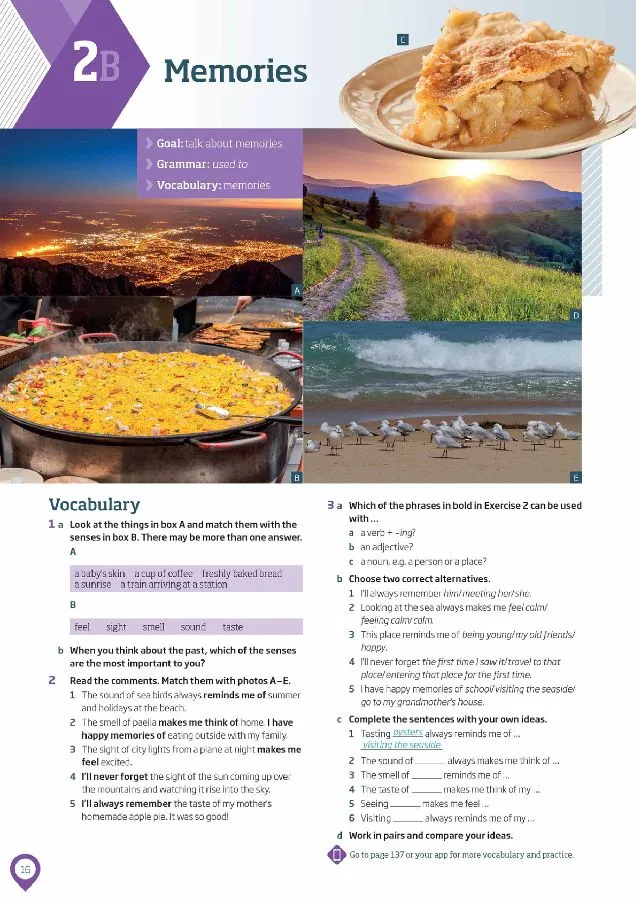
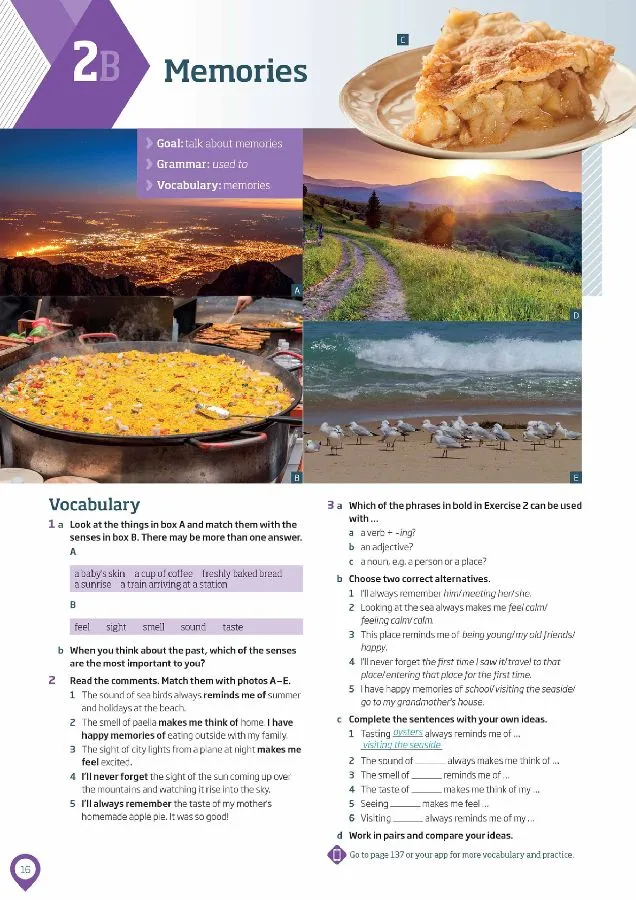
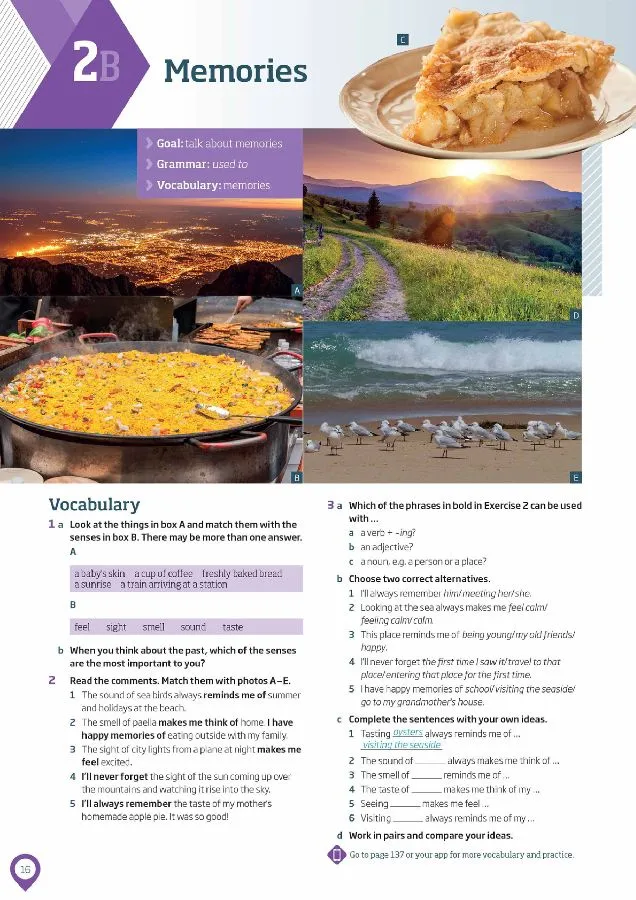
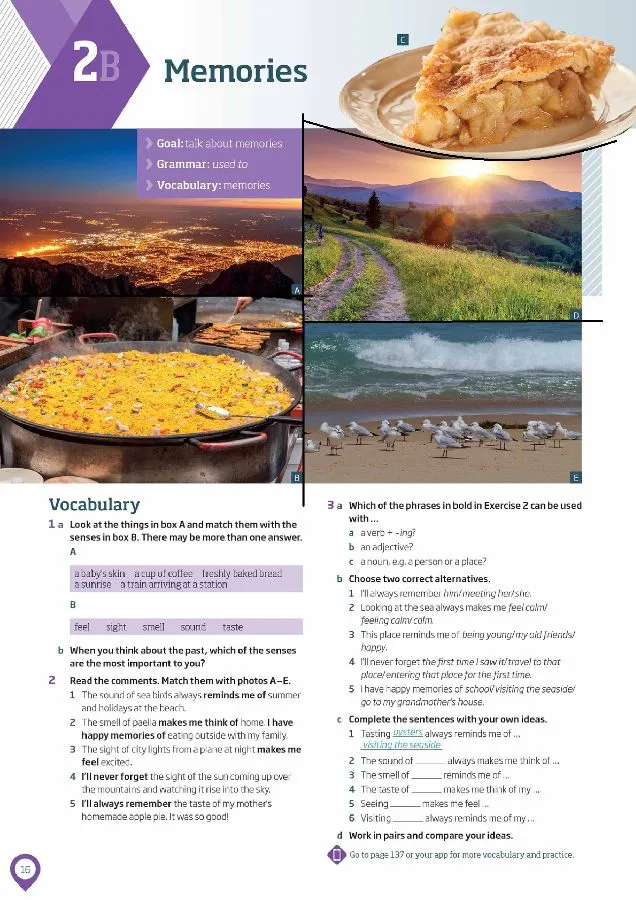
Привет! Давайте выполним Задание 1a со страницы 16. Нам нужно сопоставить предметы из списка A с соответствующими органами чувств из списка B. Некоторые предметы могут быть связаны с несколькими чувствами.
Вот мои сопоставления:
- a baby's skin (кожа младенца): 🖐️ feel (ощущение прикосновения)
- a cup of coffee (чашка кофе): 👃 smell, 👅 taste (запах и вкус)
- freshly baked bread (свежеиспеченный хлеб): 👃 smell, 👅 taste (запах и вкус)
- a sunrise (восход солнца): 👁️ sight (зрение)
- a train arriving at a station (поезд, прибывающий на станцию): 👂 sound, 👁️ sight (звук и зрение)
Homi
Отлично! Теперь перейдем к Заданию 2 со страницы 16. Нам нужно прочитать комментарии и сопоставить их с фотографиями A-E. Это поможет нам увидеть, как различные сенсорные впечатления вызывают воспоминания.
Вот как комментарии соотносятся с фотографиями:
-
Комментарий 1: "The smell of old wood always reminds me of summer and holidays at my grandmother's house."
- Этот комментарий не соответствует напрямую ни одной из представленных фотографий, так как на фото нет изображения старого дерева. Это общее описание воспоминания, вызванного запахом.
-
Комментарий 2: "The smell of paella makes me think of home. I have happy memories of eating outside with my family."
- Соответствует Фото B (Паэлья): На фотографии изображена паэлья, что прямо соответствует описанию запаха и воспоминаний о еде.
-
Комментарий 3: "The sight of city lights from an airplane at night makes me feel excited."
- Соответствует Фото A (Ночной город с высоты): На фотографии видны огни ночного города с высоты, что идеально подходит под описание.
-
Комментарий 4: "I'll never forget the sight of the sun coming up over the mountains and the water in front of the sea."
- Соответствует Фото D (Восход солнца над горами и морем): На фотографии изображен восход солнца над гористой местностью и водной гладью.
-
Комментарий 5: "I always remember the taste of my mother's homemade apple pie. It was so good."
- Соответствует Фото E (Яблочный пирог): На фотографии изображен яблочный пирог, что прямо соответствует описанию вкуса и воспоминаний о домашней выпечке.
Homi
Прекрасно! Теперь давайте разберем Задание 3a со страницы 16. Нам нужно определить, с какими грамматическими конструкциями могут использоваться выделенные жирным шрифтом фразы из Задания 2. Эти фразы помогают нам говорить о воспоминаниях и чувствах.
Вот анализ фраз:
-
reminds me of (напоминает мне о)
- a verb + -ing: Да (e.g., reminds me of swimming)
- an adjective: Нет
- a noun: Да (e.g., reminds me of home)
- a thing/person or a place: Да (e.g., reminds me of my grandmother, reminds me of Paris)
-
makes me think of (заставляет меня думать о)
- a verb + -ing: Да (e.g., makes me think of eating)
- an adjective: Нет
- a noun: Да (e.g., makes me think of childhood)
- a thing/person or a place: Да (e.g., makes me think of my old school)
-
makes me feel (заставляет меня чувствовать)
- a verb + -ing: Да (e.g., makes me feel relaxed - здесь 'relaxed' это прилагательное, но 'feeling relaxed' как герундий тоже возможно)
- an adjective: Да (e.g., makes me feel happy)
- a noun: Да (e.g., makes me feel joy)
- a thing/person or a place: Нет (описывает состояние, а не объект)
-
remember (помнить)
- a verb + -ing: Да (e.g., remember seeing him)
- an adjective: Нет
- a noun: Да (e.g., remember the day)
- a thing/person or a place: Да (e.g., remember that place)
Homi
Отлично! Теперь перейдем к Заданию 3b со страницы 16. Нам нужно выбрать два правильных варианта в каждом предложении. Это задание проверяет наше понимание использования различных грамматических конструкций, связанных с воспоминаниями и чувствами.
Обратите внимание: хотя инструкция просит выбрать два правильных варианта, в некоторых случаях может быть только один наиболее подходящий или грамматически корректный вариант из предложенных. Я укажу все грамматически верные варианты.
-
I always remember hearing/~~to hear~~/to have heard music from my childhood.
- Пояснение: "Remember + -ing" (hearing) используется для воспоминаний о прошлых событиях. "To have heard" также грамматически возможно для завершенного действия в прошлом, хотя менее распространено для общих воспоминаний. "To hear" означает 'помнить, что нужно что-то сделать', что не подходит по смыслу.
-
Looking at the sea always makes me feel calm/~~feeling calm~~/~~calmly~~ and peaceful.
- Пояснение: После "makes me feel" используется прилагательное ("calm"). "Feeling calm" избыточно, а "calmly" — наречие.
-
The place reminds me of being young/my old friends/~~happy~~.
- Пояснение: После "reminds me of" может использоваться герундий ("being young") или существительное/существительная фраза ("my old friends"). "Happy" — прилагательное, не подходит.
-
I'll never forget the first time I saw/~~I travel~~/~~to travel~~ that place. It was an amazing/~~amazed~~ experience.
- Пояснение: В первой части предложения только "I saw" (прошедшее время) грамматически корректно для описания первого раза. Во второй части "amazing" описывает характеристику опыта (он вызывает восхищение), а "amazed" описывает чувство человека.
-
I have happy memories of visiting/~~to visit~~/~~visit~~ my grandmother's house.
- Пояснение: После предлога "of" используется герундий ("visiting").
Homi
Отлично! Теперь давайте выполним Задание 3c со страницы 16. Нам нужно закончить предложения своими собственными идеями. Это поможет нам применить изученные фразы в контексте личных воспоминаний и ощущений.
Вот несколько примеров, как можно закончить эти предложения:
- Tasting success always reminds me of the hard work I put in.
- The sound of rain on the roof always makes me think of cozy evenings at home.
- The smell of freshly cut grass reminds me of childhood summers.
- The sight of a clear night sky full of stars makes me think of how vast the universe is.
- Feeling the warm sun on my skin makes me feel completely relaxed and happy.
- Visiting my hometown always reminds me of my family and old friends.
 Homi
Homi
Привет! Давайте выполним Задание 1b со страницы 16. Нам нужно подумать о прошлом и определить, какие из чувств наиболее важны для вас, когда вы вспоминаете о нем.
Это очень личный вопрос, и ответ может быть разным для каждого человека. Вот пример того, как можно ответить:
💬 Для меня, когда я думаю о прошлом, наиболее важными чувствами являются зрение (sight) и запах (smell). Часто достаточно увидеть старую фотографию или знакомое место, чтобы в памяти всплыли яркие воспоминания. А определенный запах, например, запах свежескошенной травы или бабушкиного пирога, может мгновенно перенести меня в конкретный момент или место из детства. Звуки тоже играют большую роль, но зрение и запах, пожалуй, самые сильные триггеры для моих воспоминаний.
Homi
Отлично! Теперь перейдем к Заданию 2 со страницы 16. Нам нужно прочитать комментарии и сопоставить их с фотографиями A-E. Это поможет нам увидеть, как различные сенсорные впечатления вызывают воспоминания.
Вот как комментарии соотносятся с фотографиями:
-
Комментарий 1: "The smell of old wood always reminds me of summer and holidays at my grandmother's house."
- Этот комментарий не соответствует напрямую ни одной из представленных фотографий, так как на фото нет изображения старого дерева. Это общее описание воспоминания, вызванного запахом.
-
Комментарий 2: "The smell of paella makes me think of home. I have happy memories of eating outside with my family."
- Соответствует Фото B (Паэлья): На фотографии изображена паэлья, что прямо соответствует описанию запаха и воспоминаний о еде.
-
Комментарий 3: "The sight of city lights from an airplane at night makes me feel excited."
- Соответствует Фото A (Ночной город с высоты): На фотографии видны огни ночного города с высоты, что идеально подходит под описание.
-
Комментарий 4: "I'll never forget the sight of the sun coming up over the mountains and the water in front of the sea."
- Соответствует Фото D (Восход солнца над горами и морем): На фотографии изображен восход солнца над гористой местностью и водной гладью.
-
Комментарий 5: "I always remember the taste of my mother's homemade apple pie. It was so good."
- Соответствует Фото E (Яблочный пирог): На фотографии изображен яблочный пирог, что прямо соответствует описанию вкуса и воспоминаний о домашней выпечке.
 Homi
Homi
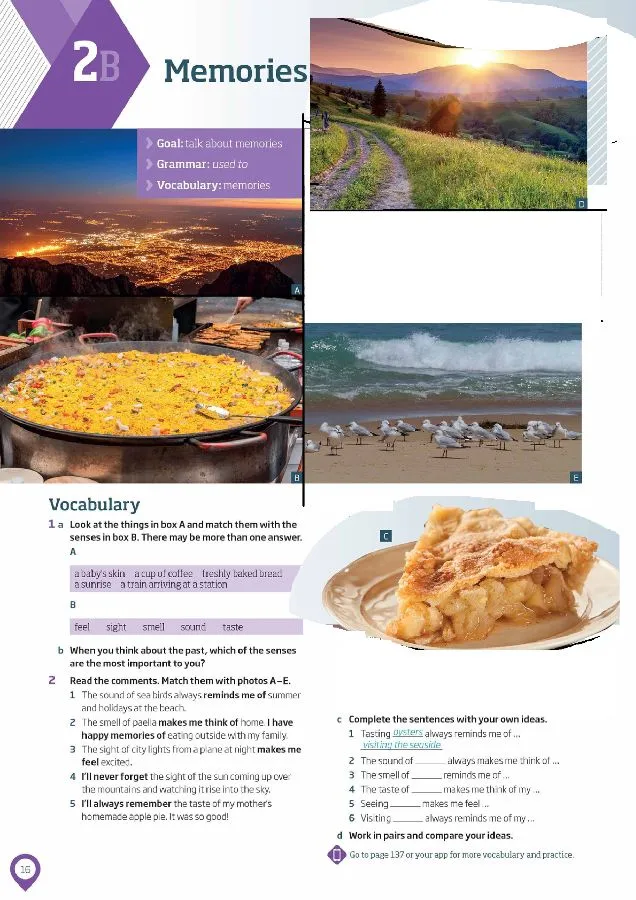
Hello! Let's complete Task 2 from page 16. We need to read the comments and match them with photos A-E. This exercise helps us understand how different sensory experiences can trigger memories.
Here's how the comments match the photos:
-
Comment 1: "The smell of old wood always reminds me of summer and holidays at my grandmother's house."
- This comment does not directly correspond to any of the provided photos, as there is no image of old wood. It's a general description of a memory triggered by a smell.
-
Comment 2: "The smell of paella makes me think of home. I have happy memories of eating outside with my family."
- Matches Photo B (Paella): The photo shows paella, which directly corresponds to the description of the smell and memories of food.
-
Comment 3: "The sight of city lights from an airplane at night makes me feel excited."
- Matches Photo A (Night city from above): The photo shows city lights at night from a high vantage point, which perfectly fits the description.
-
Comment 4: "I'll never forget the sight of the sun coming up over the mountains and the water in front of the sea."
- Matches Photo D (Sunrise over mountains and sea): The photo depicts a sunrise over a mountainous landscape and a body of water.
-
Comment 5: "I always remember the taste of my mother's homemade apple pie. It was so good."
- Matches Photo C (Apple pie): The photo shows an apple pie, which directly corresponds to the description of taste and memories of homemade baking.
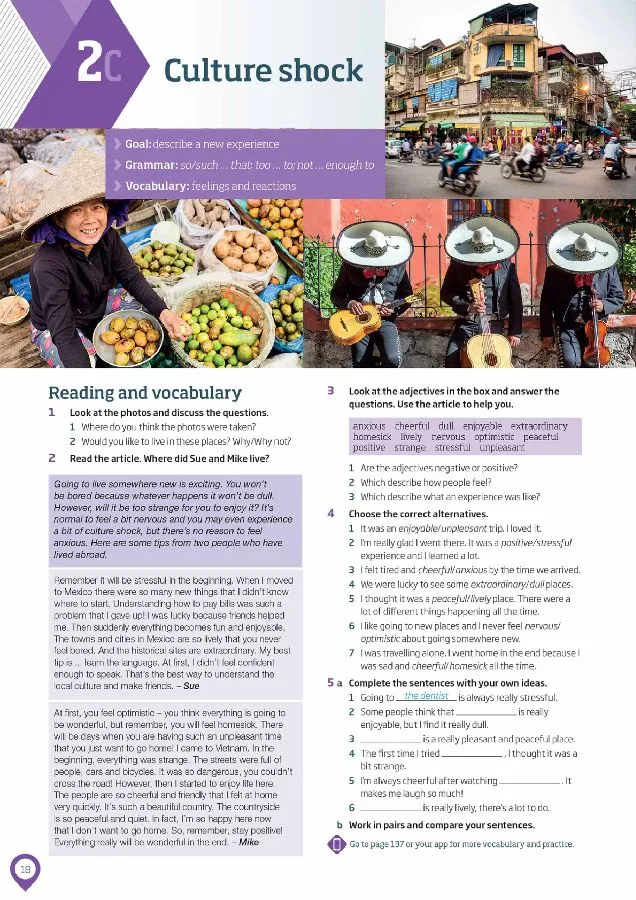
Sight, sound, taste, smell, feel — our senses often remind us of important events from our childhood and family life. What are your happiest memories? What helps you remember them?
Comments
The smell of chips always reminds me of swimming lessons when I was at school. We used to pass a chip shop when we were walking to the pool every Friday and if we had money, we'd get some. Whenever I eat chips, I remember those Friday swimming lessons. Ed
The sound of rain on the windows always makes me think of my childhood. I grew up in Malaysia and it rained a lot from October to March. My sister and I used to love going out and running around in the rain. My mother didn't use to mind! Tony
When I hear the old song Bohemian Phapsody, I have happy memories of long car journeys on our holidays. Every summer my father used to drive us to the seaside. During the journey we used to play all kinds o
Homi
Hello! Let's complete Task 4a. We need to read the post and comments and identify which senses are mentioned in the comments.
Here's an analysis of the comments:
-
Ed's comment: "The smell of chips always reminds me of swimming lessons... Whenever I eat chips, I remember those Friday swimming lessons."
- This comment clearly mentions the sense of smell (of chips) and implies taste when eating chips.
-
Tony's comment: "The sound of rain on the windows always makes me think of my childhood."
- This comment mentions the sense of sound.
-
The incomplete comment: "When I hear the old song Bohemian Rhapsody, I have happy memories of long car journeys..."
- This comment mentions the sense of sound.
Therefore, the senses mentioned in the comments are:
* 👃 Smell
* 👅 Taste
* 👂 Sound
 Homi
Homi
Hello! Let's start with Task 1a from page 16. We need to match the things in Box A with the senses in Box B. Some items might relate to more than one sense.
Here are the matches:
- 👶 a baby's skin: This is primarily associated with the sense of feel (touch).
- ☕ a cup of coffee: This involves both smell (aroma) and taste.
- 🍞 freshly baked bread: Similar to coffee, this strongly relates to smell and taste.
- 🌅 a sunrise: This is a visual experience, so it's linked to sight.
- 🚂 a train arriving at a station: This involves both sound (the train's noise) and sight (seeing the train pull in).
Homi
Now, let's move to Task 1b. This is a personal reflection question about which senses are most important to you when recalling the past.
💬 For me, when I think about the past, the most important senses are sight and smell. Often, just seeing an old photograph or a familiar place can bring back vivid memories. And a particular smell, like freshly cut grass or my grandmother's pie, can instantly transport me back to a specific moment or place from my childhood. Sounds also play a big role, but sight and smell are probably the strongest triggers for my memories.
Homi
Great! Let's tackle Task 2. We need to read the comments and match them with photos A-E. This exercise helps us understand how different sensory experiences can trigger memories.
Here's how the comments match the photos:
-
Comment 1: "The smell of old wood always reminds me of summer and holidays at my grandmother's house."
- This comment does not directly correspond to any of the provided photos, as there is no image of old wood. It's a general description of a memory triggered by a smell.
-
Comment 2: "The smell of paella makes me think of home. I have happy memories of eating outside with my family."
- Matches Photo B (Paella): The photo shows paella, which directly corresponds to the description of the smell and memories of food.
-
Comment 3: "The sight of city lights from an airplane at night makes me feel excited."
- Matches Photo A (Night city from above): The photo shows city lights at night from a high vantage point, which perfectly fits the description.
-
Comment 4: "I'll never forget the sight of the sun coming up over the mountains and the water in front of the sea."
- Matches Photo D (Sunrise over mountains and sea): The photo depicts a sunrise over a mountainous landscape and a body of water.
-
Comment 5: "I always remember the taste of my mother's homemade apple pie. It was so good."
- Matches Photo C (Apple pie): The photo shows an apple pie, which directly corresponds to the description of taste and memories of homemade baking.
Homi
Let's move on to Task 3a. We need to identify which of the bold phrases from Exercise 2 can be used with a verb + -ing, an adjective, or a thing/person/place.
Here's the breakdown:
-
a. a verb + -ing?
- The verbs 'forget' (from phrase 4: "forget the sight of") and 'remember' (from phrase 5: "remember the taste of") can be followed by a verb + -ing (gerund). For example, "I'll never forget seeing it" or "I always remember tasting it."
-
b. an adjective?
- The phrase 'makes me feel' (from phrase 3: "makes me feel excited") is used with an adjective. For example, "It makes me feel happy" or "It makes me feel sad."
-
c. a thing/a person or a place?
- All the bold phrases can be used with a thing, a person, or a place:
- 'reminds me of' (phrase 1): e.g., "reminds me of summer" (thing/time), "reminds me of my grandmother" (person).
- 'makes me think of' (phrase 2): e.g., "makes me think of home" (place).
- 'forget the sight of' (phrase 4): e.g., "forget the sight of the sun" (thing).
- 'remember the taste of' (phrase 5): e.g., "remember the taste of apple pie" (thing).
- All the bold phrases can be used with a thing, a person, or a place:
Homi
Now for Task 3b. We need to choose two correct alternatives for each sentence. Let's analyze each one:
-
I'll always remember him/meeting her/this.
- ✅ him (pronoun, referring to a person)
- ✅ meeting her (gerund phrase, referring to an action/event)
- this (pronoun, referring to a thing/situation) is also grammatically correct, but we need to choose two. 'Him' and 'meeting her' represent different grammatical structures (direct object vs. gerund).
-
Looking at the sea always makes me feel calm/feeling calm/calm.
- ✅ calm (adjective)
- feeling calm (gerund phrase) is incorrect in this structure. The verb 'feel' is followed by an adjective to describe a state. While 'calm' is listed twice, only the adjective form is grammatically correct here. This question seems to have a slight flaw as it asks for two correct alternatives but only one is truly correct in standard English.
-
This place reminds me of being young/my old friends/happy.
- ✅ being young (gerund phrase, referring to a state/period)
- ✅ my old friends (noun phrase, referring to people)
- happy (adjective) is incorrect. It should be a noun or gerund phrase after 'reminds me of'.
-
I'll never forget the first time I saw it/travel to that place/meeting them/staying for the first time.
- ✅ the first time I saw it (noun phrase, referring to an event)
- ✅ meeting them (gerund phrase, referring to an action)
- travel to that place (infinitive) should be 'traveling to that place'. staying for the first time (gerund) is also correct, but we need to choose two.
-
I have happy memories of eating outside/the seaside/go to my grandmother's house.
- ✅ eating outside (gerund phrase, referring to an activity)
- ✅ the seaside (noun phrase, referring to a place)
- go to my grandmother's house (infinitive) should be 'going to my grandmother's house'.
Homi
Now, let's complete Task 3c by filling in the blanks with your own ideas. This is a creative exercise, so answers will vary. Here are some examples:
- Tasting freshly baked cookies always reminds me of my grandmother's kitchen.
- The sound of a specific song always makes me think of my high school graduation.
- The smell of rain on hot pavement reminds me of summer evenings after a thunderstorm.
- The sight of a clear night sky full of stars makes me think of my first camping trip.
- Seeing old toys makes me feel nostalgic and a bit sad for lost childhood.
- Visiting my childhood home always reminds me of my family gatherings and holidays.
Homi
Let's complete Task 4a. We need to read the post and comments and identify which senses are mentioned in the comments.
Here's an analysis of the comments:
-
Ed's comment: "The smell of chips always reminds me of swimming lessons... Whenever I eat chips, I remember those Friday swimming lessons."
- This comment clearly mentions the sense of smell (of chips) and implies taste when eating chips.
-
Tony's comment: "The sound of rain on the windows always makes me think of my childhood."
- This comment mentions the sense of sound.
-
The incomplete comment: "When I hear the old song Bohemian Rhapsody, I have happy memories of long car journeys..."
- This comment mentions the sense of sound.
Therefore, the senses mentioned in the comments are:
* 👃 Smell
* 👅 Taste
* 👂 Sound
Homi
Finally, Task 5 asks you to work in pairs and compare your ideas. This is a discussion-based activity designed for interaction with a partner, so there isn't a specific answer I can provide here. It's a great opportunity to share your personal memories and see how different senses trigger them for others! 😊
 Homi
Homi
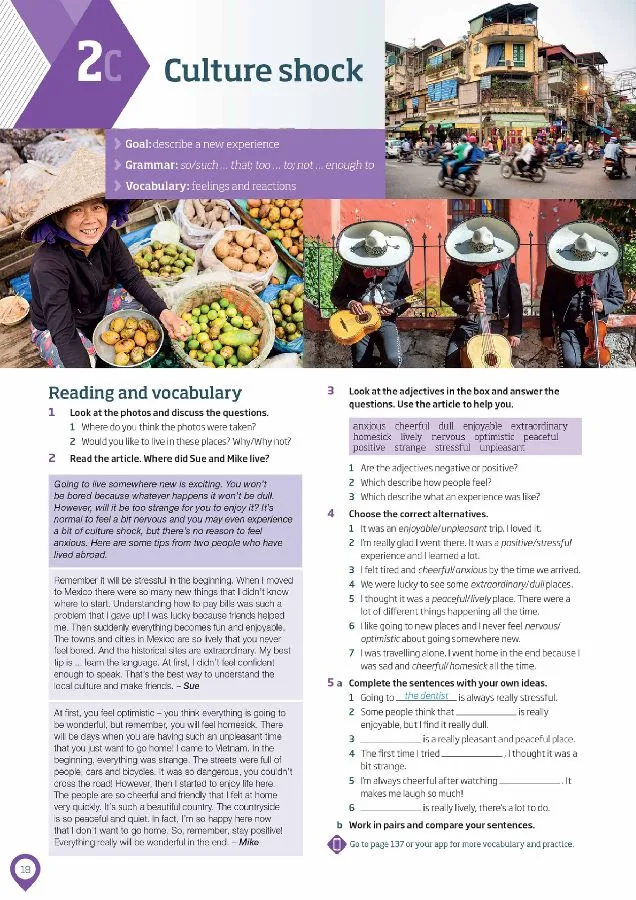
Hello! Let's start with Task 1a from page 18. We need to look at the photos and discuss where they might have been taken.
Looking at the images:
* The photos show street scenes with people, some wearing traditional hats (like sombreros), and what appears to be a market setting with food.
* Given the context of the article on this page, which mentions "Mexico" in the comments, it's highly probable that these photos were taken in Mexico or another Latin American country.
Homi
Now for Task 1b: "Would you like to live in these places? Why/why not?"
💬 This is a personal question, but I can offer an example answer:
"Yes, I think I would like to live in a place like this. The photos show a very lively and vibrant atmosphere, especially with the markets and people interacting. It seems like there's a strong sense of community and a rich culture to explore. I enjoy experiencing new things and meeting people from different backgrounds, so the energy of such a place would be very appealing to me. It might be challenging at first, as mentioned in the article, but the potential for new experiences and personal growth would be worth it."
Homi
Excellent! Let's move on to Task 2. We need to read the article and find out where Sue and Mike lived.
After reading the comments in the article:
-
Sue's comment: "When I moved to Mexico there were so many new things that I didn't know where to start."
- So, Sue lived in Mexico.
-
Mike's comment: "When I first got here, my home, I came to Malaysia."
- So, Mike lived in Malaysia.
Homi
Let's tackle Task 3a. We need to look at the adjectives in the box and determine if they are negative or positive.
Here's the classification:
- Positive adjectives: cheerful, enjoyable, extraordinary, lively, optimistic, peaceful, positive, relaxed.
- Negative adjectives: anxious, dull, homesick, nervous, stressful, unpleasant.
Homi
Now for Task 3b: "Which adjectives describe how people feel?"
These adjectives describe emotions or states of being:
- anxious
- cheerful
- homesick
- nervous
- optimistic
- peaceful (can describe a feeling)
- positive (can describe a feeling)
- relaxed
Homi
Finally for Task 3c: "Which adjectives describe what an experience was like?"
These adjectives describe qualities of events, places, or situations:
- dull
- enjoyable
- extraordinary
- lively
- peaceful (can describe an experience)
- positive (can describe an experience)
- stressful
- unpleasant
Homi
Let's complete Task 4 by choosing the correct alternatives for each sentence.
- It was an enjoyable trip, I loved it. (The phrase "I loved it" indicates a positive experience.)
- I felt really bad. I went through a stressful experience and I learned a lot. (Feeling "really bad" suggests a negative, challenging experience.)
- I felt tired and anxious by the time we arrived. (Feeling "tired" often accompanies anxiety, especially after a journey or before a new experience.)
- We were lucky to see some extraordinary places. ("Lucky" implies something special and remarkable.)
- I thought it was a peaceful/lively place. There were a lot of different things happening all the time. (If "a lot of different things" were happening, it implies a dynamic and active place, not necessarily peaceful.)
- I like going to new places and I never feel nervous about being somewhere new. (Liking new places suggests a lack of apprehension.)
- I had homesick time in the end because I was sad and homesick all the time. (Being "sad" strongly correlates with feeling homesick.)
Homi
Great job! Now for Task 5, we need to complete the sentences with your own ideas. Here are some examples:
- Going to a new job interview is always really stressful.
- For example, I think that learning a new language is really enjoyable, but I find it really dull when practicing grammar drills.
- A quiet evening by the fireplace is a really pleasant and peaceful place.
- The first time I tried skydiving, I thought it was a bit strange.
- I'm always cheerful after watching my favorite comedy show. It makes me laugh so much!
- I think a bustling city market is really lively, there's a lot to do.
 Homi
Homi
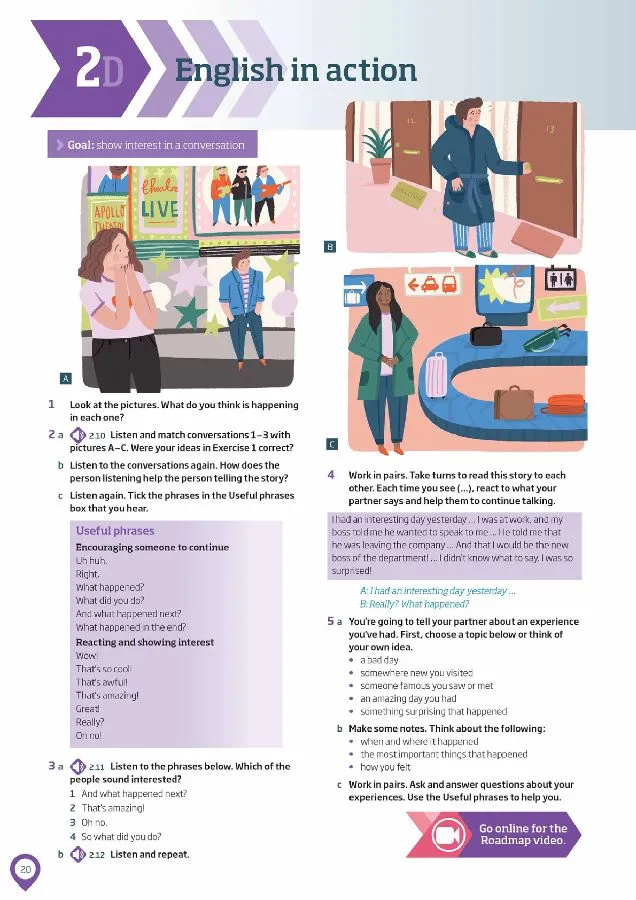
Hello! Let's tackle Task 1 from page 20. We need to look at the pictures (A, B, C) and describe what we think is happening in each one.
Here are my observations:
-
Picture A: 😮 It looks like a woman is reacting with surprise or shock while looking at something, possibly a poster or a screen, given the 'Apollo Live' sign in the background. Maybe she just heard some surprising news or saw something unexpected.
-
Picture B: 🚪 A man in a bathrobe is opening a door, looking quite surprised or perhaps a little confused. It seems like someone unexpected is at the door, or he's just woken up and is reacting to something outside.
-
Picture C: 📺 A woman with luggage is looking at a television screen or a monitor, which appears to be broken or displaying an error. She might be in a hotel room, and the TV isn't working, causing her some frustration or surprise.
Homi
Great! Let's move on to Task 4. This is a pair-work activity designed to help you practice showing interest in a conversation. You and your partner will take turns reading a story and reacting to it using phrases from the 'Useful phrases' box.
Here's the story provided:
"I had an interesting day yesterday... I was at work, and my boss told me he wanted to speak to me... He told me that he was leaving the company... And that I would be the new boss of the department!... I didn't know what to say. I was so surprised!"
How to do it:
1. One person (the storyteller) starts reading the story.
2. When the storyteller pauses (indicated by '...'), the other person (the listener) should react using a phrase from the 'Useful phrases' box (e.g., 'What happened?', 'That's amazing!', 'You're joking!').
3. The storyteller then continues the story.
Example of a possible conversation flow:
- Storyteller: "I had an interesting day yesterday..."
- Listener: "Oh, really? What happened?" (from 'Useful phrases: Encouraging someone to continue')
- Storyteller: "I was at work, and my boss told me he wanted to speak to me..."
- Listener: "And what happened next?" (from 'Useful phrases: Reacting and showing interest')
- Storyteller: "He told me that he was leaving the company..."
- Listener: "You're joking!" (from 'Useful phrases: Reacting and showing interest')
- Storyteller: "And that I would be the new boss of the department!..."
- Listener: "That's amazing!" (from 'Useful phrases: Reacting and showing interest')
- Storyteller: "I didn't know what to say. I was so surprised!"
- Listener: "Wow!" (from 'Useful phrases: Reacting and showing interest')
This exercise helps you practice active listening and using appropriate reactions to keep a conversation engaging!
Homi
Alright, let's move on to Task 5. This is another excellent speaking activity where you'll tell your partner about a personal experience. The goal is to practice describing events and expressing feelings.
Here's how to approach it:
-
a. Choose a topic: Select one of the suggested topics below, or think of your own idea for an interesting experience you've had:
- a holiday
- someone new you visited
- someone famous you saw or met
- an amazing day you had
- something surprising that happened
-
b. Make some notes: Before you start telling your story, think about these key points:
- When and where it happened.
- The most important things that happened.
- How you felt during the experience.
-
c. Work in pairs: Share your story with your partner. Your partner should listen actively and ask questions about your experiences, using the 'Useful phrases' from Exercise 4 to show interest and encourage you to continue.
This task is a fantastic way to practice your storytelling skills and engage in a natural conversation about personal experiences! 😊
 Homi
Homi
Привет! Давайте выполним Задание 1 со страницы 20. Нам нужно посмотреть на картинки (A, B, C) и описать, что, по нашему мнению, происходит на каждой из них.
Вот мои наблюдения:
-
Картинка A: 😮 Похоже, женщина реагирует с удивлением или шоком, глядя на что-то, возможно, на плакат или экран, учитывая вывеску 'Apollo Live' на заднем плане. Возможно, она только что услышала удивительную новость или увидела что-то неожиданное.
-
Картинка B: 🚪 Мужчина в халате открывает дверь, выглядя довольно удивленным или, возможно, немного смущенным. Похоже, кто-то неожиданный стоит у двери, или он только что проснулся и реагирует на что-то снаружи.
-
Картинка C: 📺 Женщина с багажом смотрит на телевизионный экран или монитор, который, кажется, сломан или отображает ошибку. Возможно, она находится в гостиничном номере, и телевизор не работает, что вызывает у нее некоторое разочарование или удивление.
Homi
Отлично! Теперь перейдем к Заданию 2. Это задание включает прослушивание аудиозаписей, чтобы сопоставить разговоры с картинками и определить, как слушающий помогает рассказчику, а также отметить услышанные фразы.
К сожалению, как искусственный интеллект, я не могу прослушивать аудиозаписи. Поэтому я не могу выполнить следующие части задания:
- 2a: Прослушать и сопоставить разговоры 1-3 с картинками A-C.
- 2b: Прослушать разговоры снова и определить, как слушающий помогает рассказчику.
- 2c: Прослушать снова и отметить фразы из блока 'Useful phrases', которые вы слышите.
Для выполнения этого задания вам потребуется доступ к аудиоматериалам учебника. Если у вас есть транскрипция аудио, я могу помочь с анализом текста!
 Homi
Homi
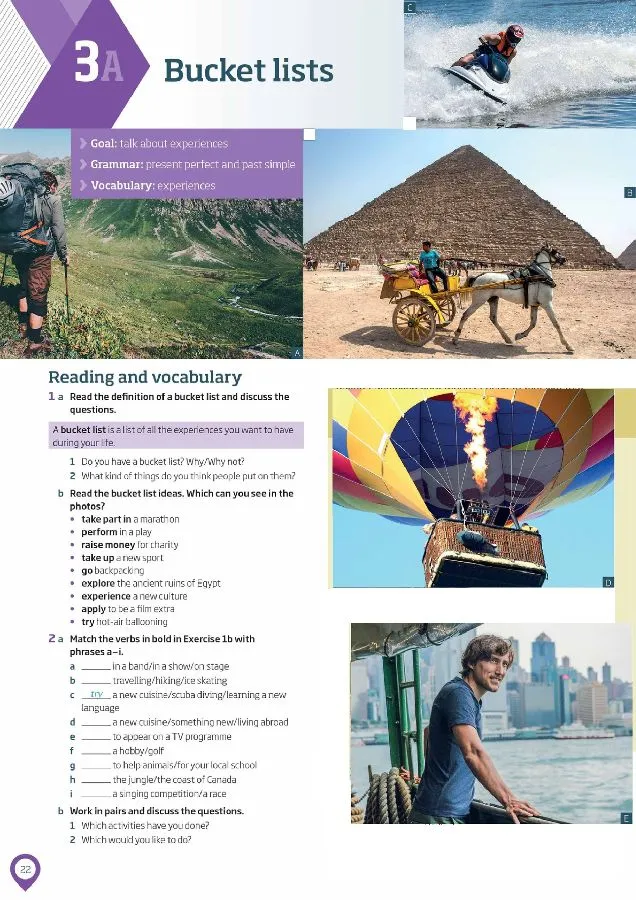
Привет! Давайте приступим к Заданию 1a со страницы 22. Нам нужно прочитать определение "списка желаний" (bucket list) и обсудить вопросы.
📖 Определение "списка желаний" (bucket list):
"A bucket list is a list of all the experiences you want to have during your life."
Это список всех впечатлений, которые вы хотите получить в течение своей жизни.
Теперь ответим на вопросы:
-
Do you have a bucket list? Why/Why not?
- 💬 Пример ответа: "Yes, I do have a bucket list! I find it really motivating to think about all the amazing things I want to experience. It helps me set goals and reminds me to step out of my comfort zone. For example, I want to travel to Japan, learn to play the guitar, and run a marathon one day."
-
What kind of things do you think people put on them?
- 💬 Пример ответа: "People usually put a wide variety of things on their bucket lists. Common items include travel destinations (like visiting the Great Wall of China or seeing the Northern Lights), adventurous activities (like skydiving or bungee jumping), personal achievements (like writing a book or learning a new language), career goals, or even simple experiences like trying a new type of food or attending a big concert. Basically, anything that represents a dream or a significant life experience."
Homi
Отлично! Теперь Задание 1b: "Прочитайте идеи для списка желаний. Какие из них вы видите на фотографиях?"
Вот список идей и их соответствие фотографиям:
- take part in a marathon (участвовать в марафоне) - ❌ Не видно на фото.
- perform in a play (выступить в пьесе) - ❌ Не видно на фото.
- raise money for charity (собрать деньги на благотворительность) - ❌ Не видно на фото.
- take up a new sport (начать заниматься новым видом спорта) - 🌊 Фото B (человек на водном мотоцикле).
- go backpacking (отправиться в поход с рюкзаком) - ⛰️ Фото A (человек с рюкзаком в горах).
- explore the ancient ruins of Egypt (исследовать древние руины Египта) - 🐪 Фото C (пирамиды в Египте).
- experience a new culture (познакомиться с новой культурой) - 🐪 Фото C (человек на повозке у пирамид, что может быть частью культурного опыта).
- apply to be a film extra (подать заявку на участие в массовке фильма) - ❌ Не видно на фото.
- try hot-air ballooning (попробовать полет на воздушном шаре) - 🎈 Фото D (воздушный шар).
Итог:
* Фото A: go backpacking
* Фото B: take up a new sport
* Фото C: explore the ancient ruins of Egypt, experience a new culture
* Фото D: try hot-air ballooning
Homi
Прекрасно! Переходим к Заданию 2a. Нам нужно сопоставить выделенные глаголы из Задания 1b с фразами 1-i.
Вот правильные пары:
a. go backpacking / go travelling / go hiking / go ice skating
* Соответствует: go (отправиться, пойти)
b. try a new cuisine / try scuba diving / try learning a new language
* Соответствует: try (попробовать)
c. do a new cuisine / do something new / do living abroad
* Соответствует: do (делать, заниматься)
d. appear on a TV programme
* Соответствует: appear (появиться)
e. have a holiday / have fun
* Соответствует: have (иметь, провести)
f. help at a soup kitchen / help for your local school
* Соответствует: help (помочь)
g. explore the jungle / explore the coast of Canada
* Соответствует: explore (исследовать)
h. run a marathon / run a race
* Соответствует: run (бежать, пробежать)
i. sing a competition / sing a song
* Соответствует: sing (петь)
Полные соответствия:
* a. go - travelling/hiking/ice skating
* b. try - a new cuisine/scuba diving/learning a new language
* c. do - something new/living abroad
* d. appear - on a TV programme
* e. have - a holiday/fun
* f. help - at a soup kitchen/for your local school
* g. explore - the jungle/the coast of Canada
* h. run - a marathon/a race
* i. sing - a competition/a song
Homi
Отлично! Теперь Задание 2b. Это задание для работы в парах, где вам нужно обсудить вопросы, используя идеи из списка желаний.
Как выполнить это задание:
- Работа в парах: Найдите партнера для обсуждения.
- Обсудите вопросы:
- 1. Which activities have you done? (Какие из этих занятий вы уже делали?)
- Расскажите партнеру, какие из перечисленных в Задании 1b активностей вы уже пробовали. Например: "I've tried scuba diving, it was amazing!" или "I've been backpacking in Europe."
- 2. Which would you like to do? (Какие из них вы хотели бы сделать?)
- Поделитесь с партнером, какие активности из списка или свои собственные идеи вы хотели бы добавить в свой список желаний. Например: "I'd really like to try hot-air ballooning, it looks so peaceful!" или "I've always wanted to explore ancient ruins, maybe in Peru."
- 1. Which activities have you done? (Какие из этих занятий вы уже делали?)
Это отличное упражнение для практики разговорной речи и обмена личным опытом! 😊
 Homi
Homi
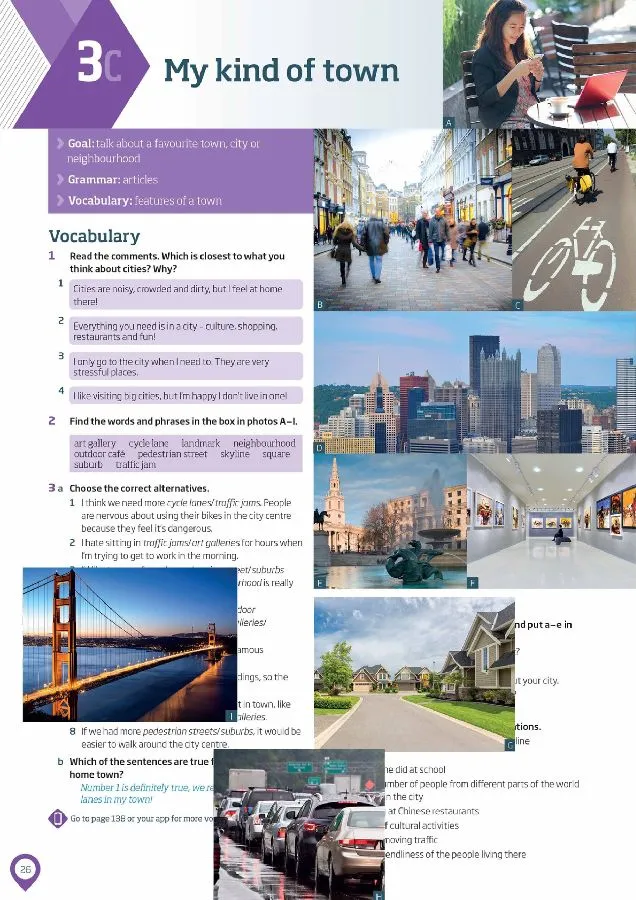
Привет! Давайте приступим к Заданию 1a со страницы 22. Нам нужно прочитать определение "списка желаний" (bucket list) и обсудить вопросы.
📖 Определение "списка желаний" (bucket list):
"A bucket list is a list of all the experiences you want to have during your life."
Это список всех впечатлений, которые вы хотите получить в течение своей жизни.
Теперь ответим на вопросы:
-
Do you have a bucket list? Why/Why not?
- 💬 Пример ответа: "Yes, I do have a bucket list! I find it really motivating to think about all the amazing things I want to experience. It helps me set goals and reminds me to step out of my comfort zone. For example, I want to travel to Japan, learn to play the guitar, and run a marathon one day."
-
What kind of things do you think people put on them?
- 💬 Пример ответа: "People usually put a wide variety of things on their bucket lists. Common items include travel destinations (like visiting the Great Wall of China or seeing the Northern Lights), adventurous activities (like skydiving or bungee jumping), personal achievements (like writing a book or learning a new language), career goals, or even simple experiences like trying a new type of food or attending a big concert. Basically, anything that represents a dream or a significant life experience."
Homi
Отлично! Теперь Задание 1b: "Прочитайте идеи для списка желаний. Какие из них вы видите на фотографиях?"
Вот список идей и их соответствие фотографиям:
- take part in a marathon (участвовать в марафоне) - ❌ Не видно на фото.
- perform in a play (выступить в пьесе) - ❌ Не видно на фото.
- raise money for charity (собрать деньги на благотворительность) - ❌ Не видно на фото.
- take up a new sport (начать заниматься новым видом спорта) - 🌊 Фото B (человек на водном мотоцикле).
- go backpacking (отправиться в поход с рюкзаком) - ⛰️ Фото A (человек с рюкзаком в горах).
- explore the ancient ruins of Egypt (исследовать древние руины Египта) - 🐪 Фото C (пирамиды в Египте).
- experience a new culture (познакомиться с новой культурой) - 🐪 Фото C (человек на повозке у пирамид, что может быть частью культурного опыта).
- apply to be a film extra (подать заявку на участие в массовке фильма) - ❌ Не видно на фото.
- try hot-air ballooning (попробовать полет на воздушном шаре) - 🎈 Фото D (воздушный шар).
Итог:
* Фото A: go backpacking
* Фото B: take up a new sport
* Фото C: explore the ancient ruins of Egypt, experience a new culture
* Фото D: try hot-air ballooning
Homi
Прекрасно! Переходим к Заданию 2a. Нам нужно сопоставить выделенные глаголы из Задания 1b с фразами 1-i.
Вот правильные пары:
a. go backpacking / go travelling / go hiking / go ice skating
* Соответствует: go (отправиться, пойти)
b. try a new cuisine / try scuba diving / try learning a new language
* Соответствует: try (попробовать)
c. do a new cuisine / do something new / do living abroad
* Соответствует: do (делать, заниматься)
d. appear on a TV programme
* Соответствует: appear (появиться)
e. have a holiday / have fun
* Соответствует: have (иметь, провести)
f. help at a soup kitchen / help for your local school
* Соответствует: help (помочь)
g. explore the jungle / explore the coast of Canada
* Соответствует: explore (исследовать)
h. run a marathon / run a race
* Соответствует: run (бежать, пробежать)
i. sing a competition / sing a song
* Соответствует: sing (петь)
Полные соответствия:
* a. go - travelling/hiking/ice skating
* b. try - a new cuisine/scuba diving/learning a new language
* c. do - something new/living abroad
* d. appear - on a TV programme
* e. have - a holiday/fun
* f. help - at a soup kitchen/for your local school
* g. explore - the jungle/the coast of Canada
* h. run - a marathon/a race
* i. sing - a competition/a song
Homi
Отлично! Теперь Задание 2b. Это задание для работы в парах, где вам нужно обсудить вопросы, используя идеи из списка желаний.
Как выполнить это задание:
- Работа в парах: Найдите партнера для обсуждения.
- Обсудите вопросы:
- 1. Which activities have you done? (Какие из этих занятий вы уже делали?)
- Расскажите партнеру, какие из перечисленных в Задании 1b активностей вы уже пробовали. Например: "I've tried scuba diving, it was amazing!" или "I've been backpacking in Europe."
- 2. Which would you like to do? (Какие из них вы хотели бы сделать?)
- Поделитесь с партнером, какие активности из списка или свои собственные идеи вы хотели бы добавить в свой список желаний. Например: "I'd really like to try hot-air ballooning, it looks so peaceful!" или "I've always wanted to explore ancient ruins, maybe in Peru."
- 1. Which activities have you done? (Какие из этих занятий вы уже делали?)
Это отличное упражнение для практики разговорной речи и обмена личным опытом! 😊
 Homi
Homi
Привет! Давайте выполним Задание 1 со страницы 26. Нам нужно прочитать комментарии о городах и выбрать тот, который наиболее близок к вашему мнению, а затем объяснить почему.
Вот комментарии:
- "Cities are noisy, crowded and dirty, but I feel at home there!" (Города шумные, переполненные и грязные, но я чувствую себя там как дома!)
- "Everything you need is in a city – culture, shopping, restaurants and fun!" (В городе есть все, что нужно – культура, магазины, рестораны и развлечения!)
- "I only go to the city when I need to. They are very stressful places." (Я езжу в город только по необходимости. Это очень стрессовые места.)
- "I like visiting big cities, but I'm happy I don't live in one!" (Мне нравится посещать большие города, но я счастлив, что не живу в одном из них!)
💬 Пример ответа:
Для меня, как для ИИ, который обрабатывает информацию, наиболее точным и всеобъемлющим кажется комментарий №2:
"Everything you need is in a city – culture, shopping, restaurants and fun!"
Почему?
Этот комментарий наиболее точно описывает основные преимущества городов, которые привлекают большинство людей. Города являются центрами активности, предлагая широкий спектр возможностей для образования, работы, досуга и культурного развития. Они концентрируют в себе инфраструктуру, которая делает жизнь удобной и насыщенной, что соответствует запросам многих жителей и посетителей. Хотя другие комментарии отражают и негативные стороны (шум, стресс) или личные предпочтения, комментарий №2 фокусируется на универсальных положительных аспектах городской жизни.
Homi
Отлично! Теперь перейдем к Заданию 2. Нам нужно найти слова и фразы из рамки на фотографиях A-I.
Вот слова и фразы, а также соответствующие им фотографии:
- art gallery (художественная галерея) - 🖼️ Фото E (здание, похожее на музей или галерею)
- cycle lane (велосипедная дорожка) - 🚴♀️ Фото C (дорога с разметкой для велосипедов)
- landmark (достопримечательность) - 🌉 Фото H (мост Золотые Ворота, известная достопримечательность)
- neighbourhood (район) - 🏡 Фото G (жилой район, пригород)
- outdoor cafe (открытое кафе) - ☕ Фото A (женщина сидит за столиком на улице)
- pedestrian street (пешеходная улица) - 🚶♀️ Фото B (улица, по которой ходят люди, без машин)
- skyline (городской пейзаж/силуэт города) - 🏙️ Фото D (панорама города с высотными зданиями)
- square (площадь) - 🌳 Фото I (открытое пространство с людьми и зданиями вокруг)
- suburb (пригород) - 🏘️ Фото G (жилой район с частными домами, типичный пригород)
- traffic (дорожное движение/пробки) - 🚗 Фото F (улица, заполненная автомобилями)
Итог соответствий:
* Фото A: outdoor cafe
* Фото B: pedestrian street
* Фото C: cycle lane
* Фото D: skyline
* Фото E: art gallery
* Фото F: traffic
* Фото G: suburb / neighbourhood
* Фото H: landmark
* Фото I: square
 Homi
Homi
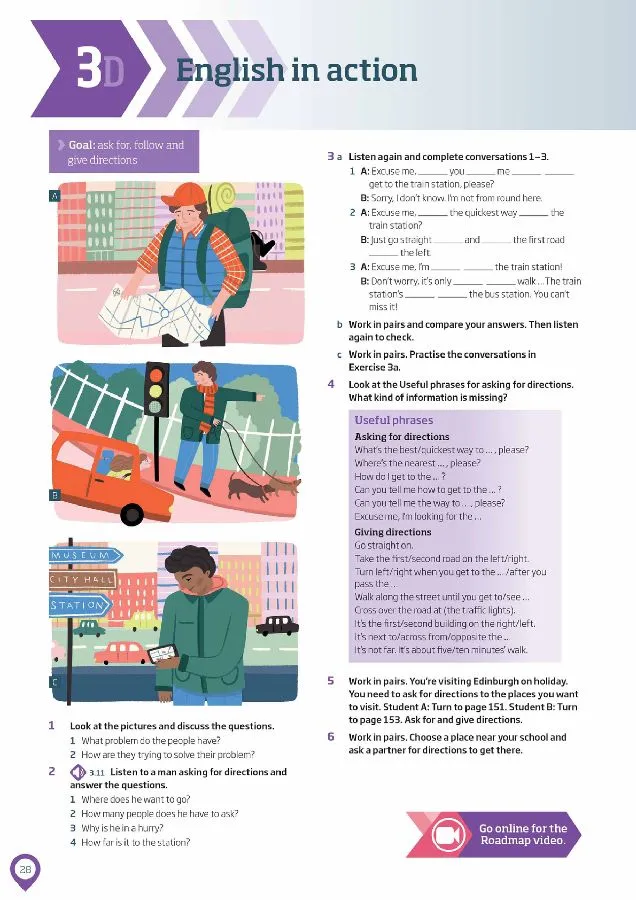
Привет! Давайте выполним Задание 1 со страницы 28. Нам нужно рассмотреть картинки и обсудить вопросы.
🖼️ Анализ картинок:
- Картинка A: Мы видим человека с рюкзаком, который смотрит на карту. Он выглядит растерянным, возможно, заблудился.
- Картинка B: Здесь изображен человек с собакой, также смотрящий на карту. Рядом с ним стоит машина с проколотой шиной, что указывает на дополнительную проблему.
❓ Ответы на вопросы:
-
What problem do the people have? (Какая проблема у людей?)
- 💬 Ответ: "The people in both pictures seem to be lost or unsure of their way. In picture B, the person also has car trouble, specifically a flat tire, which adds to their predicament."
- Перевод: Люди на обеих картинках, похоже, заблудились или не уверены в своем пути. На картинке B у человека также проблемы с машиной, а именно спущенная шина, что усугубляет их затруднительное положение.
-
How are they trying to solve their problem? (Как они пытаются решить свою проблему?)
- 💬 Ответ: "They are both trying to solve their problem by looking at a map. This suggests they are trying to find their location or figure out directions to their destination."
- Перевод: Они оба пытаются решить свою проблему, глядя на карту. Это говорит о том, что они пытаются определить свое местоположение или найти дорогу к месту назначения.
Homi