Решение математических задач по шагам онлайн
 Homi
It looks like you didn't include the math problem or equation you would like me to solve!
Please provide the equation, system of equations, or math problem, and I will be happy to solve it for you step by step.
 Homi
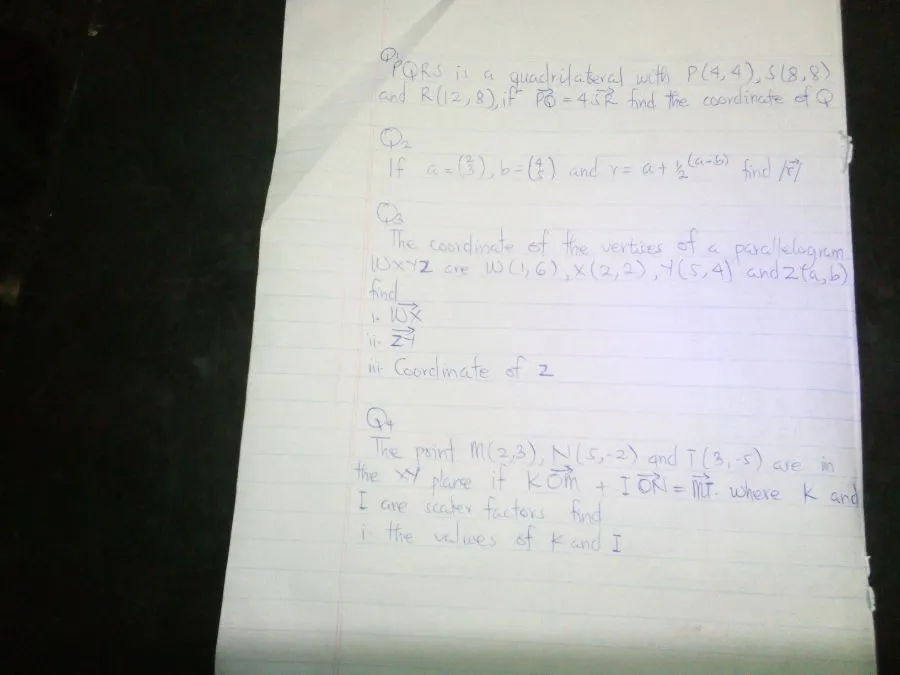
Here are the step-by-step solutions for all four questions presented in the image:
Question 1
Problem: \(PQRS\) is a quadrilateral with \(P(4, 4)\), \(S(8, 8)\) and \(R(12, 8)\). If \(\vec{PQ} = 4\vec{SR}\), find the coordinates of \(Q\).
Step 1: Find the vector \(\vec{SR}\)
Given the coordinates of \(S(8, 8)\) and \(R(12, 8)\):
$\(\vec{SR} = R - S = \begin{pmatrix} 12 - 8 \\ 8 - 8 \end{pmatrix} = \begin{pmatrix} 4 \\ 0 \end{pmatrix}\)$
Step 2: Use the relation \(\vec{PQ} = 4\vec{SR}\)
Step 3: Find the coordinates of \(Q(x, y)\)
Since \(\vec{PQ} = Q - P\), we have:
$\(\vec{PQ} = \begin{pmatrix} x_Q - x_P \\ y_Q - y_P \end{pmatrix} = \begin{pmatrix} 16 \\ 0 \end{pmatrix}\)$
Given \(P(4, 4)\):
$\(x_Q - 4 = 16 \implies x_Q = 20\)$
$\(y_Q - 4 = 0 \implies y_Q = 4\)$
- Answer for Q1: \(Q = (20, 4)\)
Question 2
Problem: If \(\vec{a} = \begin{pmatrix} 2 \\ 3 \end{pmatrix}\), \(\vec{b} = \begin{pmatrix} 4 \\ 5 \end{pmatrix}\) and \(\vec{r} = \vec{a} + \frac{1}{2}(\vec{a} - \vec{b})\), find \(|\vec{r}|\).
Step 1: Compute \(\vec{a} - \vec{b}\)
Step 2: Multiply by \(\frac{1}{2}\)
Step 3: Compute \(\vec{r}\)
Step 4: Find the magnitude \(|\vec{r}|\)
- Answer for Q2: \(|\vec{r}| = \sqrt{5}\) (or \(\approx 2.24\))
Question 3
Problem: The coordinates of the vertices of a parallelogram \(WXYZ\) are \(W(1, 6)\), \(X(2, 2)\), \(Y(5, 4)\) and \(Z(a, b)\). Find:
i. \(\vec{WX}\)
ii. \(\vec{ZY}\)
iii. Coordinate of \(Z\)
Part i: Find \(\vec{WX}\)
Part ii: Find \(\vec{ZY}\)
Since \(WXYZ\) is a parallelogram, opposite sides are equal and parallel: \(\vec{WX} = \vec{ZY}\).
Therefore:
$\(\vec{ZY} = \begin{pmatrix} 1 \\ -4 \end{pmatrix}\)$
Part iii: Find the coordinates of \(Z(a, b)\)
Using the vector \(\vec{ZY} = Y - Z\):
$\(\begin{pmatrix} 1 \\ -4 \end{pmatrix} = \begin{pmatrix} 5 - a \\ 4 - b \end{pmatrix}\)$
Set up the equations:
1. \(5 - a = 1 \implies a = 4\)
2. \(4 - b = -4 \implies b = 8\)
- Answers for Q3:
- i. \(\vec{WX} = \begin{pmatrix} 1 \\ -4 \end{pmatrix}\)
- ii. \(\vec{ZY} = \begin{pmatrix} 1 \\ -4 \end{pmatrix}\)
- iii. \(Z = (4, 8)\)
Question 4
Problem: The points \(M(2, 3)\), \(N(5, -2)\) and \(T(3, -5)\) are in the \(xy\)-plane. If \(k\vec{OM} + l\vec{ON} = \vec{MT}\), where \(k\) and \(l\) are scalar factors, find the values of \(k\) and \(l\). (Note: Assuming \(\vec{OM}, \vec{ON}, \vec{MT}\) represent the position vectors or displacements, let's use the coordinates directly).
(Assuming standard notation where vectors are formed from the origin: \(\vec{OM} = \begin{pmatrix} 2 \\ 3 \end{pmatrix}\), \(\vec{ON} = \begin{pmatrix} 5 \\ -2 \end{pmatrix}\))
Step 1: Find vector \(\vec{MT}\)
Step 2: Set up the vector equation
This gives a system of two linear equations:
1. \(2k + 5l = 1\)
2. \(3k - 2l = -8\)
Step 3: Solve the system of equations
Multiply equation (1) by \(3\) and equation (2) by \(2\):
1. \(6k + 15l = 3\)
2. \(6k - 4l = -16\)
Subtract the second equation from the first:
$\((15l) - (-4l) = 3 - (-16)\)$
$\(19l = 19 \implies l = 1\)$
Substitute \(l = 1\) back into equation (1):
$\(2k + 5(1) = 1\)$
$\(2k + 5 = 1\)$
$\(2k = -4 \implies k = -2\)$
- Answer for Q4: \(k = -2\), \(l = 1\)
Homi