Identify Figurative Language: Simile and Anaphora
can you solve this? if u can i give cookie :D
 Homi
Homi
Task 1
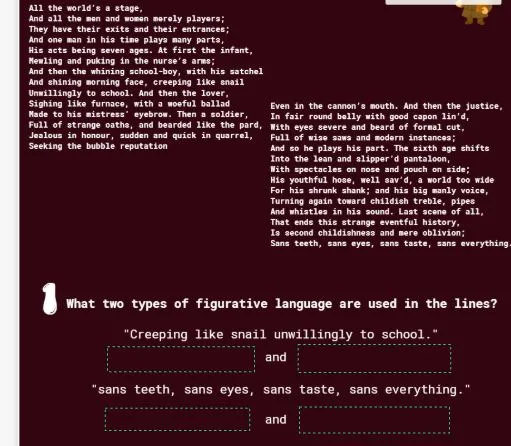
The question asks to identify two types of figurative language used in the provided lines of text. Let's analyze the given phrases:
-
"Creeping like snail unwillingly to school."
- This phrase directly compares the subject's movement to a snail using the word "like." This is a clear example of a simile. A simile is a figure of speech that directly compares two different things, usually by employing the words "like" or "as."
-
"sans teeth, sans eyes, sans taste, sans everything."
- This phrase is a repetition of the word "sans" (meaning "without") at the beginning of successive clauses. This repetition for emphasis and rhetorical effect is known as anaphora. Anaphora is a rhetorical device that consists of the repetition of a word or phrase at the beginning of successive clauses or sentences.
Therefore, the two types of figurative language are simile and anaphora.
Continue options:

Figurative Language
a
Homi
Task 1
The question asks to identify two types of figurative language used in the provided lines of text. Let's analyze the given phrases:
-
"Creeping like snail unwillingly to school."
- This phrase directly compares the subject's movement to a snail using the word "like." This is a clear example of a simile. A simile is a figure of speech that directly compares two different things, usually by employing the words "like" or "as."
-
"sans teeth, sans eyes, sans taste, sans everything."
- This phrase is a repetition of the word "sans" (meaning "without") at the beginning of successive clauses. This repetition for emphasis and rhetorical effect is known as anaphora. Anaphora is a rhetorical device that consists of the repetition of a word or phrase at the beginning of successive clauses or sentences.
Therefore, the two types of figurative language are simile and anaphora.
Continue options:
Homi

Text copied
Done
Error