English Grammar Check and Correction
 Homi
Yes, you can! I can help you generate an image. What would you like to create? Please describe the picture you have in mind, including details about the subject, style, and atmosphere.
 Homi
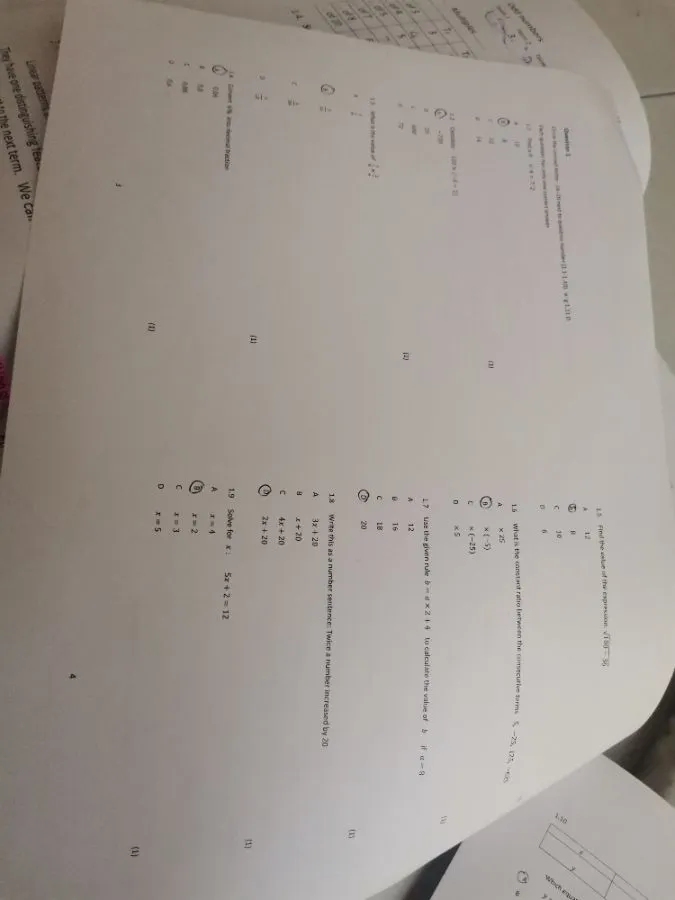
It looks like you've provided an image of a math worksheet. I can help you with the questions on it. Please tell me which question you'd like to start with, or if you'd like me to go through them one by one.
Homi
I can help you check your answers! Please tell me which questions you've circled, and I'll review them for you.
Homi
Let's check question 1.8. The question asks to write "Twice a number increased by 20" as a number sentence.
Here's how to break it down:
* "A number" can be represented by a variable, let's use \(x\).
* "Twice a number" means multiplying the number by 2, so \(2x\).
* "Increased by 20" means adding 20 to the result.
Therefore, the number sentence is \(2x + 20\).
Looking at the options provided for question 1.8:
A. \(3x + 20\)
B. \(x + 20\)
C. \(2x + 20\)
D. \(20\)
Your circled answer, C, is correct!

Алгебраические выражения
Homi
Let's verify question 1.7. The question states: "Use the given rule \(b = a \times 2 + 4\) to calculate the value of \(b\), if \(a = -9\)."
Here's how to solve it:
1. Substitute the value of \(a\) into the rule: \(b = (-9) \times 2 + 4\).
2. Perform the multiplication: \(b = -18 + 4\).
3. Perform the addition: \(b = -14\).
Looking at the options provided for question 1.7:
A. \(x \times 25\)
B. \(12\)
C. \(x \times (-25)\)
D. \(x \times (-35)\)
It appears there might be a misunderstanding with the options presented for question 1.7, as they don't seem to directly correspond to the calculated value of \(b = -14\). However, if we assume the options were meant to be numerical values, and there's a typo in the question or options, please let me know.
Based on the calculation, the correct value for \(b\) is \(-14\).
Homi
It looks like you're asking about question 1.7 again, but this time with a different value for 'a'. The rule is \(b = a \times 2 + 4\).
If \(a = 8\), then we can calculate \(b\) as follows:
1. Substitute \(a = 8\) into the rule: \(b = 8 \times 2 + 4\).
2. Perform the multiplication: \(b = 16 + 4\).
3. Perform the addition: \(b = 20\).
So, if \(a = 8\), then \(b = 20\).
Homi
Absolutely! Let's tackle question 1.10.
The question states: "The sum of three consecutive numbers is 45. Find the numbers."
Here's how to solve it:
-
Represent the consecutive numbers:
Let the first consecutive number be \(x\).
Then the next consecutive number is \(x + 1\).
And the third consecutive number is \(x + 2\). -
Set up the equation:
The sum of these three numbers is 45. So, we can write the equation:
\(x + (x + 1) + (x + 2) = 45\) -
Solve for x:
Combine like terms: \(3x + 3 = 45\)
Subtract 3 from both sides: \(3x = 42\)
Divide by 3: \(x = 14\) -
Find the three numbers:
The first number is \(x = 14\).
The second number is \(x + 1 = 14 + 1 = 15\).
The third number is \(x + 2 = 14 + 2 = 16\).
So, the three consecutive numbers are 14, 15, and 16.

Решение уравнений
Homi
Let's break down question 1.9. The question asks: "If \(x = -5\), what is the value of \(3x - 7\)?"
Here are the steps to solve it:
-
Substitute the value of x:
Replace every instance of \(x\) in the expression \(3x - 7\) with \(-5\).
So, the expression becomes \(3(-5) - 7\). -
Perform the multiplication:
Multiply 3 by -5.
\(3 \times (-5) = -15\).
The expression is now \(-15 - 7\). -
Perform the subtraction:
Subtract 7 from -15.
\(-15 - 7 = -22\).
Therefore, the value of \(3x - 7\) when \(x = -5\) is \(-22\).
Homi
Let's solve the equation \(5x + 3 + 2 = 12\) for \(x\).
-
Combine the constant terms on the left side:
\(3 + 2 = 5\).
So the equation becomes: \(5x + 5 = 12\). -
Isolate the term with x:
Subtract 5 from both sides of the equation:
\(5x + 5 - 5 = 12 - 5\)
\(5x = 7\). -
Solve for x:
Divide both sides by 5:
\(\frac{5x}{5} = \frac{7}{5}\)
\(x = \frac{7}{5}\).
So, the solution is \(x = \frac{7}{5}\), or \(x = 1.4\).

Линейные уравнения
Homi
Let's tackle question 1.6. Please provide the full text of question 1.6 so I can help you solve it.
Homi
I need the actual question for 1.6 to solve it for you. Please provide the full text of question 1.6.
 Homi
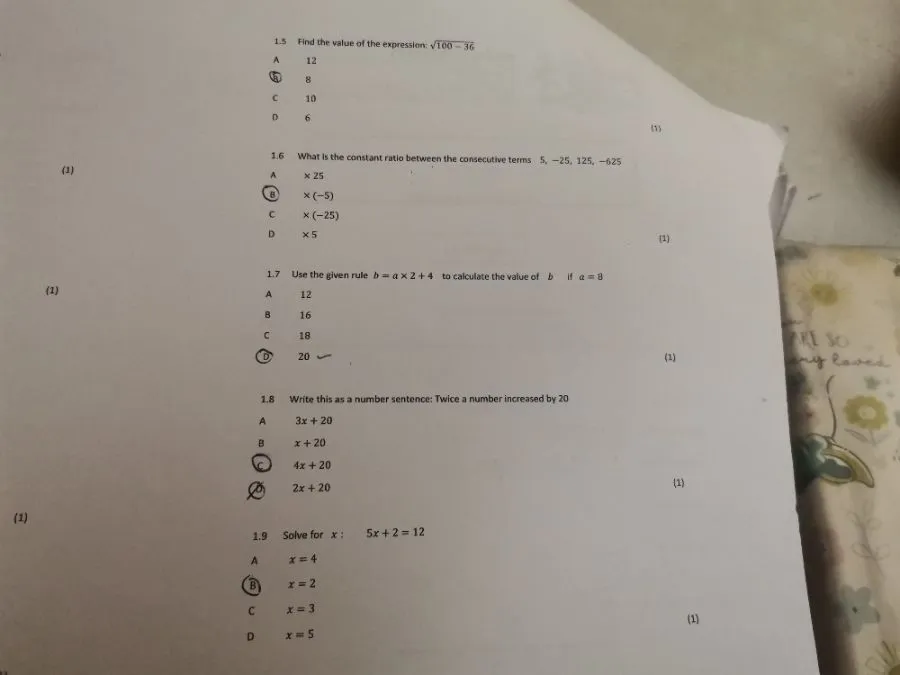
Okay, I see question 1.6 now.
Question 1.6: What is the constant ratio between the consecutive terms 5, -25, 125, -625?
To find the constant ratio in a sequence, you divide any term by its preceding term. Let's check the ratio between consecutive terms:
-
Ratio between the second and first term:
\(\frac{-25}{5} = -5\) -
Ratio between the third and second term:
\(\frac{125}{-25} = -5\) -
Ratio between the fourth and third term:
\(\frac{-625}{125} = -5\)
Since the ratio is consistent between all consecutive terms, the constant ratio is -5.
Looking at the options provided in the image, the correct answer is B: x (-5).
Homi
Let's solve question 1.5.
Question 1.5: Find the value of the expression: \(\sqrt{100 - 36}\)
Here's how to solve it:
-
Calculate the value inside the square root:
First, subtract 36 from 100:
\(100 - 36 = 64\).
The expression becomes \(\sqrt{64}\). -
Find the square root:
The square root of 64 is the number that, when multiplied by itself, equals 64.
\(\sqrt{64} = 8\).
So, the value of the expression \(\sqrt{100 - 36}\) is 8.
Looking at the options provided in the image, the correct answer is B: 8.
Homi
Let's solve question 1.9.
Question 1.9: Solve for \(x\): \(5x + 2 = 12\)
Here's how to solve for \(x\):
-
Isolate the term with \(x\):
Subtract 2 from both sides of the equation:
\(5x + 2 - 2 = 12 - 2\)
\(5x = 10\) -
Solve for \(x\):
Divide both sides by 5:
\(\frac{5x}{5} = \frac{10}{5}\)
\(x = 2\)
So, the solution is \(x = 2\).
Looking at the options provided in the image, the correct answer is B: \(x = 2\).
Homi