Homework Help Chat
 Homi
Homi
Okay, I'm ready to help you with your homework. Please provide the homework problems, and I'll do my best to assist you!
Homi
Alright, I'm ready to help you with your homework. Please upload the image with the problems, and I will solve them step by step.
 Homi
Homi
Okay, I will solve the problems step by step.
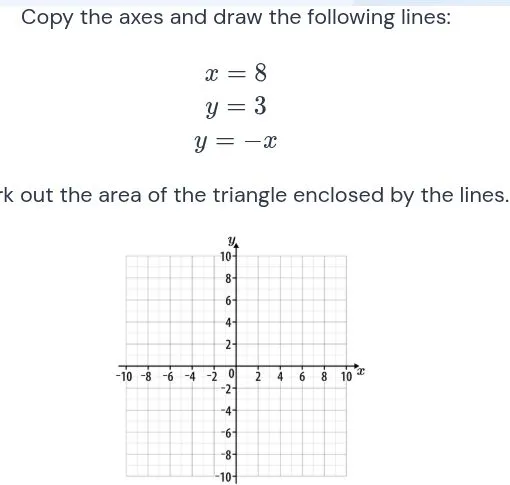
Task 1: Draw the lines
First, let's draw the lines on the coordinate plane:
- \(x = 8\): This is a vertical line that passes through the point \((8, 0)\) on the x-axis.
- \(y = 3\): This is a horizontal line that passes through the point \((0, 3)\) on the y-axis.
- \(y = -x\): This is a straight line that passes through the origin \((0, 0)\) and has a slope of \(-1\). This means for every 1 unit you move to the right on the x-axis, you move 1 unit down on the y-axis.
Task 2: Calculate the area of the triangle
The lines \(x = 8\), \(y = 3\), and \(y = -x\) form a triangle. To find the area of this triangle, we need to determine the coordinates of its vertices.
- Intersection of \(x = 8\) and \(y = 3\): The point of intersection is \((8, 3)\).
- Intersection of \(x = 8\) and \(y = -x\): Substituting \(x = 8\) into \(y = -x\), we get \(y = -8\). So the point of intersection is \((8, -8)\).
- Intersection of \(y = 3\) and \(y = -x\): Substituting \(y = 3\) into \(y = -x\), we get \(3 = -x\), so \(x = -3\). The point of intersection is \((-3, 3)\).
Now we have the vertices of the triangle: \((8, 3)\), \((8, -8)\), and \((-3, 3)\).
We can use the formula for the area of a triangle given the coordinates of its vertices \((x_1, y_1)\), \((x_2, y_2)\), and \((x_3, y_3)\):
\(Area = \frac{1}{2} |x_1(y_2 - y_3) + x_2(y_3 - y_1) + x_3(y_1 - y_2)|\)
Plugging in the coordinates:
\(Area = \frac{1}{2} |8(-8 - 3) + 8(3 - 3) + (-3)(3 - (-8))|\)
\(Area = \frac{1}{2} |8(-11) + 8(0) - 3(11)|\)
\(Area = \frac{1}{2} |-88 + 0 - 33|\)
\(Area = \frac{1}{2} |-121|\)
\(Area = \frac{1}{2} \cdot 121\)
\(Area = 60.5\)
So, the area of the triangle is 60.5 square units.
Final Answer: The area of the triangle enclosed by the lines is 60.5 square units.
 Homi
Homi
Okay, let's proceed with the next task.
Task 3: Find the fourth point to form a square
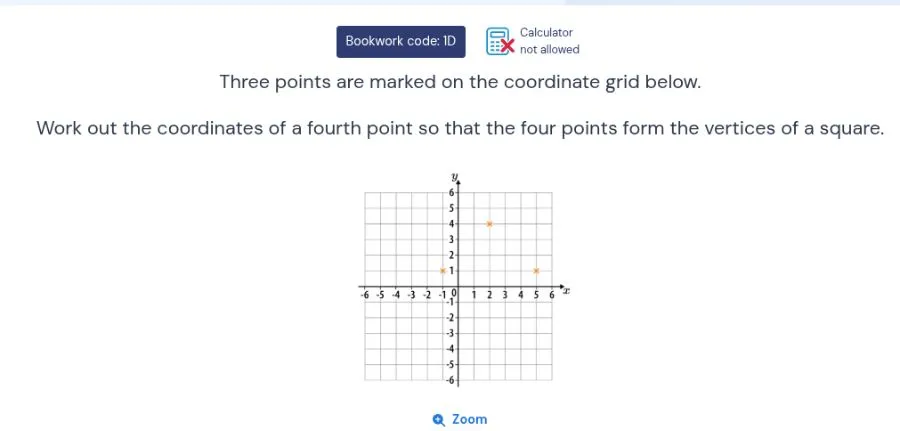
We are given three points on the coordinate grid and need to find a fourth point that forms a square. Let's denote the given points as follows:
* \(A = (1, 4)\)
* \(B = (1, 1)\)
* \(C = (4, 1)\)
To form a square, the sides must be equal in length and the angles must be 90 degrees. We can analyze the given points to determine the possible locations of the fourth point, \(D\).
- Side AB: The length of side \(AB\) is \(4 - 1 = 3\) units (vertical).
- Side BC: The length of side \(BC\) is \(4 - 1 = 3\) units (horizontal).
Since \(AB\) and \(BC\) are perpendicular and equal in length, we can assume that \(A\), \(B\), and \(C\) are consecutive vertices of the square. Therefore, we need to find point \(D\) such that \(AD\) is parallel to \(BC\) and \(CD\) is parallel to \(AB\).
To find the coordinates of point \(D\), we can move from point \(A\) horizontally by the same distance as \(BC\), but in the opposite direction. Since \(C\) is to the right of \(B\), \(D\) will be to the left of \(A\). The x-coordinate of \(A\) is 1, so we subtract 3 to get \(1 - 3 = -2\). The y-coordinate of \(D\) will be the same as \(A\), which is 4.
Therefore, the coordinates of point \(D\) are \((-2, 4)\).
Final Answer: The coordinates of the fourth point are \((-2, 4)\).
 Homi
Homi
Okay, let's proceed with the next task.
Task 4: Create a table of \(x\) and \(y\) values for the line \(y = 4x + 2\)
We need to create a table of \(x\) and \(y\) values for the line \(y = 4x + 2\), where \(x\) ranges from \(-1\) to \(3\).
Here's how we can calculate the \(y\) values for each \(x\):
- For \(x = -1\):
\(y = 4(-1) + 2 = -4 + 2 = -2\) - For \(x = 0\):
\(y = 4(0) + 2 = 0 + 2 = 2\) - For \(x = 1\):
\(y = 4(1) + 2 = 4 + 2 = 6\) - For \(x = 2\):
\(y = 4(2) + 2 = 8 + 2 = 10\) - For \(x = 3\):
\(y = 4(3) + 2 = 12 + 2 = 14\)
Now, let's create the table:
| \(x\) | \(y = 4x + 2\) |
|---|---|
| -1 | -2 |
| 0 | 2 |
| 1 | 6 |
| 2 | 10 |
| 3 | 14 |
Final Answer: The table of \(x\) and \(y\) values for the line \(y = 4x + 2\) is shown above.
 Homi
Homi
Okay, let's proceed with the next task.
Task 5: Create a table of \(x\) and \(y\) values for the line \(y = 8x + 4\)
We need to create a table of \(x\) and \(y\) values for the line \(y = 8x + 4\), where \(x\) ranges from \(-1\) to \(3\).
Here's how we can calculate the \(y\) values for each \(x\):
- For \(x = -1\):
\(y = 8(-1) + 4 = -8 + 4 = -4\) - For \(x = 0\):
\(y = 8(0) + 4 = 0 + 4 = 4\) - For \(x = 1\):
\(y = 8(1) + 4 = 8 + 4 = 12\) - For \(x = 2\):
\(y = 8(2) + 4 = 16 + 4 = 20\) - For \(x = 3\):
\(y = 8(3) + 4 = 24 + 4 = 28\)
Now, let's create the table:
| \(x\) | \(y = 8x + 4\) |
|---|---|
| -1 | -4 |
| 0 | 4 |
| 1 | 12 |
| 2 | 20 |
| 3 | 28 |
Final Answer: The table of \(x\) and \(y\) values for the line \(y = 8x + 4\) is shown above.
 Homi
Homi
Okay, I will solve the problems step by step.
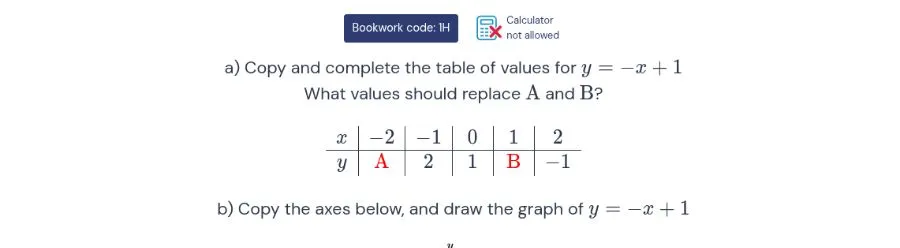
Task 6: Complete the table of values for \(y = -x + 1\)
We need to complete the table of values for the line \(y = -x + 1\). Let's find the values for \(A\) and \(B\).
- For \(x = -2\) (Value A):
\(y = -(-2) + 1 = 2 + 1 = 3\)
So, \(A = 3\) - For \(x = 1\) (Value B):
\(y = -(1) + 1 = -1 + 1 = 0\)
So, \(B = 0\)
Now, let's complete the table:
| \(x\) | -2 | -1 | 0 | 1 | 2 |
|---|---|---|---|---|---|
| \(y\) | 3 | 2 | 1 | 0 | -1 |
Final Answer: \(A = 3\) and \(B = 0\).
Task 7: Draw the graph of \(y = -x + 1\)
To draw the graph of \(y = -x + 1\), we can use the table of values we just completed. The points are:
- \((-2, 3)\)
- \((-1, 2)\)
- \((0, 1)\)
- \((1, 0)\)
- \((2, -1)\)
Plot these points on the coordinate plane and draw a straight line through them. The line should have a slope of \(-1\) and a y-intercept of \(1\).
Homi