What the Ten of Wands Means in Tarot
The Ten of Wands is a Minor Arcana, and it's important to state this upfront: the card doesn't describe fate or summarize an entire life, as the Major Arcana like the Tower or the Wheel of Fortune do. It pertains to a specific episode – a project that needs to be completed by a deadline, a week when everything suddenly falls on a person, an obligation they took on themselves and now cannot abandon or share with anyone else.
In the sequence of the suit of Wands, this is the finale: the Ace gave the spark of an idea, the Seven required defending it, the Nine brought weary vigilance, and the Ten represents the moment when the task is almost complete, but moving forward becomes increasingly difficult. Success is near, but there is no joy in this card – only the burden and stubborn progress.
A crucial nuance that is often missed: the Ten of Wands is rarely about someone else's burden. The load carried by the figure in the card is almost always taken voluntarily – by their own hands, step by step, often with the best intentions. The card doesn't accuse, nor does it pity: it directly shows that carrying everything alone is not a feat, but a choice that could have been made differently.
Reversed Ten of Wands: Meaning
The reversed card is interpreted in one of three ways, and the context of the reading helps determine which one.
- The burden is finally lifted. Some responsibilities have been transferred, removed, or simply completed – the person can breathe a sigh of relief.
- The same, but internally. Externally, nothing has changed, the load is the same, but the person has recognized that they cannot cope, and this is the first step towards asking for help.
- Breakdown under the weight. The most unpleasant scenario: strength ran out before the task was completed, and something had to be abandoned or rushed.
Neighboring cards help distinguish these variants: next to the Star or the Ten of Cups, it's more likely relief; next to the Nine of Swords or the Moon, it's more likely burnout. All three interpretations have one thing in common: in the reversed position, the focus shifts from the burden itself to the attitude towards it.
Ten of Wands in a "Yes/No" Reading
In "yes/no" readings, the upright Ten of Wands usually means no – not because the endeavor will fail, but because it's unsustainable in its current form and with its current load. The card answers not the question "will it succeed?", but "is it worth continuing like this?"
If the question is "will this finally end?" – the answer is likely yes, but with a caveat: it will end through effort, not on its own.
The reversed position in this reading is more often interpreted as "yes, but some of the load needs to be removed" – a conditional agreement, depending on whether the person is willing to delegate or postpone anything.
Ten of Wands in Relationships and Feelings
In a relationship reading, the upright card most often describes an imbalance: one partner carries the household, finances, organization, or emotional labor of the couple, and the other may not even notice. This is not necessarily the fault of the second partner – sometimes the first doesn't ask for help and quietly takes on everything.
In the position of feelings, the Ten of Wands signifies fatigue from caring, not a cooling of affection. Love hasn't disappeared, but it's overshadowed by a simple lack of energy: for conversation, for attention, for tenderness, there's simply no resource left.
The reversed card here is often a good sign rather than bad: it indicates the moment when the overload is finally spoken aloud, responsibilities begin to be shared anew, and this usually eases the relationship rather than destroys it.
Ten of Wands in Work and Money
In a career reading, this represents one person carrying the workload of several: handling others' tasks, finishing a project alone, agreeing to "just a little more" so often that it becomes the new norm. Often, there is recognition and imminent success nearby – the price for it is simply growing faster than the return.
In terms of money, the card doesn't speak of a lack of funds, but of tension before a major goal: a loan before buying a home, the final payment on a long-term obligation, a budget stretched to its limit for one important purchase or event.
The card's advice in this context is practical: calculate what part of the current workload is truly necessary for the result, and what has accumulated simply because it was easier to agree than to refuse.
Ten of Wands as a Person: Man and Woman
In the "what kind of person" position, this card describes not a character trait, but a role: someone who carries much more than they should and does it silently. Such a person rarely complains – they are more likely to apologize for being tired, as if it were their fault.
A Ten of Wands man is reliable to the extreme: he takes on the obligations of others because "it's easier that way" or "no one else will do it." A Ten of Wands woman is one who juggles multiple roles and usually remembers her own rest last.
This is not a description of weakness – quite the opposite: the card depicts a person with an excess of responsibility who needs not more strength, but permission to shift some of the burden onto someone else.
Ten of Wands in the position of thoughts
In the position of thoughts, the card signifies a constant internal "just hold on a little longer" and endless to-do lists, even in dreams. The person thinks about the finish line, but keeps pushing it back by a day, adding a new task to an already full list.
Often, this is driven by a fear that if they stop and delegate some of the work, the project will fall apart or the result will be worse. Neighboring cards will indicate how justified this concern is: next to the Eight of Swords, it's likely self-suggestion; next to the Five of Pentacles, the anxiety might be well-founded.
What to do if the Ten of Wands appears
The card's advice is simple but inconvenient: don't heroically carry everything alone until the very end, but lighten at least part of the load before the finish, not after.
What should be done in essence:
- Divide the burden into "necessary for the result" and "accumulated on its own." The latter can be temporarily set aside without compromising the task.
- Verbalize what is difficult. Often, overload is not seen by anyone simply because it is not spoken about.
- Find someone to whom at least one task can be delegated. Not everything, but one task – this already noticeably reduces the load.
- Do not add new tasks until old ones are closed. The Ten of Wands most often forms this way – one task at a time.
If fatigue lasts for months and does not pass after rest, it's a reason to talk to a doctor or specialist, not just to review the to-do list: the spread describes the situation but does not replace health care.
What is depicted on the card
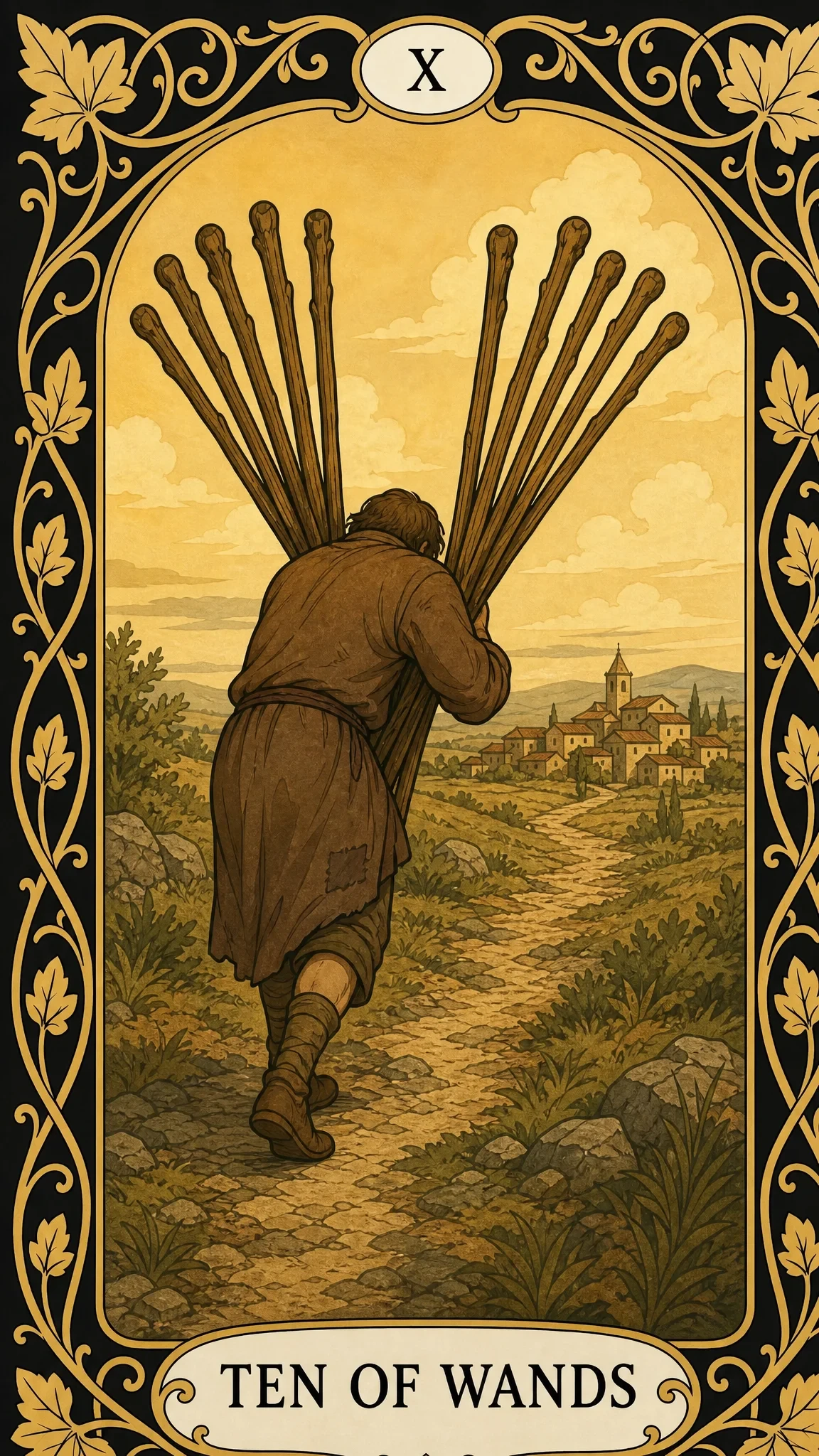
On our card, a man in worn brown clothing and cloth-wrapped boots walks along a stony path towards a village, already visible ahead among the hills. We see him from behind: he carries a bundle of ten wooden wands, pressing it to his shoulder with both hands, his head bowed under the weight. The wands fan out above him in two bunches with a gap of sky between them, and each can be traced entirely: there are exactly ten.
The scene is interpreted as follows:
- Ten wands on one person – the maximum load for the suit: not a new beginning, but everything taken at once and carried to the end by oneself.
- The road is almost finished – the village is ahead, not behind: the burden of this card is not about an endless journey, but about its last, most inconvenient stretch.
- Bent back and lowered head – the person looks at their feet, not forward. The load obstructs the view: preoccupation with one's own burden prevents noticing that the goal is already close.
- Not a single wand is free in his hands – both are occupied with the bundle. Until the load is put down, nothing else can be done, even if one really wants to.
- Warm golden sky – not a storm or twilight: the fatigue here is mundane, not tragic, and it ends with the usual arrival home.
At the top of the card is the Roman numeral X, and at the bottom is the inscription TEN OF WANDS: our deck is drawn in the Rider-Waite tradition, where the Ten of Wands completes the Minor Arcana of Wands.
Ten of Wands as a card of the day
As a card of the day, the Ten of Wands almost always describes a busy, overloaded day: the to-do list is longer than the time available for it, and the feeling that everything must be completed today and by oneself.
A useful approach for such a day is not to add anything new to the list and to decide in advance which single task can be honestly delegated to someone else or postponed without harming the result. The card does not advise abandoning everything: it reminds that finishing the task is more important than carrying it alone and at the limit of one's strength.
Frequently asked questions about the Ten of Wands card
Is it a Major or Minor Arcana?
A Minor Arcana of the suit of Wands, element of Fire. There are 56 Minor Arcana cards in a Tarot deck – 14 cards in each of the four suits, and the Ten of Wands concludes the numerical sequence of its suit.
How does the Ten of Wands differ from the Ten of Cups?
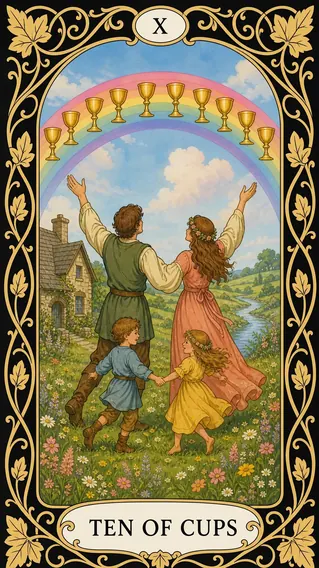
Both cards conclude the numerical sequence, but they speak of different things. The Ten of Wands is about the burden of achievement: success is present, but it comes at the cost of overload and fatigue. The Ten of Cups is about an outcome of a completely different kind: calm emotional well-being, family, a feeling of "I have everything I need." One card is about a physical and organizational burden, the other is about emotional completion and peace.
Does the reversed Ten of Wands mean relief?
Often yes, but not always. It can be a real shedding of burden and delegation, or it can be a breakdown when strength ran out before the task was completed. Neighboring cards in the spread help distinguish: next to the Star or the Sun, it's more likely relief; next to the Nine of Swords or the Moon, it's more likely exhaustion.
Is the Ten of Wands about burnout?
The card describes overload and fatigue from an unbearable burden, and in a prolonged variant, this can indeed be burnout. But the Ten of Wands itself is not a diagnosis, but a depiction of the situation. If fatigue persists for a long time and does not pass after rest, it is reasonable to consult a specialist, not just review the spread.
Is the Ten of Wands a "yes" or "no"?
More often "no" – not because the task is doomed, but because continuing it at the previous pace and volume no longer makes sense. If the question is about completing the task, the answer is rather positive, but with a clarification: only if at least part of the load is removed.